Launch Faster: Drone Business Plan with Monthly Forecasts and Ops

Launch Faster: Drone Business Plan with Monthly Forecasts and Ops
A drone business plan needs seven core parts: executive summary, company overview, market analysis, marketing and sales, operations, management and a financial plan with monthly first-year projections and a five-year forecast. The immediate next step is simple. Pick one service niche, open a template, and fill in your numbers before you write a single paragraph of prose.
TL;DR:
- Solo operators can start with under $6,000 in equipment and generate around $6,000 monthly revenue by billing approximately 10 hours weekly at standard rates.
- Growth relies on building a referral pipeline; utilization often remains below projections in the first year, delaying breakeven beyond expected timelines.
- Exact fleet size, customer acquisition cost, and niche choice critically influence profitability, with higher ticket sizes and recurring demand shortening the path to positive cash flow.
- An investor-ready plan requires detailed monthly projections, defensible assumptions, and clear regulatory and insurance considerations, unlike simpler self-funded setups.
- Automation tools can streamline compliance, proposals, and flight logs, reducing costs and accelerating execution once the business plan is translated into operational systems.
Table of Contents
- Why a Formal Business Plan Matters for Drone Entrepreneurs
- Step-by-Step Drone Business Plan Template: What Goes in Each Section
- Startup Costs, Pricing Examples, and Realistic Revenue Ranges
- Building First-Year Monthly Forecasts and a Five-Year Model
- How to Pick a Profitable Niche and Define Your Service Offering
- Operations, Compliance, and Procurement Checklist for Your Plan
- How an Integrated Operations Workspace Speeds Execution of the Plan
- Author Perspective: Pragmatic Advice for Launch vs. Scale
- How Dronable Helps You Build and Operate Your Drone Business Plan
- Sources
- FAQ
Why a Formal Business Plan Matters for Drone Entrepreneurs
Investors read a drone business plan looking for three things: a defined market, believable unit economics, and enough cash runway to survive the slow months. A drone business plan template that skips monthly detail in year one signals that the founder hasn’t done the math. Growthink’s standard format calls for month-by-month projections through year one, then annual figures for years two through five. That level of detail forces you to confront questions you’d rather avoid, like what happens to cash flow in month four when the first drone needs a battery replacement and a client payment is 30 days late.
Operationally, the plan does something different but equally important. It matches fleet procurement to expected revenue. A founder who buys three drones before landing a single client has inverted the order of operations. The plan should show you exactly how many billable hours you need before a second aircraft pays for itself, and it should flag the gap between when you spend on hardware and when a job actually pays.
Not every drone company needs a 20-page investor deck. A solo pilot doing real estate listings on nights and weekends can operate off a one-page plan: niche, pricing, monthly targets, and a basic expense list. The full version becomes necessary the moment you’re asking someone else for money, hiring your first employee, or applying for a business loan that requires financial statements.
Use this rule of thumb to decide which version you need:
- One-page plan: Solo operator, self-funded, under $15,000 in startup capital, no outside investors.
- Investor-ready plan: Raising capital, applying for an SBA-backed loan, or bringing on a co-founder with equity at stake.
- Full operational plan without funding needs: Scaling past one pilot, hiring crew, or adding a second service line where fleet and cash-flow coordination gets complicated.
The difference isn’t cosmetic. An investor-ready plan needs defensible assumptions on customer acquisition cost, market size, and payback period. A one-page plan just needs to keep you honest about what you’re spending and what you’re making.
Step-by-Step Drone Business Plan Template: What Goes in Each Section
Copy this structure into a document and fill in your own numbers. Each part exists to answer a specific question a reader, whether that’s a lender, an investor, or future you, will ask.
1. Executive summary. Write this last, even though it appears first. Summarize your niche, target market, and the top-line numbers that matter: projected year-one revenue, breakeven timeline, and funding requested if applicable. A drone mapping company targeting agricultural cooperatives might open with a line like “projected to reach breakeven in month 14 at a monthly utilization of 20 billable hours per drone.”
2. Company overview. List your legal structure (LLC, sole proprietorship, S-corp), your mission in one sentence, and the credentials that make you credible. This is where FAA Part 107 certification, EASA equivalents, or specialty endorsements like night operations or waivers belong. If you have a co-founder or crew lead, list their relevant flight hours and certifications here too.
3. Market analysis. Define your total addressable market (TAM), serviceable available market (SAM), and serviceable obtainable market (SOM) for your specific niche and geography. A national TAM figure for “drone services” is meaningless to an investor; a regional SAM for agricultural mapping in a three-county radius is not. Build a customer persona: who buys this service, how often, and what their sales cycle looks like. Roof inspections might close in a single call. Agricultural contracts often require a full growing season of relationship-building before the first invoice.
4. Products and services. Define exactly what you sell and how you price it. Are you charging per job, per acre, per listing, or moving toward a recurring Drone-as-a-Service (DaaS) subscription model? The shift toward DaaS revenue structures mirrors what happened in the tractor industry: hardware-only sales give way to recurring service contracts that stabilize cash flow. If you’re offering both one-off jobs and subscriptions, separate the pricing logic for each.
5. Marketing and sales. Estimate your customer acquisition cost (CAC) by channel. A referral from a real estate broker might cost you nothing but a split commission on the first job. A cold outreach campaign to construction firms might run $200 to $400 per closed client once you factor in time and ad spend. List which channels you’ll prioritize first and why.
6. Operations plan. Detail your fleet size, maintenance cadence (weekly checks, battery cycle tracking, annual FAA-required inspections where applicable), and the airspace clearance process for your typical job sites. If you’re flying near controlled airspace, note your LAANC or equivalent authorization workflow here.
7. Management and financial plan. List who does what, even if that’s just you wearing five hats for the first year. Attach financial appendices: startup cost breakdown, monthly year-one projections, five-year summary, and break-even analysis.
Pro Tip: Write the market analysis section before the executive summary, even though the executive summary comes first in the document. You cannot summarize numbers you haven’t calculated yet, and writing market analysis first forces you to nail down your SAM and SOM before you start making revenue promises.
Startup Costs, Pricing Examples, and Realistic Revenue Ranges
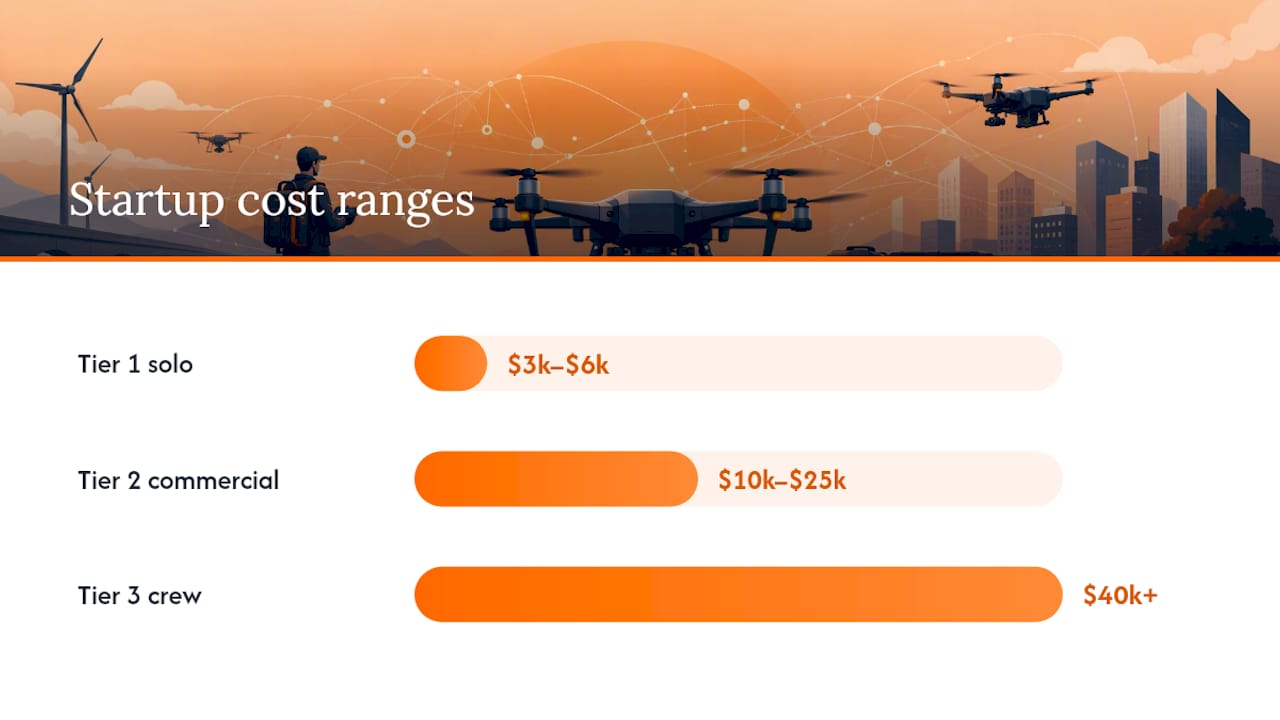
Startup costs for a drone business vary enormously depending on the equipment tier and niche, and comprehensive cost breakdowns generally organize spending into tiers rather than a single number. A hobby-grade entry into real estate photography looks nothing like a thermal-imaging inspection outfit built around a $15,000 sensor payload.
Tier one: lean solo operator. A consumer-grade drone, basic editing software, liability insurance, and a website account for roughly $3,000 to $6,000 total. This covers real estate photography, small event coverage, or basic mapping for a handful of local clients.
Tier two: mid-range commercial operator. A professional-grade drone with a mapping or thermal payload, backup batteries, insurance with higher liability limits, business registration fees, and initial marketing spend. This typically runs $10,000 to $25,000 and supports inspection work, agricultural mapping, or construction progress monitoring.
Tier three: multi-drone crew operation. Two or more specialized aircraft, crew training and certification costs, enterprise software subscriptions, comprehensive insurance, and a marketing budget aimed at securing recurring contracts. Expect $40,000 and up, often financed through a mix of savings, small business loans, or early investor capital.
Startup budgets built for cooperative or agricultural ventures show how granular this gets. The Country Partners Cooperative drone business plan lays out specific line items for equipment, training, and operational costs in a public-sector agricultural context, a useful reference point if you’re building a similar cost structure for row-crop or livestock monitoring.
Pricing structures differ sharply by niche:
- Real estate: Per-listing flat fee, often bundled with photo and video packages.
- Inspections (roof, cell tower, solar): Per-inspection flat fee, sometimes scaled by structure size or complexity.
- Agricultural mapping: Per-acre pricing, frequently discounted at higher volumes for repeat clients.
- Recurring DaaS contracts: Monthly or seasonal subscription covering scheduled flights and data delivery.
A quick reality check on templates: one widely circulated commercial financial model shows an 8-month breakeven and a 25-month payback period built into its sample projections. Treat numbers like that as an example of what’s possible under optimistic assumptions about utilization and customer acquisition cost, not a guarantee. Your actual breakeven depends heavily on how fast you fill your calendar, and early-stage utilization is almost always lower than a polished template assumes.
Revenue scenarios shift fast with utilization. A pilot billing 10 hours a week at $150 per hour clears roughly $6,000 monthly before expenses. Push that to 20 hours a week, the realistic ceiling for a solo operator juggling flights, editing, and client communication, and monthly revenue can approach $12,000. The math looks great on a spreadsheet. Getting there requires a sales pipeline that doesn’t exist on day one.
Building First-Year Monthly Forecasts and a Five-Year Model
Your financial model needs five inputs before you write a single formula: utilization rate (billable hours per drone per week), average price per job, repeat customer rate, customer acquisition cost, and fixed monthly overhead. Realistic early-stage utilization tends to run well below what mature operators achieve, since you’re still building a client base and a referral pipeline in the first several months.
Depreciation deserves its own line item, not a footnote. Model your fleet’s useful life in months and schedule replacement capital as a cash outflow at a specific point, not a vague future expense. A straight-line schedule works fine for most early-stage operators: divide the drone’s cost by its expected useful life in months, and post that amount as a non-cash expense each period while tracking the actual cash you’ll need on hand when the aircraft needs replacing.
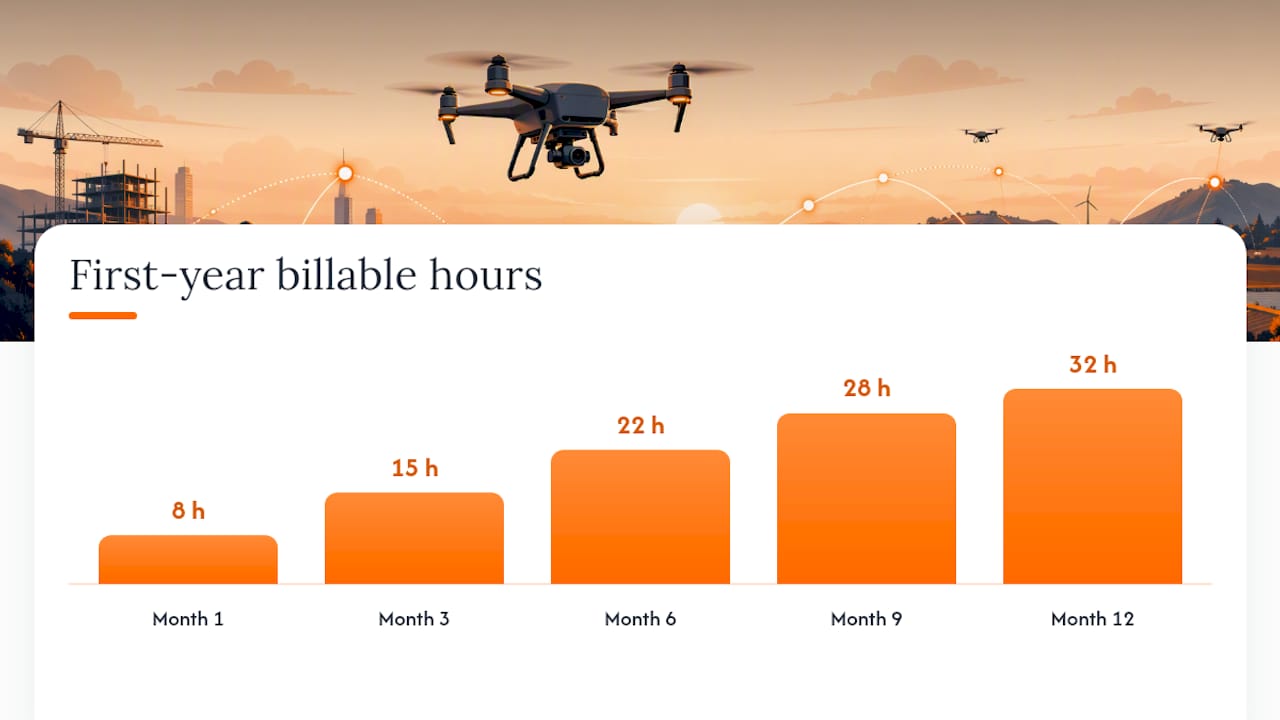
Here’s a simplified first-year snapshot for a single-drone inspection business:
| Month | Billable Hours | Revenue | Fixed Costs | Net Cash Flow | Cumulative |
|---|---|---|---|---|---|
| 1 | 8 | $1,200 | $1,800 | −$600 | −$600 |
| 3 | 15 | $2,250 | $1,800 | $450 | −$300 |
| 6 | 22 | $3,300 | $1,900 | $1,400 | $2,900 |
| 9 | 28 | $4,200 | $1,900 | $2,300 | $9,200 |
| 12 | 32 | $4,800 | $2,000 | $2,800 | $16,700 |
This model assumes gradual utilization growth as the referral pipeline builds and a modest fixed-overhead increase around month six when insurance and software subscriptions scale up. Breakeven happens in month three here, and full payback of a $6,000 startup investment lands around month five. Your own numbers will move depending on niche, pricing, and how fast you close your first five clients.
Investors expect this monthly granularity through year one, then a shift to annual summaries for years two through five, per the standard drone business plan template format. Year two typically shows margin improvement as fixed costs get absorbed across higher revenue. Years three through five should reflect fleet expansion, added service lines, or a shift toward recurring contracts rather than one-off jobs.
Pro Tip: Build a separate “procurement lag” row into your cash-flow model. Specialized sensors and replacement parts can take weeks to arrive, and a launch delay of even one month compounds across your entire first-year forecast if you don’t account for it upfront.
How to Pick a Profitable Niche and Define Your Service Offering
Niche selection determines almost everything else in your plan, from pricing to sales cycle length to regulatory burden. Evaluate candidate niches against four criteria before committing capital:
- Ticket size: Can a single job generate enough revenue to justify the sales effort, or are you chasing $150 jobs that eat a full day of prospecting?
- Repeat frequency: Does this client come back monthly, seasonally, or once and never again?
- Regulatory complexity: Does the work require waivers, night-flight authorization, or operations near controlled airspace that add friction to every job?
- Channel accessibility: Can you reach buyers through existing networks (real estate agents, farm co-ops, construction firms) or do you need to build demand from nothing?
A drone industry review makes a case that specializing in a single vertical before diversifying builds credibility faster than spreading across three or four service types at once. That tracks with how commercial buyers actually behave. A construction firm hiring for progress monitoring wants to see prior progress-monitoring work, not a portfolio that mixes weddings, roof inspections, and crop scouting. Specialization shortens the sales cycle because you’re not re-explaining your capability every time.
Strong starter niches share a common trait: predictable, recurring demand paired with low competitive saturation in most regional markets. Real estate photography is accessible but crowded. Roof and solar panel inspections carry higher ticket sizes and less price competition. Agricultural mapping requires more upfront relationship-building but rewards you with seasonal repeat contracts once you’re established.
Operations, Compliance, and Procurement Checklist for Your Plan
Your operations section needs to answer three questions clearly: are you legally allowed to fly where your clients need you, are you insured against the risk, and can you actually get the equipment you need on the timeline you’re promising.
- Confirm licensing requirements for your operating region. Rules vary by country and even by airspace class, so check with your national aviation authority (the FAA in the United States, EASA in the European Union, or the equivalent body wherever you operate) before finalizing your service area.
- Secure liability insurance sized to your niche. A photography operation and a heavy-lift agricultural sprayer carry very different risk profiles, and insurers price accordingly.
- Set a maintenance schedule. Weekly visual inspections, battery cycle logs, and firmware updates should be routine, not reactive.
- Track a small set of operational KPIs. Utilization rate, average job turnaround time, and repeat-client percentage tell you more about business health than revenue alone.
- Build procurement lead time into your launch timeline. Specialized sensors, replacement rotors, and certain enterprise drone models can take weeks to arrive, and that delay directly affects when you can start generating cash.
That last point trips up more first-time founders than any regulatory hurdle. A plan that assumes equipment arrives instantly the moment funding closes is a plan that’s already behind schedule before day one.
Pro Tip: Order your primary aircraft and one backup battery set at the same time, even if it strains your initial budget. A grounded drone during a busy week costs you more in lost bookings than the extra battery cost upfront.
How an Integrated Operations Workspace Speeds Execution of the Plan
Writing the plan is one task. Executing it fast enough to hit your projections is another. This is where the gap between a spreadsheet and a working business tends to show up.
Airspace clearance and client proposals eat disproportionate time for new operators. A platform feature is designed to cut down the hours spent manually checking airspace restrictions before a job, and client proposal tools handle client-facing documents so you’re not rebuilding a quote from scratch every time a prospect asks for pricing. These tools relate directly to sections of the plan you just wrote: operations (airspace process) and marketing and sales (proposal turnaround).
Platform outputs can serve as investor-pack material. Credential tracking, automated flight logs, and sample client proposals generated through proposal tools can strengthen the appendices of an investor-ready plan far more than a verbal claim that “we’re compliant” or “we have a sales process.”
Automation also changes your CAC assumptions. If proposal generation and airspace checks that once took hours now take minutes, your cost per closed deal drops, and that shift belongs in your financial model, not just in your operations narrative.
Author Perspective: Pragmatic Advice for Launch vs. Scale
The founders who struggle most aren’t the ones with weak flying skills. They’re the ones trying to be a real estate photographer, an agricultural mapper, and an inspection specialist all in year one, because turning down any job feels like leaving money on the table.
Launch mode calls for a different discipline: preserve cash, prove the model works with one niche, and partner with a local business (a real estate brokerage, a farm co-op) rather than trying to build demand from zero. Scale mode is a different game entirely. It rewards recurring contracts over one-off jobs, fleet utilization over fleet size, and compliance systems that hold up under institutional scrutiny, not just a folder of certificates.
The most common founder error isn’t underpricing. It’s underestimating procurement lead times, then watching a launch date slip by weeks while a specialized sensor sits in transit and burns through runway that was never budgeted for the delay.
— Brent
How Dronable Helps You Build and Operate Your Drone Business Plan
Dronable is the execution layer for the plan you just wrote. Where a spreadsheet stops at projections, Dronable turns those same operational assumptions, airspace checks, client proposals, flight logs, into working systems from day one.
SkyScore™ supports the operations and compliance section by handling airspace clearance checks before you commit to a job. Deal Studio covers the marketing and sales section, generating client-facing proposals without rebuilding a document every time. Academy backs the management section with certification tracking your investor pack can reference directly, and the Operations Manual gives you a ready structure for the maintenance schedules and procedures your plan calls for.
Once your plan is written, the next move is practical: import your niche and pricing assumptions into a working proposal template, log your first flights automatically instead of by hand, and use the platform’s output as appendix material when you approach a lender or investor. If you’re also building out the funding-ask side of your plan, an investor database focused on technology and AI-adjacent sectors can help you target the right conversations once your numbers are ready. Start by exploring the full toolset and mapping which features match the sections you’ve already drafted.
Sources
For startup-cost tiers and a long list of niche ideas, the UAV Coach guide remains one of the more exhaustive free references available. For the canonical section-by-section template with monthly projection guidance, Growthink’s drone business plan template is worth working from directly. If you want to see real line-item budgeting in a public-sector context, the Country Partners Cooperative plan shows exactly how an agricultural drone venture itemized its costs. And before you trust any pre-built financial model’s breakeven claims, compare them against the assumptions in a commercial template example to see how optimistic default numbers can skew your expectations.
- How to Start a Drone Business: A Complete Guide—Includes 36 Drone Business Ideas
- Drone Business Plan Template & Example
- Country Partners Cooperative Drone Business Plan
- Drone Service Plan Template: 8-Mo Breakeven, 25-Mo Payback
FAQ
Is a Drone Business Profitable?
Profitability depends heavily on niche, utilization, and pricing discipline. A solo inspection or mapping operator billing 20+ hours a week at typical industry rates can clear meaningful monthly profit once fixed costs are covered, but early months typically run at breakeven or a loss while the client pipeline builds.
How Much Does It Cost to Start a Drone Business?
Startup costs range from roughly $3,000 to $6,000 for a lean solo operation using consumer-grade equipment, up to $40,000 or more for a multi-drone crew with specialized sensors and enterprise software. Your tier depends on which niche you’re targeting and how much equipment that niche requires.
Do I Need an LLC for a Drone Business?
An LLC isn’t legally required to fly commercially, but forming one separates your personal assets from business liability, a meaningful protection given drone operations carry real crash and property-damage risk. Most lenders and investors also expect a formal business structure before extending funding.
What Is the 1:1 Rule for Drones?
The 1:1 rule generally refers to a visual line-of-sight guideline used in some drone operating contexts, where a pilot maintains a viewing angle roughly equal to the drone’s altitude and distance. Specific application varies by jurisdiction and airspace class, so confirm the exact rule with your national aviation authority before planning flights near this threshold.
Recommended
Explore Dronable Tools
Deepen Your Knowledge
Get step-by-step video courses in the Dronable Academy — FAA Part 107, EASA, real estate drone photography, and more.
Browse CoursesFree: How to Start a Drone Business
The complete step-by-step guide to turning your passion for flying into a profitable drone business — completely free.
- 10 steps to launching your drone business
- 51 proven drone business ideas
- How to get FAA certified (Part 107)
- Pricing, clients & recurring income
Join the Dronable Newsletter
Get drone tips, new articles, and exclusive deals straight to your inbox. No spam, unsubscribe anytime.


