4 Drone Privacy Steps Operators Must Document Before Every Flight
4 Drone Privacy Steps Operators Must Document Before Every Flight
Consent is often required when a drone records people in places where they reasonably expect privacy, like homes or private gardens, or when state or data-protection law applies to the flight. FAA registration and airspace clearance cover safety only, not permission to record someone. When in doubt, skip the recording, tell people nearby what you’re doing, and collect the least data possible.
- Drone operators must obtain consent when recording in private spaces where individuals reasonably expect privacy, especially outdoors or in secluded areas.
- Both FAA airspace regulations and privacy laws apply independently, requiring separate checks before each flight to ensure legal compliance.
- Disabling microphones, avoiding private spaces, and capturing only essential data reduce audio and video privacy risks during operations.
- Proper preflight documentation, including purpose, necessity, and consent, is critical to defending against privacy claims and potential penalties.
- Posting clear signage or informing nearby residents beforehand helps prevent complaints, but written permission is essential for documenting legal compliance.
Flydronable
Keep Drone Operations Organised
Dronable brings airspace safety, client management, digital credentials, and flight logs into one unified drone workspace.
Table of Contents
- What Laws Actually Govern Drone Consent and Privacy?
- When Is Consent Required, and When Doesn’t It Work?
- Do Wiretap Laws Apply to Drone Audio Recording?
- How Do State and International Drone Privacy Rules Differ?
- What Preflight Steps Reduce Drone Privacy Risk?
- What Should You Do if a Drone Invades Your Privacy?
- Where Dronable Fits Into Compliance
- What Consent Documentation Should Drone Operators Keep?
- What Happens if You Violate Drone Privacy Rules?
- How Should You Use Signage or Public Notice for Drone Flights?
- A Practitioner’s Take on Flying Responsibly
- Manage Consent and Client Permissions in One Place
- Sources
- FAQ
What Laws Actually Govern Drone Consent and Privacy?
Two separate legal systems apply to every flight, and confusing them causes most of the trouble operators run into. The FAA regulates airspace safety: registration, pilot certification under Part 107, altitude limits, and where you’re allowed to fly. None of that touches privacy. Privacy and surveillance law is handled separately, and according to a Brookings analysis, that responsibility falls mostly to state and local governments in the US, which produces a patchwork of rules that shift depending on where you launch.
Outside the US, data-protection regimes add another layer entirely. The EASA privacy handbook tells operators to avoid photographing people in private or secluded locations without consent and to build data minimization into flight planning from the start. A “household exemption” that might cover someone filming their own backyard usually stops applying the moment footage includes a neighbor’s property or gets posted publicly.
Before any flight, check both layers:
- Confirm airspace and certification rules with your national aviation authority (FAA, UK CAA, or CASA).
- Confirm privacy obligations under your state’s laws or, in Europe, GDPR and EASA guidance.
- Treat these as two independent checklists, not one combined rule.
When Is Consent Required, and When Doesn’t It Work?
Consent under privacy frameworks like GDPR has to be freely given, informed, specific, and demonstrable. That standard works fine when you’re photographing a client’s rooftop for a real estate listing. It falls apart the moment your sensor sweeps across a public park, a street, or a stranger’s backyard, because you can’t get informed consent from dozens of passing strangers before your battery dies.
This is exactly why the EDPB guidelines on video devices treat consent as rarely appropriate for systematic monitoring. Instead, the guidance points operators toward necessity, proportionality, and legitimate-interest balancing tests. A commercial roof inspection has a narrower, more defensible purpose than a general “capture the neighborhood” flight, and that distinction matters when you’re building a legal basis that doesn’t rely on individual consent.
Document these before flying:
- The specific purpose of the flight and why it requires aerial data.
- Why less intrusive alternatives (ground photos, existing imagery) won’t work.
- The data minimization steps you’re taking (altitude, resolution, retention limits).
- A data protection impact assessment (DPIA) for any flight involving systematic or repeated surveillance of an area.
Pro Tip: Write your justification down before takeoff, not after a complaint arrives. A two-line note in your flight log stating purpose and necessity is often the difference between “documented compliance” and “we’ll figure it out if someone asks.”
Do Wiretap Laws Apply to Drone Audio Recording?
Audio is where operators get into serious trouble fast. Many jurisdictions have wiretap or eavesdropping statutes that treat recording private conversations as a criminal matter, separate from and often stricter than image-based privacy rules. Capturing someone’s backyard conversation with an onboard microphone, even accidentally, can trigger liability that a photograph of the same scene never would.
Video isn’t automatically safe either. Footage that reveals someone sunbathing in a fenced yard, identifies faces through a window, or documents a private gathering can cross the same line the UK CAA warns about: recording in spaces where people reasonably expect privacy.
Practical steps that actually reduce this risk:
- Disable the microphone entirely for flights near residential areas.
- Avoid framing shots that point into windows, yards, or enclosed private spaces.
- Fly at altitudes and use sensor resolutions too low to identify individual faces when the flight doesn’t require facial detail.
- Prefer still images over continuous video when the job allows it. Stills are easier to review and redact before anyone sees them.
How Do State and International Drone Privacy Rules Differ?
Rules vary enough that a flight legal in one state can carry civil or criminal exposure in another. Florida’s statute on drone surveillance creates specific prohibitions and remedies for surveillance that violates a reasonable expectation of privacy, with both civil and criminal consequences depending on the conduct. Other states lean more heavily on general privacy torts, while some have almost no drone-specific statute at all, leaving the matter to existing trespass and nuisance law.
Internationally, Transport Canada and CASA both publish guidance recommending notice to affected people, data minimization, and specific distance rules from persons and property. The EU layers GDPR obligations on top of aviation rules through EASA.
Before any flight outside familiar territory, check these sources in order:
- Your state’s drone-specific statute, if one exists, for civil and criminal thresholds.
- Your national aviation authority’s privacy guidance (FAA, CAA, CASA, Transport Canada).
- Your national data-protection authority’s rules if any footage will be stored, shared, or published.
- Local ordinances, since some cities layer additional restrictions on top of state law.
What Preflight Steps Reduce Drone Privacy Risk?
Privacy risk gets decided before the drone ever leaves the ground, not after a complaint shows up. The EASA privacy handbook frames this as privacy-by-design: build the minimization into the plan rather than trying to clean it up in post-production.
Before the flight, define the purpose in writing, choose the lowest altitude and resolution the job actually requires, and get written permission whenever a flight will pass over or near private property. If the job is a scheduled shoot near residential areas, a short notice to nearby residents (even a note through a door or a quick conversation) goes a long way. Transport Canada points out that transparency reduces complaints even on flights that are already fully lawful.
During the flight, disable microphones you don’t need, limit recording windows to the specific area required for the job, and log who authorized the flight and what data you actually collected.
After the flight, the work isn’t done. Store footage securely, set a retention limit instead of keeping everything indefinitely, and review captures for anyone caught incidentally who wasn’t part of the job. Delete or blur those captures. If someone objects to being in your footage, have a process ready to respond, not a blank stare. The Dutch data protection authority notes that publishing footage online can strip away any personal-use exemption you were relying on, turning a casual recording into regulated data processing.
- Define purpose and necessity before takeoff.
- Disable unused sensors, especially microphones.
- Set a retention limit and stick to it.
- Redact or delete incidental captures of bystanders.
Pro Tip: Keep a simple flight log with four fields: date, purpose, authorization, and data collected. It takes thirty seconds per flight and becomes your strongest evidence if anyone questions a specific mission months later.
What Should You Do if a Drone Invades Your Privacy?
If you believe a drone violated your privacy, act quickly and methodically.
- Note the date, time, location, and drone description, and photograph or film it if you can safely do so.
- Report the incident to local police and, if it involves a licensed operator, to your national aviation authority.
- Check whether your state recognizes a civil privacy tort or a specific drone surveillance statute, since remedies range from injunctions to statutory damages depending on the jurisdiction.
- File a complaint with your national data-protection authority if the footage was stored, shared, or published.
For operators facing a complaint, the response matters as much as the original flight. Preserve your flight logs and any documentation showing purpose and authorization. Respond transparently rather than going silent, and offer voluntary deletion or redaction where it’s reasonable. Law enforcement generally needs a warrant to seize footage as evidence, though emergency exceptions exist. Get legal counsel involved early if a formal claim is threatened, since the difference between a documented, proportionate flight and an undocumented one often decides the outcome.
Where Dronable Fits Into Compliance
Dronable’s workspace supports the documentation drone privacy compliance actually requires. Drone Passport stores digital credentials. Automated flight logs record what was captured and when. Deal Studio manages client permissions for jobs on private property. Operations manual templates help document purpose and necessity for a given flight.
These tools handle documentation and operational tracking. They don’t replace a lawyer’s review of your specific state’s statute or a data-protection authority’s guidance for your jurisdiction. Use them alongside, not instead of, that legal homework.
What Consent Documentation Should Drone Operators Keep?
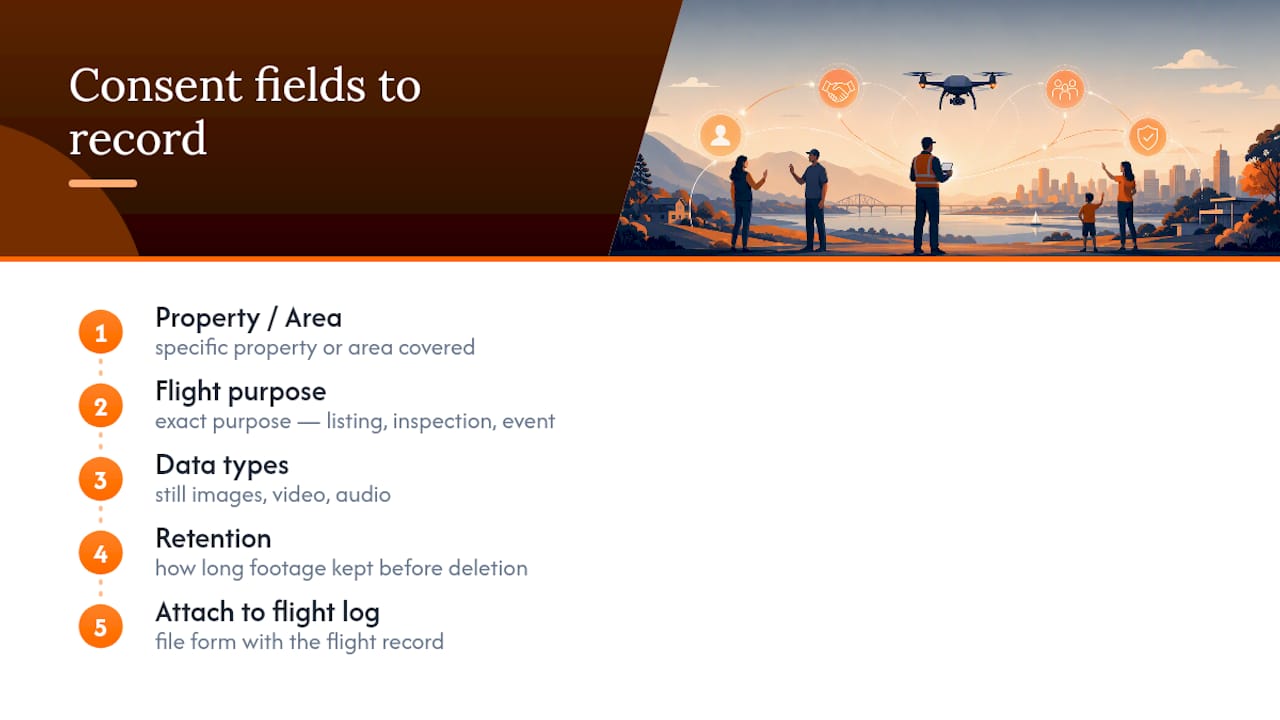
A verbal “yes” from a client is not documentation. Written consent, even a short signed form, is what actually protects an operator when a job is questioned later. A usable drone consent form covers four things: the specific property or area covered, the exact purpose of the flight (real estate listing, roof inspection, event coverage), the type of data being collected (still images, video, audio), and how long the footage will be retained before deletion.
For jobs touching multiple properties, such as neighborhood real estate shoots or construction site surveys, get separate written acknowledgment from each affected property owner rather than assuming one client’s signature covers adjacent land. When a flight can’t reasonably get individual consent, such as a public event with hundreds of attendees, document your legitimate-interest basis instead: what you needed to capture, why lower-intrusion options wouldn’t work, and what steps you took to minimize identifiable footage of bystanders.
Keep these records for as long as your state’s statute of limitations for privacy claims runs, not just until the invoice is paid. A consent form filed away and forgotten after 90 days does you no good if a complaint surfaces eight months later. Pair the form with your flight log entry so the authorization and the actual data collected are tied together in one record, not scattered across an email inbox and a memory card.
What Happens if You Violate Drone Privacy Rules?
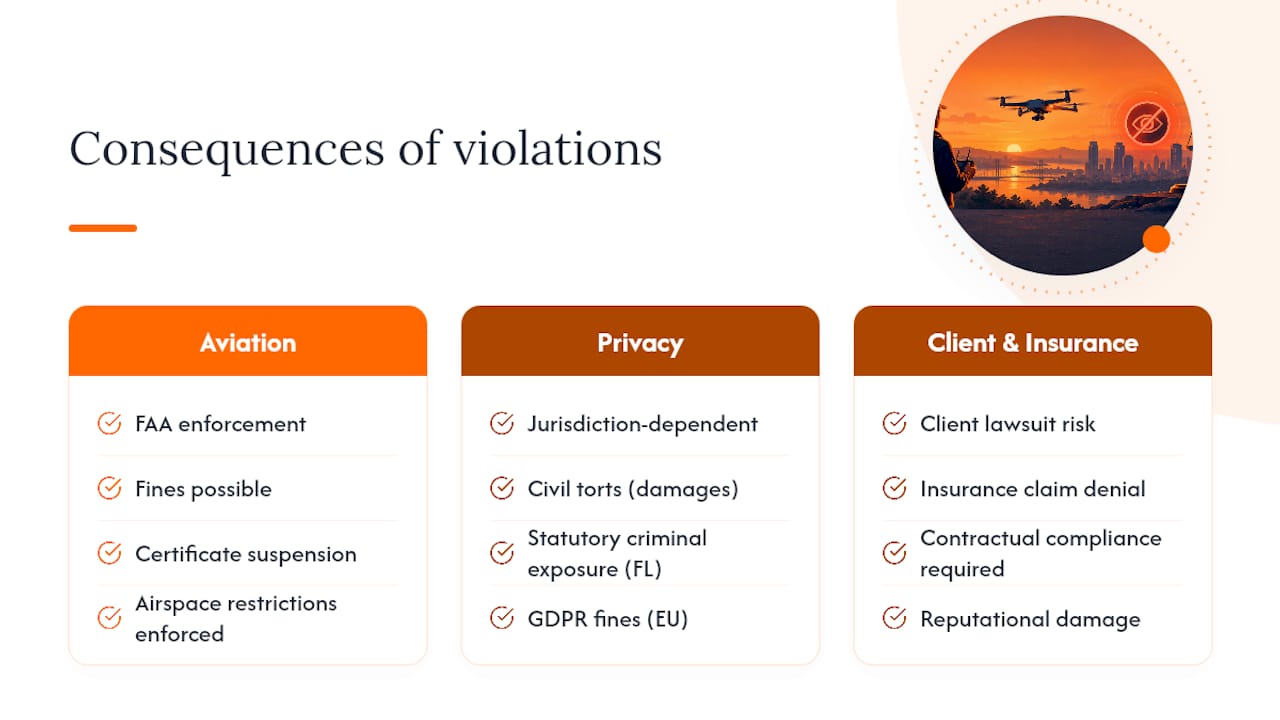
Penalties split into two tracks: aviation violations and privacy violations, and they don’t cancel each other out. Flying without proper certification or violating airspace restrictions brings FAA enforcement, which can include fines and certificate suspension. That’s separate entirely from privacy exposure.
On the privacy side, consequences depend heavily on jurisdiction. Some states recognize a civil tort for invasion of privacy, letting affected individuals sue for damages tied to unauthorized surveillance. Florida’s statute on drone surveillance creates both civil remedies and, in some circumstances, criminal exposure for surveillance that violates a reasonable expectation of privacy. In Europe, a GDPR violation from unauthorized data processing can bring regulatory fines from a national data-protection authority, on top of any civil claim from the person recorded.
For commercial pilots, there’s a third layer most hobbyists don’t think about: client and insurance liability. A client who hired you for a real estate shoot doesn’t want to inherit a lawsuit because your flight path captured a neighbor’s backyard without permission. Insurance policies covering drone operations often require documented compliance procedures, and a claim tied to an undocumented, non-consensual recording can get denied outright. The financial risk isn’t just the fine. It’s the lost client, the voided insurance claim, and the reputational damage that follows a public complaint.
How Should You Use Signage or Public Notice for Drone Flights?
Posting notice isn’t legally required everywhere, but it’s one of the cheapest ways to prevent complaints before they start. Transport Canada’s guidance points out that transparency reduces friction even on flights that are already fully compliant, because most complaints come from people who simply didn’t know what was happening overhead.
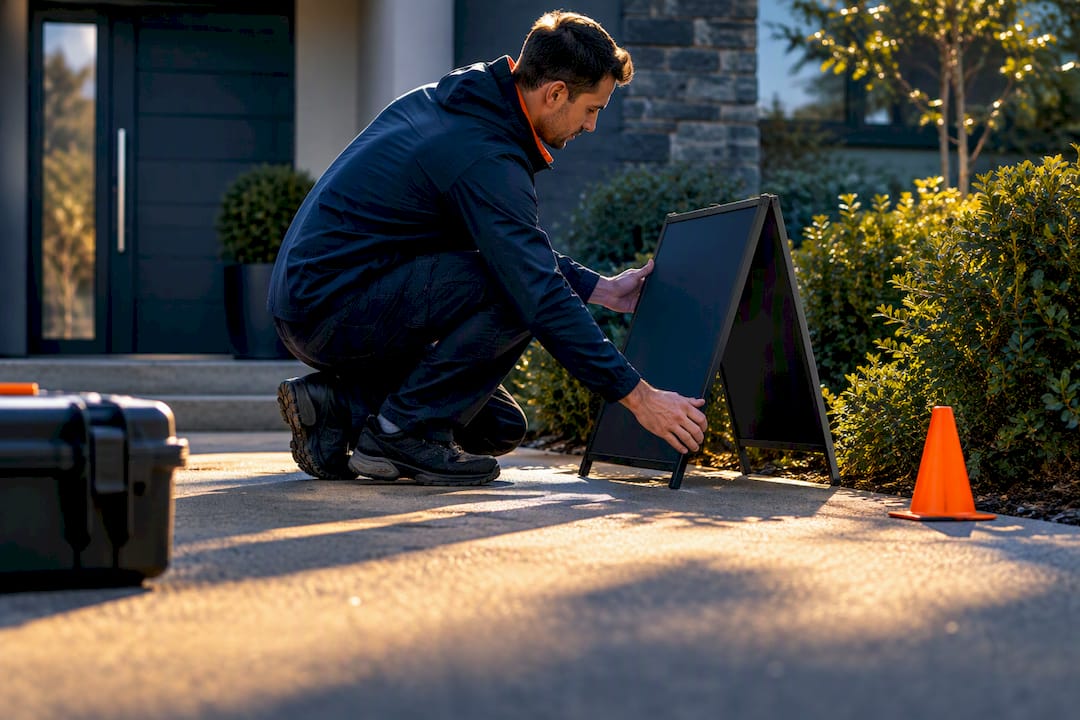
A basic sign at a job site should state that drone operations are underway, name the general purpose (photography, inspection, survey), give a timeframe, and include a contact method for questions. For repeated or ongoing flights over the same area, such as a construction site surveyed weekly, a standing notice posted at entry points works better than posting fresh signage every visit.
For neighborhood shoots without a fixed job site, a quick verbal heads up to adjacent property owners, or a note through a mailbox, covers the same ground informally. It won’t satisfy a formal consent requirement, but it demonstrates good faith and often prevents a call to the police before you’ve even landed. Community drone privacy concerns rarely start with malicious operators. They start with people who saw something unexplained in their airspace and had no way to ask what it was.
A Practitioner’s Take on Flying Responsibly
Legal compliance and privacy respect aren’t the same checklist, and treating them as one is where operators get burned. You can be fully FAA-compliant and still violate someone’s privacy badly enough to face a civil claim. The gap between “I have my Part 107” and “I documented why this footage was necessary” is where most disputes actually start. Write your justification down before you fly, minimize what you collect, and when a shot feels invasive even if it’s technically legal, that instinct is usually right.
— Brent
Manage Consent and Client Permissions in One Place
Chasing signed permissions, flight logs, and client approvals across email threads and spreadsheets is how documentation gaps happen. Dronable is built as the workspace where that paperwork actually lives, not an afterthought bolted onto your flight planning. Deal Studio keeps client permissions and proposal history in one thread instead of scattered across inboxes, while Drone Passport stores your digital credentials so you’re not digging through folders when a client or authority asks for proof of certification.
Automated flight logs capture what was flown, when, and under what authorization automatically, which is exactly the record this article has been describing as your best protection if a privacy question ever comes up. Pilots who need the full documentation and compliance toolkit can start with the Pilot Pro membership at $24.99 per month, or check the operations manual templates for consent and retention documentation you can adapt today.
This article is general information, not a substitute for advice from a qualified lawyer. Consult a qualified legal professional about your own circumstances before acting on anything here.
Sources
- Privacy rules when flying drones | UK Civil Aviation Authority
- Civilian drones, privacy, and the federal-state balance | Brookings
- Privacy handbook | EASA
FAQ
Is It Illegal to Fly a Drone Over Private Property?
Flying over private property is legal in most places since airspace above a certain height isn’t privately owned. Recording people below without consent, particularly where they expect privacy, is a separate issue that can violate state law or data-protection rules regardless of the airspace question.
Can Drones Legally Invade Someone’s Privacy?
No lawful flight gives an operator permission to invade privacy just because the aircraft itself is flying legally. Recording someone in a place where they reasonably expect privacy, like a fenced yard or through a window, can trigger civil or criminal liability under state statutes even when the flight followed every FAA rule.
Can I Shoot Down a Drone Spying on My Property?
No. Shooting down any aircraft, including a drone, is a federal crime in the US regardless of why you believe it’s there, and it exposes you to serious criminal liability. The correct response is to document the incident and report it to local police or your aviation authority instead.
Do Drones Sometimes Violate Privacy Even When Flights Are Legal?
Yes. A flight can comply fully with airspace and certification rules while still violating privacy law if it records people in private spaces without consent or a documented lawful basis. That’s why EDPB guidance urges operators to treat aviation compliance and privacy compliance as two separate requirements.
Does Dronable Help With Privacy Compliance Documentation?
Dronable’s flight logging, Drone Passport credentials, and Deal Studio client tools help operators document purpose, authorization, and client permissions for each flight. Current membership pricing, including the Pilot Pro plan, is listed on the Dronable site.
Recommended
Explore Dronable Tools
Deepen Your Knowledge
Get step-by-step video courses in the Dronable Academy — FAA Part 107, EASA, real estate drone photography, and more.
Browse CoursesFree: How to Start a Drone Business
The complete step-by-step guide to turning your passion for flying into a profitable drone business — completely free.
- 10 steps to launching your drone business
- 51 proven drone business ideas
- How to get FAA certified (Part 107)
- Pricing, clients & recurring income
Join the Dronable Newsletter
Get drone tips, new articles, and exclusive deals straight to your inbox. No spam, unsubscribe anytime.


