Drone Pilots: Insurance Quotes, Real Examples and a Checklist

Drone Pilots: Insurance Quotes, Real Examples and a Checklist
Most drone pilots pay several hundred to over a thousand dollars annually for coverage, with combined liability and hull policies averaging close to $750 annually. Occasional flyers can skip the annual commitment and buy on-demand coverage for as little as $6 to $14 per hour at modest limits. The final number depends mostly on your coverage limit, your drone’s value, and how often you fly for money versus fun.
- Annual drone insurance costs range from $300 to $1,500, with combined liability and hull policies averaging around $750; hourly coverage can be as low as $6 to $14 per hour.
- Costs increase significantly with drone value, payload complexity, higher liability limits, and flying over high-risk areas such as crowds or airports.
- Liability coverage is typically cheaper than combined liability and hull, and premiums for hull insurance depend on the drone’s replacement value.
- Documented flight hours, certification, and flight logs can lower premiums by proving lower risk to underwriters.
- Choosing the right coverage model depends on your flying frequency: annual plans suit frequent flyers, while on-demand hourly policies favor occasional operators.
Flydronable
Keep Drone Operations Organized
Dronable brings airspace safety, flight logs, certifications, and client management together in one workspace for more efficient operations.
Table of Contents
- How Much Does Drone Insurance Cost Per Year or Hour?
- What Drives Your Drone Insurance Premium?
- Liability Vs Hull Coverage: What Are You Actually Buying?
- Worked Examples: What Three Different Pilots Actually Pay
- How Do You Lower Your Drone Insurance Cost?
- Annual, Monthly, or On-Demand: Which Coverage Model Fits You?
- What Do You Need to Get an Accurate Quote?
- Can Flight Logs and Safety Tools Lower Your Premium?
- The Bottom Line on Drone Insurance Pricing
- Why Most Drone Insurance Advice Misses the Point
- Sources
How Much Does Drone Insurance Cost Per Year or Hour?
Annual liability-only policies typically run $300 to $1,500, depending on the limit you carry and how you use the aircraft. Combined hull and liability policies land in a similar band, with market data pointing to a national average near $750 a year for full coverage.
Hull insurance, which covers the physical drone, follows a different math. Insurers commonly price it at 8% to 12% of the drone’s replacement value per year. A $2,000 drone might cost $160 to $240 a year to insure against crash or theft damage, on top of whatever liability coverage you carry.
Hourly and on-demand policies serve a different crowd. Pricing starts in the single digits per hour and climbs to roughly $6 to $14 per hour for common limit tiers. That structure works well if you fly a handful of paid jobs a month rather than daily.
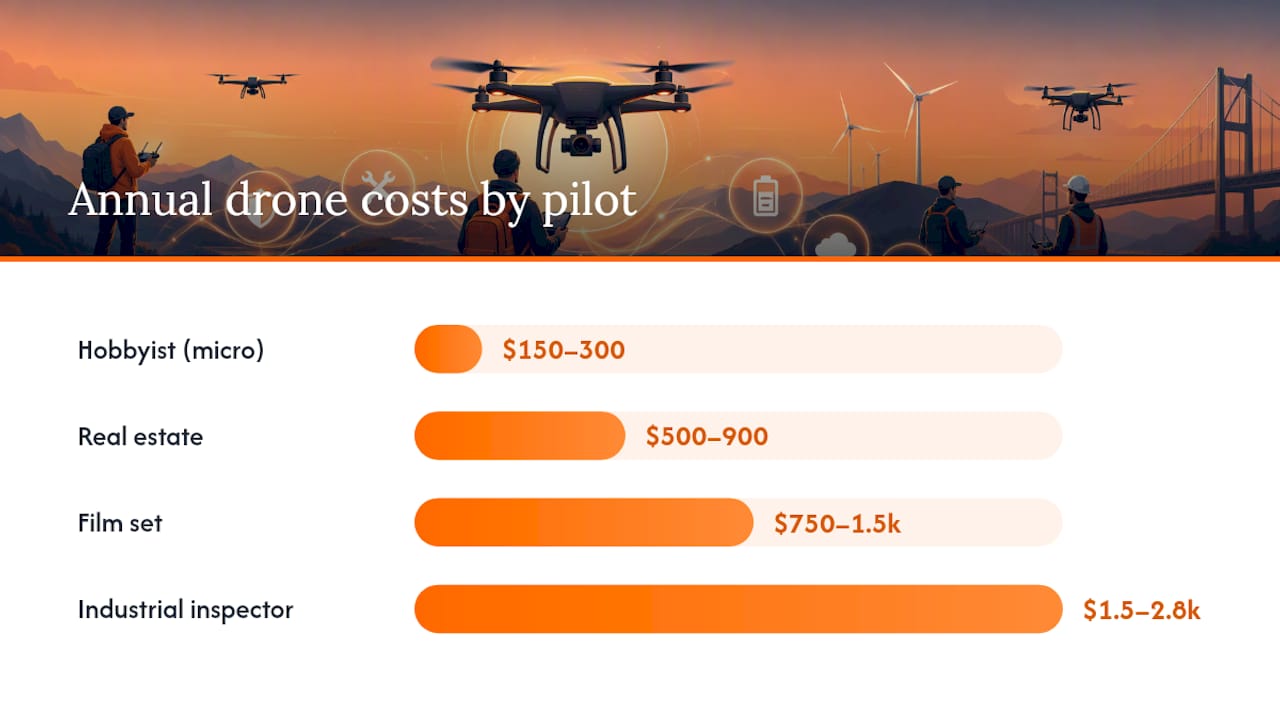
| Pilot type Typical annual cost Hourly alternative | ||
| Hobbyist (micro-drone, under $500) | $150 to $300 (liability only) | $6 to $10/hr |
| Real estate photographer | $500 to $900 combined | $10 to $14/hr |
| Industrial inspector (high-value payload) | $1,500 to $2,800 | Often not cost-effective hourly |
| Film set operator | $750 to $1,500 combined | $12 to $20/hr depending on limit |
A few patterns show up across every quote:
- Liability-only coverage is always cheaper than combined liability and hull.
- Hull premiums scale directly with the drone’s replacement value, not the limit you request.
- Occasional commercial flyers who log fewer than about four hours a month generally save money going hourly instead of annual.
- High-payload aircraft (thermal cameras, LiDAR) push premiums up even when the airframe itself is modest in price.
What Drives Your Drone Insurance Premium?
Underwriters price risk, not sentiment. Several concrete factors move your quote up or down.
- Drone value and payload. A $10,000 mapping drone with a LiDAR sensor costs far more to insure than a $600 camera drone, since payloads act as a multiplier on both replacement cost and liability exposure.
- Usage type. Commercial work like inspection, mapping, or film production usually costs more than pure recreational flying, since the exposure to third-party claims is higher.
- Client-required limits. If a contract demands a $2 million liability limit instead of $1 million, expect a higher premium to match.
- Pilot credentials and history. Part 107 certification, logged flight hours, and a clean claims record all influence your rate, and many carriers apply certification-linked discounts, though the exact amount varies by insurer.
- Location and flight context. Flying over crowds, near airports, or around critical infrastructure raises risk and premium alike.
- Policy structure. Per-occurrence versus aggregate limits, added endorsements, and your chosen deductible all shift the final number.
Pro Tip: Before requesting quotes, pull your actual flight hours from your logbook or flight-logging app. A pilot who can show 200 documented hours with zero incidents almost always quotes lower than one who estimates “a couple of hundred, probably.”
Liability Vs Hull Coverage: What Are You Actually Buying?
These two coverage types solve different problems, and insurers price them separately.
Liability insurance pays for third-party bodily injury or property damage if your drone hits someone or something. A $1 million limit is the common baseline for commercial contracts, while riskier jobs in construction, utilities, or film often require $2 million to $5 million. Price scales with the limit, your usage type, and where you fly.
Hull insurance covers your drone itself against crash damage, theft, or a flyaway. It’s usually priced as a percentage of replacement value, that 8% to 12% rule of thumb again.
A few buying rules worth knowing:
- Most working pilots carry both, bundled into a single combined policy.
- Higher contract-required limits ($2M to $5M) raise your annual premium even if your actual flying hasn’t changed.
- If you only need the higher limit for one job, an on-demand policy that adds temporary coverage is usually cheaper than upgrading your whole annual plan.
Worked Examples: What Three Different Pilots Actually Pay
Numbers mean more with a name attached. Here’s how the math plays out for three common profiles.
- The weekend hobbyist flying a $400 camera drone for fun carries liability-only coverage around $150 to $250 a year, or roughly $6 to $8 per hour on an on-demand plan if they only fly a few times a month.
- The real estate photographer flying a mid-priced DJI drone worth around $2,500 typically pays $500 to $900 a year combined: liability coverage at a $1 million limit plus hull coverage at roughly 8% to 10% of the drone’s value (about $200 to $250).
- The industrial inspector flying a $15,000 aircraft with a thermal payload, required by a client contract to carry $2 million in liability, often lands in the $1,500 to $2,800 range once hull coverage on the higher-value airframe is added.
Change any one input and the premium moves. Raise the deductible from $500 to $1,000 and the hull portion typically drops. Add a $10,000 LiDAR payload to that inspection drone and the hull premium climbs proportionally, since insurers treat payload value as part of the insured total, not a separate afterthought.
How Do You Lower Your Drone Insurance Cost?
Several levers are within your control, and most cost nothing but time.
- Get Part 107 certified. Insurers commonly treat certification as a discount-qualifying credential, and the Way2Insurance calculator data confirms it’s a standard rating factor.
- Right-size your deductible. A higher deductible lowers your hull premium; just make sure you can cover it out of pocket if you crash.
- Use on-demand coverage for one-off jobs. Buying temporary higher limits for a single contract beats carrying that limit year-round.
- Keep clean, timestamped flight logs. Documented hours and incident-free history give underwriters concrete evidence, not guesswork.
- Go annual once you’re flying regularly. The break-even point against hourly coverage sits around four flight hours a month.
Pro Tip: Certification alone doesn’t guarantee a discount at every carrier. Ask directly during the quote process whether Part 107 status affects your rate, and get the discounted number in writing.
Annual, Monthly, or On-Demand: Which Coverage Model Fits You?
Your flight frequency should decide your purchase model, not your budget alone.
Annual plans suit pilots flying regularly across the year, since the per-flight cost drops the more you fly. Monthly subscriptions work for pilots ramping up a part-time business who want flexibility without a year-long commitment. On-demand hourly policies fit occasional commercial flyers, generally those under four flight hours a month, since the per-hour rate beats an annual premium at low volume. Membership or club coverage offers low-limit hobbyist protection but rarely satisfies commercial contract requirements, since limits are usually capped well below the $1 million baseline clients expect.
Before comparing quotes, ask every insurer or broker the same three questions:
- What liability limit and deductible does this quote assume?
- Does the hull coverage use replacement value or depreciated value?
- Are there exclusions for specific payloads, locations, or flight types?
What Do You Need to Get an Accurate Quote?
Gather this before you request quotes, and the process moves faster with fewer surprises.
- Drone make, model, serial number, and current replacement value.
- A list of payloads (cameras, thermal sensors, LiDAR) and their individual values.
- Primary use cases, typical flight locations, and flight frequency.
- Pilot certifications, total logged hours, and any prior claims.
- Desired liability limit, deductible preference, and any client-required endorsements.
Occasional flyers can often get instant quotes through on-demand insurance apps. Pilots running regular commercial operations or needing higher limits typically get better terms working directly with a broker who can shop multiple carriers.
Can Flight Logs and Safety Tools Lower Your Premium?
Underwriters respond to evidence, not assurances. A pilot who shows up with organized flight logs, a documented safety process, and verifiable credentials looks like a lower risk than one who shows up with none of that. Presenting a consistent, timestamped flight log and credential package to a broker speeds up underwriting and reduces friction in the quote process.
This is where operational habits matter as much as the policy itself.
- Automated flight logs give underwriters exact hours flown, not estimates.
- Digital pilot credentials confirm certification status without a scanned PDF hunt.
- Safety-scoring tools give brokers a quick risk signal beyond “trust me.”
Dronable’s platform builds these pieces into one workspace: automated flight logging, digital credentials through Drone Passport, and airspace safety scoring through SkyScore. Pilots preparing for a quote can pull documented hours and credentials in one place rather than assembling them from scattered apps and spreadsheets. None of this replaces a licensed insurance agent’s advice. It just makes the conversation with one faster and better informed.
The Bottom Line on Drone Insurance Pricing
Expect $300 to $1,500 a year for most combined policies, or single-digit hourly rates for occasional flying. Get Part 107 certified, pull your flight logs, and request quotes from at least two sources before committing. The pilots who pay least are usually the ones who show up with documentation already in hand.
Why Most Drone Insurance Advice Misses the Point
Most guides stop at listing price ranges and call it a day. That’s the easy part. The harder truth, backed by how underwriters actually price these policies, is that two pilots flying the same drone can pay wildly different premiums based entirely on paperwork they could have prepared in an afternoon.
Conventional advice treats certification and flight logs as nice-to-haves. The pricing mechanics say otherwise. A documented, timestamped flight history changes how a broker reads your risk profile before they even quote a number. That’s not a minor detail buried in the fine print. It’s the difference between guessing your hours and proving them.
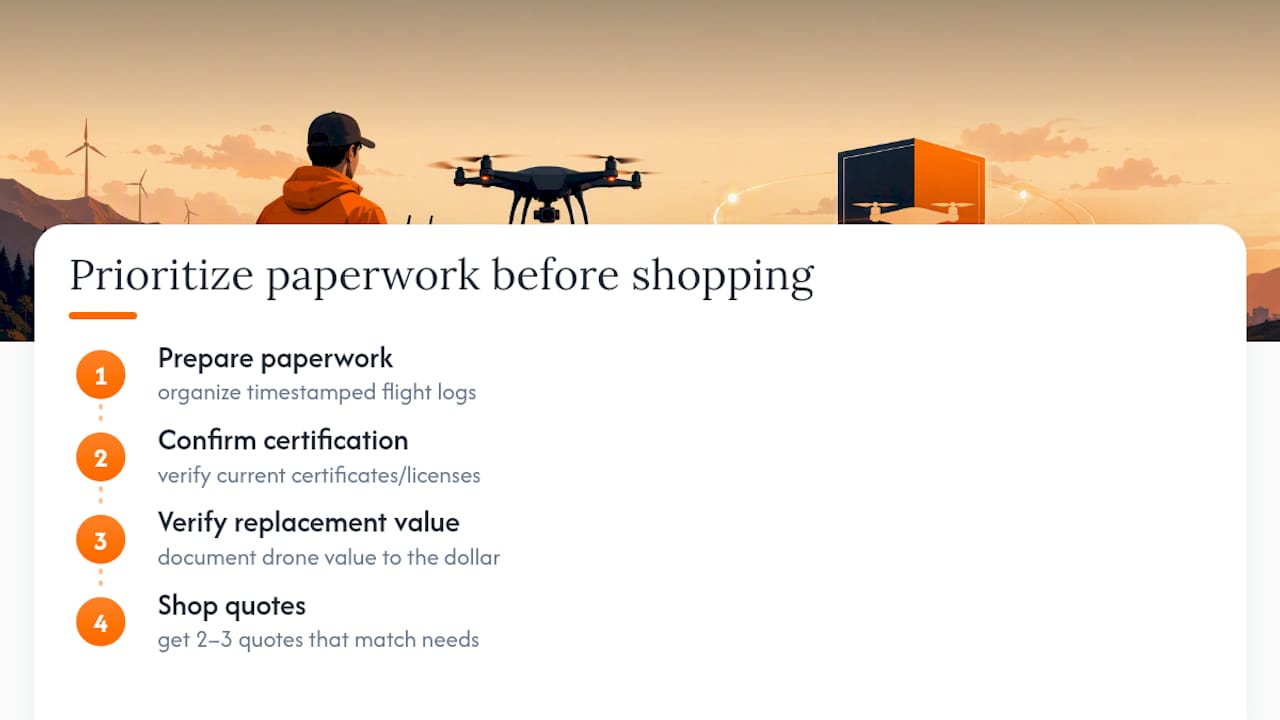
If you take one thing from this, prioritize the paperwork before the shopping. Get your logs organized, confirm your certification status, and know your drone’s real replacement value down to the dollar. Then shop two or three quotes. Pilots who skip that prep step and jump straight to comparing prices are often comparing apples to oranges without realizing it, since a $500 quote with a low limit isn’t actually cheaper than a $700 quote that matches your contract requirements.
Sources
Cost bands came from the Way2Insurance calculator, Dronesgator’s pricing guide, UAV Coach’s insurance guide, SkyWatch’s liability limit breakdown, and SimplyInsurance’s cost overview.
- Drone Insurance Cost Calculator Updated Version 2026 » Way2Insurance
- How Much Does Drone Insurance Cost? 2026 Guide
- Drone Insurance: A Step-by-Step Guide to Liability & Drone Hull Insurance
- How Much Drone Liability Insurance Do You Actually Need for Client Contracts? | SkyWatch
Recommended
Explore Dronable Tools
Deepen Your Knowledge
Get step-by-step video courses in the Dronable Academy — FAA Part 107, EASA, real estate drone photography, and more.
Browse CoursesFree: How to Start a Drone Business
The complete step-by-step guide to turning your passion for flying into a profitable drone business — completely free.
- 10 steps to launching your drone business
- 51 proven drone business ideas
- How to get FAA certified (Part 107)
- Pricing, clients & recurring income
Join the Dronable Newsletter
Get drone tips, new articles, and exclusive deals straight to your inbox. No spam, unsubscribe anytime.


