$500K–$1M Liability: Drone Insurance Requirements for Pro Pilots
$500K–$1M Liability: Drone Insurance Requirements for Pro Pilots
The FAA does not require liability insurance for small drones under Part 107. Clients, permits, and many other countries do. Commercial operators typically need third-party liability coverage of $500,000 to $1 million per occurrence, and EU member states enforce a minimum near €750,000 under EC Regulation 785/2004. If you plan commercial jobs, international flights, or work under a client contract, treat insurance as a real cost of doing business.
- Many countries and clients require liability insurance of at least €750,000 in the EU or $1 million in the US for commercial drone work, especially over people or high-value property.
- Insurance requirements vary widely by jurisdiction, with Germany and France mandating coverage regardless of the drone’s purpose, while the US and Australia have no federal mandate.
- Most commercial operators need third-party liability coverage, hull insurance, payload coverage, and key endorsements like additional insured and primary wording to meet contractual and legal demands.
- Coverages typically range from $500,000 to $1 million for routine jobs, scaling up to $10 million or more for large infrastructure or government projects, with premiums influenced by drone value and flight risk.
- Proper documentation, including flight logs, maintenance records, pilot certifications, and certificates of insurance, is essential to validate coverage and avoid claim denials, especially when operating internationally.
Flydronable
Keep Your Flight Records Organized
Dronable brings flight logs, certifications, airspace safety, and client tools together for more efficient commercial drone operations.
Table of Contents
- Is Drone Insurance Legally Required? (FAA, EASA, and National Rules)
- Who Actually Needs Insurance: Clients, Venues, and Permits
- Types of Coverage: Liability, Hull, Payload, and Key Endorsements
- What Coverage Limits and Premiums Actually Look Like
- How to Buy and Verify a Policy That Actually Works
- Flying Internationally: What Changes Outside Your Home Country
- Recordkeeping That Protects Your Coverage
- How Weight and Risk Level Change What You Need
- What Happens If You Fly Without Coverage
- Exclusions and Pitfalls That Quietly Void Coverage
- How Dronable’s Tools Support Compliance and Insurer-Facing Documentation
- Manage Insurance-Ready Records Without the Extra Apps
- Sources
- FAQ
Is Drone Insurance Legally Required? (FAA, EASA, and National Rules)
Regulatory answers to drone insurance requirements depend entirely on where you fly. FAA Part 107 governs remote pilot certification, registration, Remote ID, and operational rules for small unmanned aircraft in the United States, but it stops short of mandating liability insurance. A hobbyist or commercial pilot flying legally under Part 107 can technically operate without a policy and stay in compliance with federal aviation law.
The European Union takes a different approach. EC Regulation 785/2004 sets a minimum third-party liability requirement of roughly €750,000 for drones under 500 kilograms, and many member states apply that floor directly to UAS operators. Germany and France go further, mandating insurance broadly across most drone activity regardless of purpose.
That patchwork creates real planning risk for operators who cross borders or scale into new markets:
- The United States, Canada, and Australia have no federal insurance mandate for drone operators.
- Germany and France require insurance for most or all drone flights, both recreational and commercial alike.
- EU member states generally apply the Reg 785/2004 liability floor to commercial and Specific Category operations.
- Local permits, even in countries without a national mandate, can impose their own insurance conditions.
Before you fly in a new jurisdiction, confirm whether the local government treats insurance as optional or as a licensing condition. The MMOWW country comparison shows just how much this varies from one border to the next.
Who Actually Needs Insurance: Clients, Venues, and Permits
Federal silence on insurance for commercial drones doesn’t mean you’re off the hook. Recreational flyers face the lowest practical pressure to insure, since they answer to no client and rarely need a permit. Commercial operators face constant pressure, because the people paying for the flight almost always set their own insurance floor regardless of what regulators require.
Here’s where insurance shifts from optional to effectively mandatory:
- Government and municipal contracts almost always specify a minimum liability limit, commonly $1 million, before you can even bid.
- Film and production permits typically require a certificate of insurance naming the production company as additional insured.
- Construction and inspection clients often carry their own liability exposure and pass insurance requirements down to every subcontractor, including drone pilots.
- Venue and park permits frequently bundle insurance or bonding requirements into the permit approval itself.
- Any flight over people or high-value property raises enough perceived risk that clients rarely proceed without proof of coverage.
State and local ordinances add another layer. Some cities tie drone permits to bonding requirements that function like insurance even when no state law technically demands it. If you work across multiple jurisdictions, check each client’s contract and each permit’s fine print before you assume last year’s policy will satisfy this year’s job.
Types of Coverage: Liability, Hull, Payload, and Key Endorsements
Drone insurance policies aren’t one-size-fits-all products. Each type covers a different failure point, and most working pilots carry more than one.
- Third-party liability pays for bodily injury and property damage you cause to someone else. This is the coverage nearly every client contract asks for by name, and it’s the baseline for insurance for commercial drones.
- Hull/equipment coverage insures the drone itself against crash damage, theft, or loss. Payload endorsements extend this to cameras, LiDAR units, or thermal sensors, which often cost more than the aircraft carrying them.
- Professional indemnity (also called errors and omissions) covers claims tied to your deliverables, not your aircraft. A survey pilot whose mapping data leads a client to a costly decision needs this far more than hull coverage.
- Non-owned/hired-in liability covers you when flying a drone you don’t own, useful for pilots who rent or borrow equipment for a job.
- Specialist policies also cover risks standard aviation forms skip entirely: electronic component failure, non-pilot ground crew injuries, and data privacy breaches, according to Global Aerospace’s drone insurance guide.
Homeowners and renters policies almost never fill these gaps. The Insurance Information Institute notes that standard homeowners forms carry aircraft exclusions that bar drone-related claims outright, so don’t assume your existing household policy will respond if a commercial job goes wrong.
Pro Tip: Request four specific endorsements when you buy a policy: additional insured, primary and non-contributory wording, waiver of subrogation, and a territory endorsement matching every state or country you plan to work in. Missing any one of these is the most common reason a certificate of insurance gets rejected by a client’s risk department.
What Coverage Limits and Premiums Actually Look Like
Most commercial clients in the U.S. ask for $500,000 to $1 million in liability coverage per occurrence, a range confirmed by Legal Clarity’s review of drone insurance law. That figure has become the de facto market minimum even where no regulator requires it.
By the numbers: The EU’s regulatory floor under Reg 785/2004 sits near €750,000 for drones under 500 kg, while U.S. commercial clients typically request $500,000 to $1 million with no federal mandate behind the request at all.
Coverage limits scale with risk, not just habit:
- $500,000 to $1 million per occurrence covers most routine commercial work: real estate, roof inspections, small events.
- $1 million to $5 million is common across the EU and UK, particularly for construction and infrastructure inspection.
- $10 million or more shows up on large infrastructure, utility, or government projects where a single incident could cause catastrophic damage.
Premiums move with several variables at once: aircraft value, payload type, whether you fly over people or beyond visual line of sight, your claims history, and the territory you operate in. A pilot flying a $2,000 quadcopter for real estate photos pays far less than one flying a $40,000 LiDAR rig on utility inspections. Because pricing shifts this much case by case, a specialist broker, not a generic quote engine, is usually the fastest way to a real number. Client-required endorsements like additional insured and primary wording typically add a modest surcharge, but skipping them to save money often means losing the contract entirely.
How to Buy and Verify a Policy That Actually Works
Buying the wrong policy is nearly as risky as buying none. Follow this sequence when you shop for coverage:
- Find a broker who specializes in UAS risk, not a generalist agent bolting a drone endorsement onto a homeowner’s policy.
- Confirm the underwriter’s appetite for your specific use case: aerial photography, industrial inspection, and agricultural spraying all carry different risk profiles to insurers.
- Request a certificate of insurance (COI) before your first job, since clients routinely reject work that starts without one on file.
- Ask for additional insured and primary and non-contributory wording by name; generic COIs almost never include this automatically.
- Confirm territory and payload coverage match your actual flight plans, not just your home base.
Read the exclusions section closely before you sign anything. Common red flags include aircraft exclusions buried in a general liability policy, electronic malfunction exclusions that leave software failures uncovered, and territorial exclusions that quietly bar coverage outside your home state or country. Global Aerospace’s guidance points out that unendorsed payload changes and undisclosed equipment modifications are among the fastest ways to void a claim.
Insurers will typically ask for equipment invoices, maintenance records, and proof of pilot certification before binding a policy. Clients will ask for the finished COI with the exact wording their contract specifies, so confirm that language matches before the job starts, not after. The Operations Manual tool can help you keep the underlying compliance records organized so you’re not scrambling when a broker or client asks for them.
For one-off jobs, ask about short-term or day-rate policies rather than committing to an annual plan you don’t need. Coverdrone’s policy options show that flexible terms exist for exactly this situation, though international endorsements still require separate confirmation.
Pro Tip: Keep a digital folder with your current COI, pilot certificate, and equipment list ready to send on demand. Clients that ask for proof of insurance rarely give you more than 24 to 48 hours to produce it.
Flying Internationally: What Changes Outside Your Home Country
The EU’s Reg 785/2004 floor of roughly €750,000 for drones under 500 kg sets a baseline, but individual member states frequently raise that limit or expand which operators it covers. Assuming your U.S. policy travels with you is one of the more expensive mistakes an operator can make.
By the numbers: Country comparisons show a genuinely split landscape: Germany and France require insurance for essentially all drone operators, while the U.S., Canada, and Australia carry no federal insurance mandate at all, leaving coverage decisions to contracts and market pressure instead of law.
Two things matter before you cross a border with a drone in your bag:
- Confirm your insurer is authorized or licensed to provide coverage in the destination country. A U.S. policy naming international coverage on paper doesn’t help if the underwriter has no legal standing to pay a claim abroad.
- Check whether the destination requires a locally issued policy, since some countries won’t recognize a foreign certificate regardless of its limits.
Run through this before any international job: verify the legal minimum in that country, confirm your policy’s stated territory actually includes it, check what the client or permit requires on top of the legal floor, and confirm insurer authorization directly with your broker. MMOWW’s country-by-country data is a useful starting point, but broker confirmation is what actually protects you if something goes wrong mid-job.
Recordkeeping That Protects Your Coverage
Insurers and regulators both expect documentation, and gaps in your records are one of the fastest ways to lose a claim you’d otherwise win. Keep these current at all times:
- Flight logs for every job, not just the ones that go wrong.
- Maintenance and repair records tied to each aircraft by serial number.
- Remote ID and registration confirmation.
- Current pilot certification and any recurrent training completions.
- Copies of every COI issued for past jobs, even after the contract ends.
Regulatory reporting has its own clock. Under 14 CFR Part 107, operators must report any incident involving serious injury, loss of consciousness, or property damage of at least $500 to the FAA within 10 days. Missing that window can complicate both your regulatory standing and your insurance claim, since insurers routinely ask whether required reports were filed on time.
Incomplete records are the single most common reason claims get denied. An insurer that can’t verify your maintenance history or confirm the flight stayed within your policy’s operational envelope has grounds to push back on payment. Build an incident packet in advance: flight log extract, maintenance record, preflight checklist, pilot certification, and COI copy. According to Coverage Criteria’s analysis, a complete packet materially shortens claim disputes compared to scrambling to assemble records after the fact.

How Weight and Risk Level Change What You Need
Drone insurance requirements scale with the aircraft, not just the job. A sub-250-gram consumer drone flown recreationally over open land carries minimal insurance pressure, since there’s little to damage and no client demanding proof of coverage. Move up to a 5-pound commercial quadcopter doing roof inspections, and the calculus shifts: you’re now flying over property with a paying client who almost certainly wants a COI on file before you take off.
Heavier aircraft and higher-risk operations push both the coverage limits and the premium higher. A drone carrying LiDAR or thermal payloads worth tens of thousands of dollars needs hull and payload coverage matched to that equipment’s replacement value, not just a generic liability policy. Operations that involve flying over people, beyond visual line of sight, or near airports and other controlled airspace carry underwriting risk that standard policies may not automatically include.
Regulatory categories reinforce this scaling. The EU’s risk-based framework separates Open, Specific, and Certified categories partly based on weight and operational risk, with insurance expectations rising accordingly. Heavier aircraft in the Specific Category typically face more scrutiny from both regulators and insurers than a lightweight drone flown under Open Category rules.
The practical takeaway: don’t buy insurance based on what a lightweight hobby drone needed two years ago if you’ve since upgraded to heavier, payload-equipped equipment for commercial jobs. Revisit your coverage every time you add aircraft weight, new payloads, or riskier flight profiles like BVLOS or night operations.
What Happens If You Fly Without Coverage
Flying uninsured doesn’t put you in violation of FAA regulations by itself, since Part 107 doesn’t mandate insurance federally. But the practical consequences of an uninsured incident can be severe regardless of that regulatory gap.
Without a liability policy, you personally absorb the full cost of any property damage or bodily injury your drone causes. That includes legal defense costs even when you’re not ultimately found liable, which can run into tens of thousands of dollars before a case ever settles. There’s no insurer standing between you and the injured party’s attorney.
Contract exposure compounds the risk. Most commercial contracts include an indemnification clause requiring you to cover the client’s losses if your operation causes damage. Without insurance backing that promise, you’re personally on the hook for whatever the contract says you owe, and breaching that obligation can also expose you to a separate breach-of-contract claim on top of the underlying damage.
In countries where insurance is legally mandated, like Germany or France, flying uninsured is a direct regulatory violation that can carry fines, aircraft grounding, or loss of operating privileges. Even in jurisdictions without a federal mandate, some states and municipalities tie permits to proof of insurance, meaning an uninsured flight can trigger a permit violation even if no aviation law was technically broken. The gap between “not required by the FAA” and “safe to fly without” is wider than most new operators assume.
Exclusions and Pitfalls That Quietly Void Coverage
Reading a policy’s exclusions section is not optional homework. It’s where most denied claims trace back to.
Operating outside your policy’s defined scope is the most common trigger. A policy written for visual line of sight operations typically excludes BVLOS flights entirely, so a single unauthorized BVLOS job can void coverage for that incident even if the rest of your operation is fully compliant. The same logic applies to night flights, operations over people, or flights near airports if your policy doesn’t specifically extend to them.
Unendorsed payload changes cause similar problems. Swapping in a new camera or sensor without notifying your insurer can leave that specific equipment uncovered, and in some cases, undisclosed modifications call the entire policy’s validity into question. Global Aerospace’s guidance flags this as one of the most preventable causes of claim denial, since a five-minute call to your broker usually resolves it before it becomes a problem.
Geographic exclusions trip up traveling pilots more than any other clause. A domestic policy rarely extends automatically to international jobs, and even within a single country, some policies exclude specific states or regions tied to higher risk or regulatory complexity. Territorial exclusions written into the fine print won’t announce themselves until a claim gets denied, so confirm territory match before every job outside your usual coverage area, not after an incident forces the question.
How Dronable’s Tools Support Compliance and Insurer-Facing Documentation
Insurers and clients ask for the same basic proof: flight logs, pilot credentials, and a clean operational record. Automated flight logging and digital credentials generate documentation as you fly, rather than after a client requests it. Airspace safety data adds to the records insurers increasingly want to see, and a central operations manual can keep maintenance and incident records in one place instead of scattered across apps.
Manage Insurance-Ready Records Without the Extra Apps
Chasing down flight logs, pilot credentials, and maintenance records across three different apps right before a client deadline is its own kind of risk. Dronable’s membership plans build that documentation automatically as you work, so the certificate of insurance conversation with a broker or client starts with records already in hand instead of a scramble.
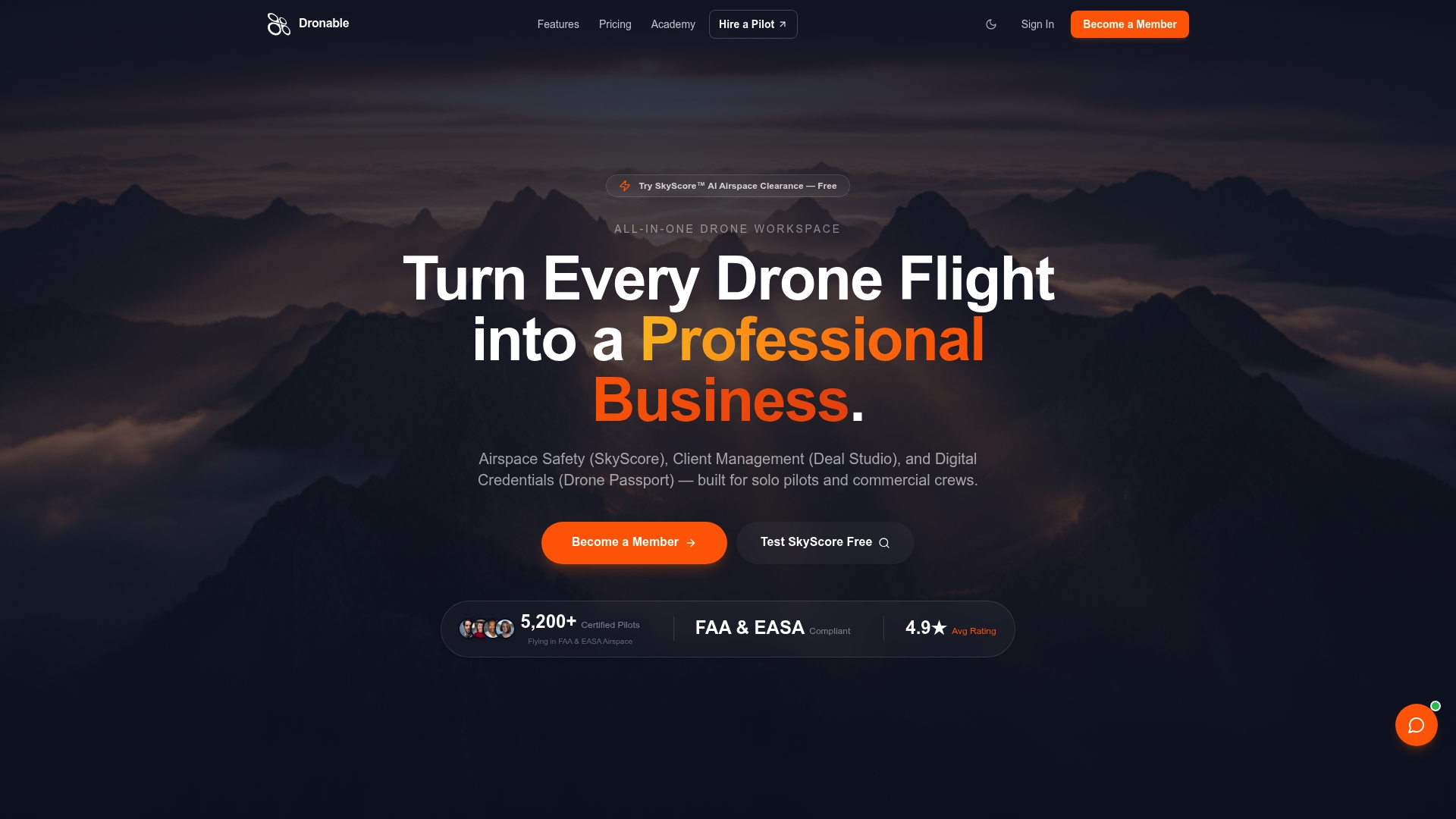
The Starter plan runs $9.99 a month, Pilot Pro is $24.99 a month, and Elite runs $49.99 a month, each unlocking more of the automated flight logging, certification prep, and client proposal tools that insurers and contracts increasingly expect to see documented. Pair that with Dronable’s full toolset, including SkyScore and Deal Studio, and the paperwork side of getting insured stops competing with actual flight time. Check the membership page to pick the plan that matches how often you fly commercial jobs.
This article is general information, not a substitute for advice from a qualified lawyer. Consult a qualified legal professional about your own circumstances before acting on anything here.
Sources
- European Union Aviation Safety Agency — Drones/FAQs
- Federal Aviation Administration — UAS
- Legal Clarity — Do I need drone insurance? What the law says
- MMOWW — Drone insurance requirements by country
FAQ
What Kind of Insurance Do I Need to Fly a Drone?
Most commercial pilots need third-party liability coverage as a baseline, typically $500,000 to $1 million per occurrence based on common market practice. Add hull coverage for the aircraft itself, payload coverage for expensive sensors, and professional indemnity if your deliverables (maps, survey data) carry their own liability risk.
Is It Worth Getting Drone Insurance?
Yes, even where no regulator requires it. Commercial clients routinely refuse to hire uninsured pilots, and a single property damage or injury claim without coverage can cost far more than years of premiums combined.
What Is the Average Cost of Drone Insurance?
Cost depends heavily on aircraft value, payload, and type of work, so exact pricing varies case by case rather than following one flat rate. A specialist broker can quote based on your specific equipment and job type, factoring in the coverage limits your clients or destination country require.
Can You Fly a Drone Without Insurance?
Under FAA rules, yes, since federal U.S. law doesn’t mandate insurance for small UAS operators. But some countries like Germany and France legally require it, and most commercial clients and permits will refuse to work with an uninsured pilot regardless of what federal aviation law says.
Recommended
Explore Dronable Tools
Deepen Your Knowledge
Get step-by-step video courses in the Dronable Academy — FAA Part 107, EASA, real estate drone photography, and more.
Browse CoursesFree: How to Start a Drone Business
The complete step-by-step guide to turning your passion for flying into a profitable drone business — completely free.
- 10 steps to launching your drone business
- 51 proven drone business ideas
- How to get FAA certified (Part 107)
- Pricing, clients & recurring income
Join the Dronable Newsletter
Get drone tips, new articles, and exclusive deals straight to your inbox. No spam, unsubscribe anytime.


