One Page Drone Proposal Template That Passes Corporate Procurement

One Page Drone Proposal Template That Passes Corporate Procurement
Use a one-page executive summary up front. Tie your price to the client’s top business driver. State your file formats clearly: PDF for delivery, editable source for revisions. Put pilot certifications and your certificate of insurance on the first page, not buried in an appendix.
- Clear, detailed scope, timeline, and pricing definitions are essential, including explicit exclusions and payment schedules to prevent scope creep and delays.
- Precise compliance language, such as FAA Part 107 certification and specific insurance coverage amounts, speeds up approval and reduces revision requests.
- Use one pricing model per proposal and clearly state deposit requirements, add-on costs, and invoice terms to simplify approval and minimize negotiation.
- Including the client’s goals, project details, and deliverables in plain language ensures procurement reviewers understand operational risks and compliance.
- Utilizing proposal tools like templates, digital credentials, and automated logs streamlines the process, saving time and improving proposal accuracy.
Flydronable
flydronable.com
Create Proposals With Less Admin
Dronable brings client management, digital credentials, and automated flight logs together for more efficient drone proposal workflows.
Table of Contents
- Checklist: must-have elements every drone proposal needs
- Section-by-section copyable template (paste into Word/Google Docs)
- Pricing approaches and payment terms that reduce negotiation
- Exact compliance and deliverable language corporate clients want to see
- Quick customizations for real estate, inspections, and mapping proposals
- How Dronable helps you produce compliant, client-ready proposals faster
- Client approval and feedback process during the project
- Author notes: three hard lessons from winning drone bids
- Try Dronable: templates, credentials, and proposal workflows
- Sources
- FAQ
Checklist: must-have elements every drone proposal needs
A complete drone proposal covers cover page, summary, scope, timeline, price, and terms. Miss one and a corporate buyer will ask for a revision before they sign anything.
- Cover page: client name, project title, date, your business name and contact details.
- Executive summary: one page, built on the APMP five-part structure, client drivers, your solution, pricing and value, next steps, and a short close.
- Scope of work: deliverables listed by name and quantity, plus explicit exclusions.
- Timeline: key milestones and a delivery date.
- Pricing summary: total cost, deposit amount, and payment schedule.
- Insurance and certification: pilot credentials and coverage amount stated plainly.
- Deliverable specs: file types, resolution, and revision limits.
- Terms and next steps: acceptance instructions and a signature line.
Skip any of these and the proposal reads unfinished. Corporate procurement teams often reject proposals that leave insurance or certification vague.
Section-by-section copyable template (paste into Word/Google Docs)
Paste this structure into your document. Fill each bracketed line with your project details.
- Cover page. Project title, client name, date, one-line project description: “Aerial photography and video coverage for [property address].”
- Executive summary. Follow the APMP five-part pattern: open with the client’s goal, state your solution, summarize price and value, name next steps, close with why you fit this job. Keep it to one page.
- Scope of work. List deliverables by quantity and format: “25 edited photos, one 60-second video, delivered as MP4 and JPEG.” Add an exclusions line: “Does not include drone-based interior photography or 3D modeling.”
- Timeline table. Shoot date, editing window, delivery date. Standard photo and video jobs typically deliver within three to seven business days; build in extra time for large mapping jobs.
- Pricing table. List package price, add-ons, and total. Add a deposit line: “50% deposit due at signing, balance due on delivery.”
- Terms summary. Insurance coverage amount, cancellation and reschedule policy, weather clause.
- Acceptance block. Signature line, date line, printed name for both parties.
- Delivery formats. State file handoff method: cloud link, USB drive, or client portal, with a revision limit stated in writing.
Pricing approaches and payment terms that reduce negotiation
Pick one pricing model per proposal and state it plainly. Mixing hourly and flat rates in the same table confuses clients and slows approval.
- Fixed packages work best for real estate and standard inspection jobs; hourly or per-acre pricing suits mapping and agriculture.
- Deposits of 25% to 50% are standard before scheduling; state the cancellation window in the same line.
- Add-ons should sit in a separate row: drone video, rush delivery, extra revisions, each with its own price.
- Invoice terms matter as much as the price. Net 15 terms and milestone billing get paid faster than open-ended net 30 invoicing.
- Insurance phrasing should name the coverage amount and offer a certificate of insurance on request, not “insurance available.”
Exact compliance and deliverable language corporate clients want to see
Procurement reviewers look for specific numbers, not general assurances. Vague insurance language is a common reason a proposal gets sent back for revision, according to guidance on drone service contracts.
- Certification line: “Flights are conducted by an FAA Part 107 certified remote pilot. Airspace authorizations, where required, are obtained prior to flight.”
- Insurance line: commercial clients often expect coverage between $1,000,000 and $5,000,000 per occurrence, with the client named as additional insured on higher-risk projects.
- Deliverable specs: state file type, resolution, coordinate reference system for mapping work, and metadata included with each file.
- Privacy line: state how long footage is retained and who has access before deletion.
- Weather clause: name who decides to reschedule. “The remote pilot in command retains final authority to delay or cancel a flight for safety.”
Corporate buyers expect operational risk references, not just a price. ICAO model UAS guidance centers safety management systems and pilot certification in operational approvals, and proposals that mirror that language tend to move through review faster.
Quick customizations for real estate, inspections, and mapping proposals
Real estate proposals should state photo count, a fast turnaround window, and marketing usage rights for the images. Inspection proposals need accuracy specs, an annotated report format, and a line on safety coordination with site staff during flight. Mapping proposals should state control point requirements, processing time, and delivery format, since a client comparing bids will look at coordinate accuracy before price.

How Dronable helps you produce compliant, client-ready proposals faster
Dronable’s tools map onto each part of the proposal above.
- Deal Studio stores proposal drafts, tracks versions, and logs client feedback in one place.
- SkyScore™ generates an airspace safety snapshot that can be attached to show the check was done.
- Drone Passport holds pilot certifications in a digital format, so credentials can be shared at a glance instead of retyped into every document.
Pro Tip: Attach your Drone Passport credential link directly in the compliance section instead of copying certification numbers by hand.
Brent has covered proposal workflows and drone operations documentation for the Dronable blog, drawing on the compliance and template standards referenced throughout this guide.
Client approval and feedback process during the project
Set the approval process in writing before the shoot, not after delivery. State how many rounds of revisions are included and how the client submits feedback: email, a shared document, or a client portal link.
Name a response window for both sides. “Client feedback is due within five business days of delivery. Revisions beyond the included round are billed at [your hourly rate].” Without a deadline, feedback rounds can stretch for weeks and delay final payment.
State who signs off on the final deliverable and what that sign-off means for payment. A line like “Final payment is due upon client approval or ten business days after delivery, whichever comes first” prevents a stalled approval from holding up an invoice indefinitely.
For jobs with multiple stakeholders, such as construction or real estate teams, name a single point of contact in the proposal. Routing feedback through one person instead of several avoids conflicting revision requests on the same set of files.

Author notes: three hard lessons from winning drone bids
Client language beats vendor superlatives. Mention the client’s name and goal twice for every time you mention your own company, a pattern proposal managers call the 2:1 rule. Spell out exclusions in writing, every time, or scope creep eats your margin. A signed proposal is not a contract. Follow it with a separate service agreement covering liability, insurance, and cancellation terms, as outlined in contract guidance for drone services.
Try Dronable: templates, credentials, and proposal workflows
Building a proposal from scratch for every client wastes time you could spend flying. Dronable keeps your templates, credentials, and compliance checks in one workspace instead of scattered across folders and apps.
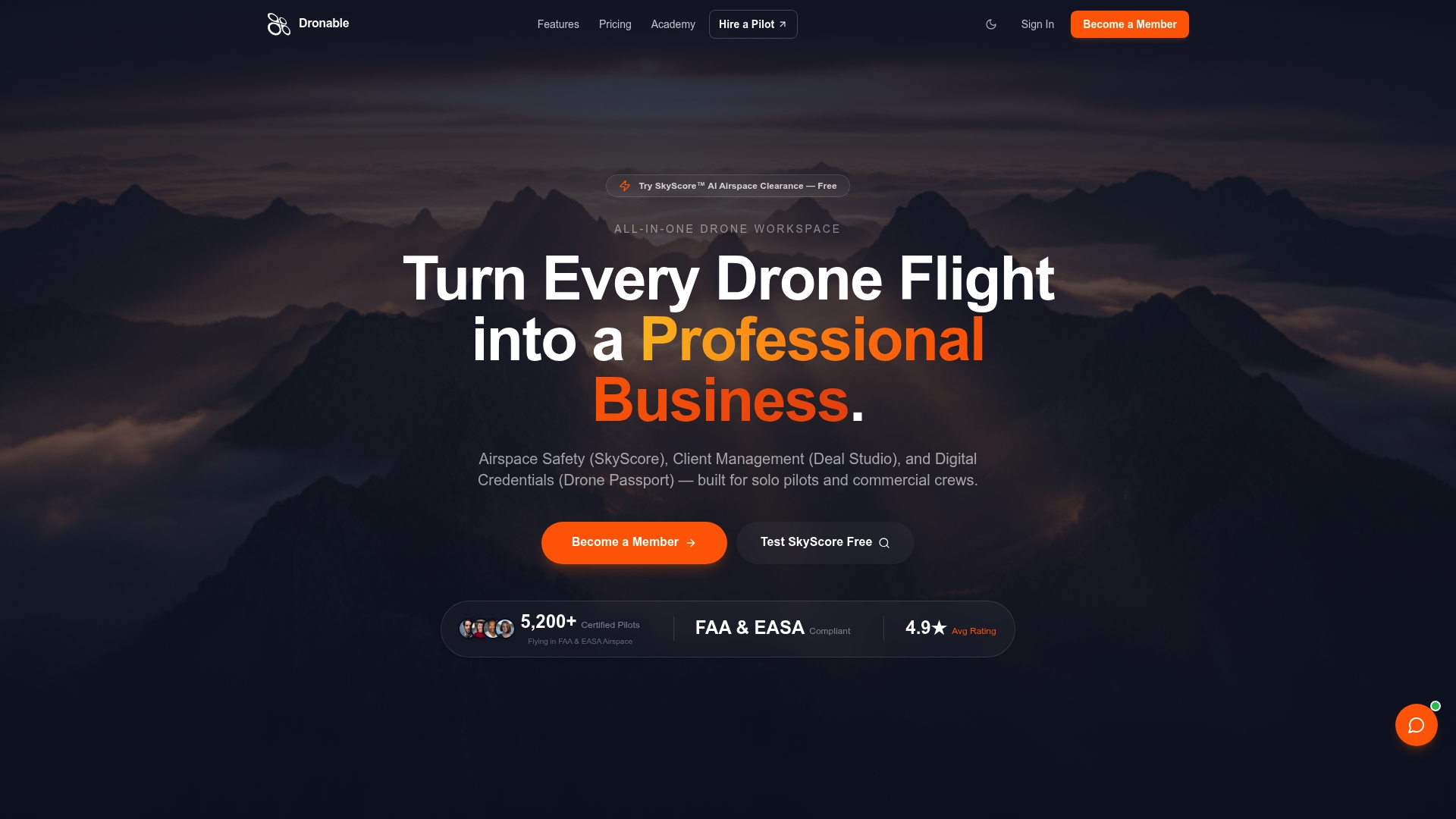
- Deal Studio stores your proposal templates and tracks each client’s status.
- Drone Passport displays your certifications so clients see them without asking.
- SkyScore™ and automated flight logs give you a compliance record to attach to any proposal.
Plans start with Starter at $9.99 a month, Pilot Pro at $24.99 a month, and Elite at $49.99 a month. Visit the membership page to see which plan fits your proposal volume.
Sources
- How to Write an Executive Summary for a Proposal (APMP guidance)
- ICAO model UAS regulations and guidance
- Drone Services Contract Template | Contractable
- What to include in a drone service contract (LegalClarity)
FAQ
How much would it cost to propose with drones?
There is no single published rate for drone proposal pricing since costs depend on project type, package, and add-ons. Structure your quote around a fixed package for standard jobs or per-area pricing for mapping work, and state the deposit and total clearly in the pricing section.
What is the 1:1 rule for drones?
This term is not a defined standard in proposal or drone regulation guidance. If you mean pricing or client-mention ratios, the closest documented practice is the 2:1 client-to-company mention rule used in executive summaries.
What are the parts of a project proposal template?
A standard drone proposal template covers a cover page, an executive summary, scope of work, timeline, pricing, terms including insurance and certifications, and a client acceptance block. The APMP five-part executive summary structure, client drivers, your solution, pricing and value, next steps, and a closing argument, fits inside that summary section.
Is it legal for my neighbor to fly a drone over my house?
Airspace and property rights rules vary by country, so check your national aviation authority’s guidance before assuming a rule applies. ICAO model UAS regulations outline how airspace authorizations and operational approvals generally work, but local property law is a separate matter from aviation rules.
Recommended
Explore Dronable Tools
Deepen Your Knowledge
Get step-by-step video courses in the Dronable Academy — FAA Part 107, EASA, real estate drone photography, and more.
Browse CoursesFree: How to Start a Drone Business
The complete step-by-step guide to turning your passion for flying into a profitable drone business — completely free.
- 10 steps to launching your drone business
- 51 proven drone business ideas
- How to get FAA certified (Part 107)
- Pricing, clients & recurring income
Join the Dronable Newsletter
Get drone tips, new articles, and exclusive deals straight to your inbox. No spam, unsubscribe anytime.


