12 Week Drone Training Curriculum Maps to Your Operations Platform
12 Week Drone Training Curriculum Maps to Your Operations Platform
A practical drone training curriculum combines three things: Part 107 or UAG certification study, progressive flight-skill modules, and operational recordkeeping tied to a flight-operations platform. The certification target is the Remote Pilot Certificate, and it does not end at the test. The FAA requires recurrent training every 24 calendar months, so the curriculum below is built as a repeatable cycle, not a one-time event.
- Recurrent training is required every 24 months and can be completed through FAA’s free ALC-677 course without retaking the knowledge test.
- Flight-skill drills focus on precision, wind handling, and advanced mission tasks like mapping and obstacle avoidance, with clear pass/fail criteria.
- Integrating digital credentials and automated logs into a flight-operations platform creates a verified portfolio that streamlines audits and enhances client proposals.
- Studying the FAA ACS thoroughly, including sectional charts and weather effects, is essential to passing the test and ensuring safety in field operations.
- A typical certification timeline ranges from 8 to 12 weeks, with accelerated paths possible for Part 61 pilots, and recordkeeping is crucial for ongoing compliance and revenue growth.
Flydronable
Build Your Drone Operations Workspace
Bring airspace safety, client management, digital credentials, and automated flight logs together in one unified platform.
Table of Contents
- What Goes Into a Drone Training Curriculum?
- What Do You Need to Study for the UAG or Part 107 Test?
- Which Flight-Skill Drills Should You Master?
- How Do You Connect Training to Your Operations Platform?
- How Long Does It Take to Complete the Curriculum?
- Why Most Training Plans Fall Apart After Certification
- Turn This Curriculum Into a Client-Ready Business
- Sources
- FAQ
What Goes Into a Drone Training Curriculum?
A drone training curriculum works best as a set of modules, not a single course. Each module has a clear objective, a rough time estimate, and an artifact you can point to when a client or an examiner asks for proof.
Here is the module map:
- Certification theory — FAA regulations, airspace classes, and Remote Pilot Certificate requirements. 15 to 20 hours. Produces: passing test score.
- Airspace & charts — reading sectional charts, controlled airspace, and LAANC authorizations. 8 to 10 hours. Produces: chart-reading proficiency checklist.
- Weather & performance — density altitude, wind limits, and aircraft performance under load. 6 to 8 hours. Produces: go/no-go decision log.
- Flight skills — takeoffs, landings, orientation drills, wind handling. 10 to 15 hours. Produces: logged proficiency flights.
- Mission planning & risk management — pre-flight risk assessment, crew briefings, contingency plans. 6 to 8 hours. Produces: mission plan template.
- Payload & data workflows — sensor operation, data capture, file handoff. 4 to 6 hours. Produces: sample deliverable package.
- Maintenance & logs — inspection routines, firmware updates, flight log discipline. 4 hours. Produces: maintenance record.
- Business & client ops — proposals, insurance, client communication. 4 to 6 hours. Produces: client-ready proposal draft.
Sequence certification theory and airspace work first, since they gate the knowledge test. Flight skills and mission planning can run in parallel once basic control is solid. Recurrent cycles skip straight to updated regulations and a flight-skill refresh, which cuts the time roughly in half.
What Do You Need to Study for the UAG or Part 107 Test?
The FAA’s Remote Pilot ACS defines exactly what gets tested, and it is the single best study reference available. It breaks the exam into specific areas of operation: airspace classification and operating requirements, applicable regulations, weather sources and effects on small UAS performance, aeronautical decision making, emergency procedures, and maintenance and inspection procedures. Each area maps to something you will actually use in the field. Weather knowledge, for instance, is not trivia. It is the difference between a safe survey flight and a damaged aircraft in gusty conditions.
Study approach that works:
- Drill the ACS knowledge areas topic by topic rather than jumping between random practice questions.
- Practice sectional chart reading until you can identify airspace boundaries in under 30 seconds.
- Run timed question sets that mirror the real two-hour exam window.
- Prepare for image-based questions embedded directly into the test. Testing centers now build these into the exam itself rather than treating them as supplemental figures, a change candidates should expect starting in late 2026.
Pro Tip: Treat every question on test day as scored. Validation questions get mixed in and cannot be identified during the exam, so skipping or rushing any question is a losing strategy.
Administrative checklist for certification:
If you do not hold a qualifying Part 61 pilot certificate, you will need to pass the UAG knowledge test at an FAA-approved testing center and apply through IACRA or Form 8710-13 as per FAA instructions. Get your FAA Tracking Number (FTN) first, schedule your test at an approved center like PSI or CATS, then submit your application. IACRA processing is faster and can issue a temporary certificate while TSA vetting completes. Part 61 certificate holders with a current flight review may use the ALC-451 online course instead of taking the knowledge test.
Once certified, the clock starts on currency. Remote pilots must complete recurrent training every 24 calendar months, and the FAA’s free ALC-677 course satisfies that requirement without a retest. Failure to complete recurrent training within the required period may affect your ability to operate commercially.
Which Flight-Skill Drills Should You Master?
Certification theory gets you legal to fly. Flight-skill drills get you good enough to fly for money. The gap between those two things is where most new commercial pilots stumble, and it is why the curriculum needs assessable exercises with pass or fail criteria, not vague practice time.
Core control drills:
- Precision takeoffs and landings within a marked zone, five consecutive clean attempts.
- Orientation drills flying the aircraft nose-in, nose-out, and crosswise without losing spatial awareness.
- Wind handling in gusts above 15 mph, tracking drift correction in real time.
Advanced mission drills:
- Mapping grid passes with consistent altitude and overlap, at least three full missions logged.
- Waypoint navigation using automated flight paths, verified against planned coordinates.
- Confined-area operations practicing obstacle avoidance in tight spaces.
- Payload operations, including sensor calibration and mid-mission adjustments.
- Night operations drills, where authorized, with anti-collision lighting checks.
Safety and crew resource management: Every mission should start with a documented crew briefing and end with an after-action review, even for solo pilots flying alone. Lost-link response and emergency landing practice belong in every cycle, not just initial training. Commercial value increasingly comes from demonstrated risk mitigation, not just imagery, so clients want to see that you rehearse failure scenarios, not just success ones.
Record everything in a flight log tied to mission reports. A signed proficiency checklist after each drill set turns “I practiced” into an auditable record you can show a client or an insurer.
How Do You Connect Training to Your Operations Platform?
Training that lives in a notebook disappears the moment a client asks for proof. Training that lives inside a flight-operations platform becomes a business asset. A few features make the difference:
- Automated flight logs that timestamp every mission and attach it to the pilot who flew it.
- Digital credentials, like a Drone Passport, that store certification status and recurrent training dates in one verifiable profile.
- Operations manual templates that turn your risk-management drills into a document clients and regulators can review.
- Mission templates that standardize briefings, checklists, and after-action reports across every flight.
- Safety scoring that gives airspace risk a number instead of a guess.
The practical move is to upload your certificate the moment it is issued, then link each logged mission back to the syllabus module it satisfies. When you bid on a client proposal, export the mission reports and safety score directly instead of assembling a packet from memory.
For audits and RFPs, keep records per flight (location, weather, crew, incident notes) and per pilot (certification date, recurrent training date, proficiency sign-offs). An operations manual template gives that recordkeeping a consistent shape from day one.

How Long Does It Take to Complete the Curriculum?
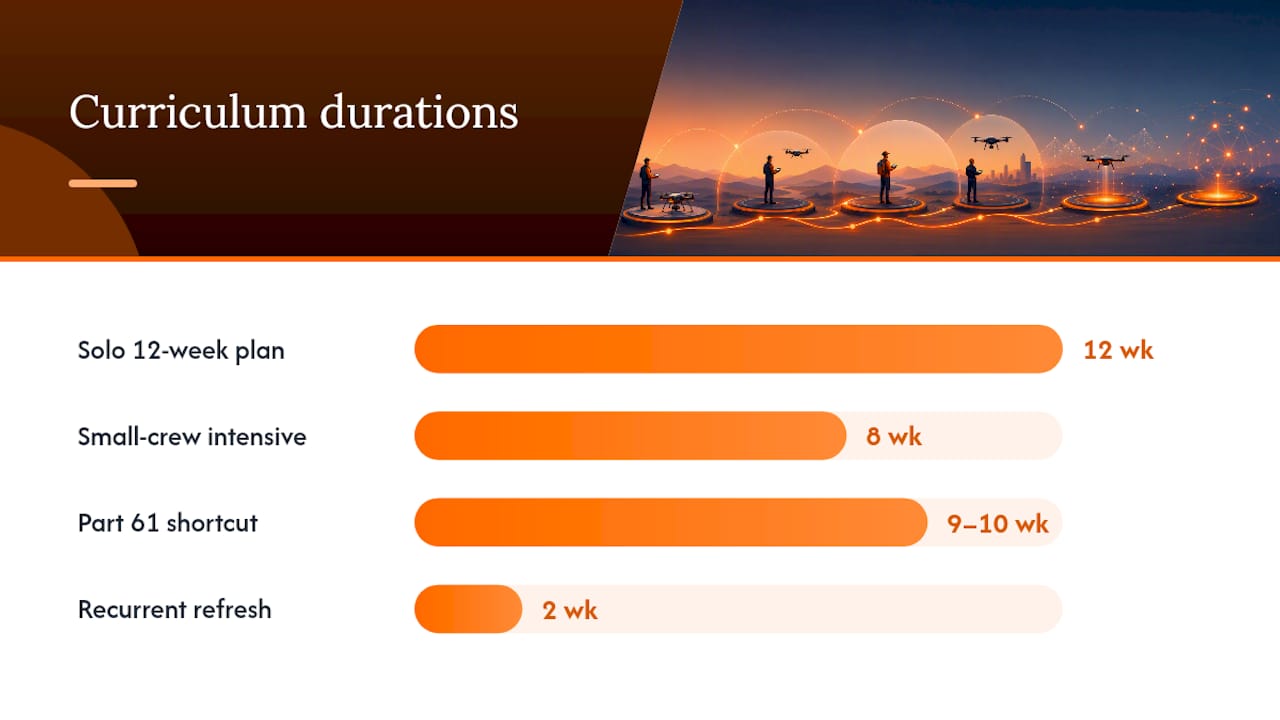
Two timelines cover most situations. A solo hobbyist moving toward certification can run a 12-week plan: weeks 1 through 4 on certification theory and chart reading, weeks 5 through 8 on flight-skill drills, weeks 9 through 10 on mission planning and risk management, and weeks 11 through 12 on business setup and the knowledge test. A small crew onboarding new pilots can compress this into an 8-week intensive by running theory and flight drills in parallel across dedicated training days.
Milestones to track regardless of timeline:
- Pass the knowledge test and receive your Remote Pilot Certificate.
- Complete your first flight-skill sign-off with a logged proficiency checklist.
- Upload a working operations manual.
- Secure liability insurance and build a client-ready mission template.
Part 61 certificate holders can skip the knowledge test entirely using the ALC-451 pathway, shaving two to three weeks off the timeline. Recurrent cycles for already-certified pilots condense to a two-week refresh focused on regulation updates and a flight-skill spot check, since the foundational drills do not need to be repeated from scratch.
Why Most Training Plans Fall Apart After Certification
Most pilots treat certification as the finish line. It is closer to the starting gun. The knowledge test proves you understand airspace and regulations on paper, but it does not prove you can brief a crew, handle a lost-link event, or hand a client a mission report that justifies your rate. Specializing in one or two niches, whether that is construction, agriculture, or real estate, tends to matter more for revenue than adding more flight hours across everything at once.
The bigger blind spot is recordkeeping. Pilots who treat their flight log as a legal chore lose the ability to show clients a track record. Pilots who tie every mission to a digital credential and a mission report build a portfolio without extra effort. That difference compounds over a 24-month recurrent cycle: one pilot walks in with two years of documented missions, the other starts over. Build your syllabus around artifacts you can hand someone, not just knowledge you can recite.
Turn This Curriculum Into a Client-Ready Business
This platform offers a way to run this syllabus without juggling a notebook, a spreadsheet, and three separate apps. The Dronable Academy maps its modules to the certification prep and recurrent training cycle laid out above, while the platform’s tools handle the operational side: automated flight logs, Digital Credentials through your Drone Passport, an Operations Manual builder, and SkyScore for airspace safety scoring.
Every drill you complete, every mission you log, and every certificate you earn feeds into a profile you can hand a client during a proposal instead of assembling from scratch. Visit Dronable’s tools to see how logs, credentials, and safety scoring work together, or start with the Academy to follow this curriculum step by step with platform support built in.
Sources
- Remote Pilot – small Unmanned Aircraft Systems (UAS) Airman Certification Standards (ACS)
- Part 107 Testing Center & Exam-Day Checklist 2026 | OpenExamPrep
- Careers involving drones | San Juan College
FAQ
How Often Do I Need Recurrent Training?
Every 24 calendar months. The FAA’s free ALC-677 course satisfies this requirement without retaking the knowledge test.
Do I Need the UAG Test If I Already Hold a Part 61 Certificate?
No. Part 61 pilots with a current flight review can use the ALC-451 online course pathway instead of sitting the UAG knowledge test.
What Happens if I Fail the Knowledge Test?
You can retest, though most approved testing centers enforce a waiting period before you can sit for the exam again.
Can Flydronable Help Me Track Certification and Recurrent Training?
Yes. Digital Credentials through a Drone Passport store certification dates and recurrent training status in one profile, which you can review through Dronable’s tools.
What’s the Fastest Way to Move From Hobbyist to Commercial Pilot?
Pass the Remote Pilot Certificate test, complete flight-skill sign-offs, secure liability insurance, and build a client-ready proposal, ideally specializing in one or two niches rather than spreading thin across every market.
Recommended
Explore Dronable Tools
Deepen Your Knowledge
Get step-by-step video courses in the Dronable Academy — FAA Part 107, EASA, real estate drone photography, and more.
Browse CoursesFree: How to Start a Drone Business
The complete step-by-step guide to turning your passion for flying into a profitable drone business — completely free.
- 10 steps to launching your drone business
- 51 proven drone business ideas
- How to get FAA certified (Part 107)
- Pricing, clients & recurring income
Join the Dronable Newsletter
Get drone tips, new articles, and exclusive deals straight to your inbox. No spam, unsubscribe anytime.


