EASA Drone Regulations 2026: A1, A2 & A3 Rules Explained
Navigate EASA drone regulations 2026 with our guide to A1/A2/A3 categories, Remote ID compliance, and the 120m altitude rule for safe flight operations.
Flying a drone in Europe is easier than it looks on paper — if you know which of the three boxes applies to you. The EU drone framework (Regulation (EU) 2019/947) runs on one simple idea: the heavier and riskier the flight, the more you need to prove.
This guide cuts through the official jargon. Five minutes from now you'll know exactly what's required for your drone, your certificate, and your flights in 2026.
The three categories in one table
EASA sorts every flight into three categories. Most recreational and commercial pilots live in the first two:
| Open | Specific | Certified | |
|---|---|---|---|
| Risk | Low | Medium | High |
| Permission needed | None — follow the rules | NAA authorization (or STS standard scenario) | Operator certificate |
| Typical flight | Vacation photos, real estate shoots | Long-range, BVLOS, heavy payloads | Manned-aviation-level ops |
| Subcategories | A1 · A2 · A3 | STS-01, STS-02, PDRA | Rare for everyday pilots |
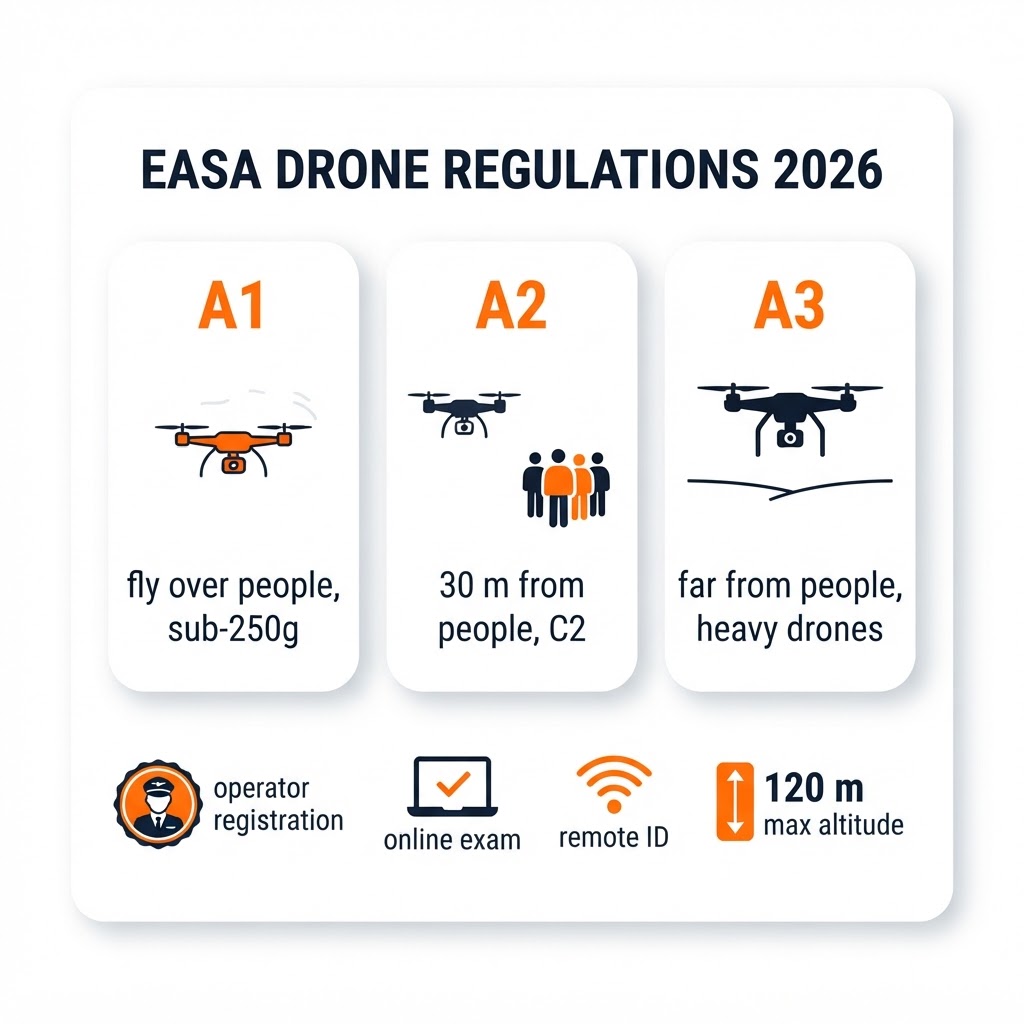
If you're reading this guide, you're almost certainly in the Open category. Here's how its three subcategories differ:
| Subcategory | Over people? | Your drone | What you need |
|---|---|---|---|
| A1 | Yes (never over assemblies of people) | Sub-250 g (C0/C1) | No certificate for sub-250 g; A1/A3 exam for C1 |
| A2 | No — but close, with ≥30 m distance | C2 class | A1/A3 exam + A2 theory exam & self-practical declaration |
| A3 | No — far from people & urban areas | Heavier (C3/C4) | A1/A3 online training + theory exam |
The 5 steps to get certified (most pilots finish in a weekend)
- Register as an operator with your national aviation authority — one registration, valid in every EASA member state. Display your operator ID on the drone.
- Complete the A1/A3 online training and pass the online theory exam (free in most member states; minimum age 16).
- Want to fly closer to people with a C2 drone? Add the A2 theory exam and sign the self-declared practical assessment.
- Check your drone's class label (C0–C4) — it determines which subcategory applies and whether Direct Remote ID is required.
- Log your certificate, flights and insurance in one place — when a client or authority asks, you show proof in seconds. The Digital Drone Passport does exactly this.
Dronable's EASA certificate course in the Academy prepares you for the exam with mock tests and analytics. Most pilots pass on the first attempt.
The rules that get pilots fined
- 120 m ceiling. In the Open category you fly max 120 metres (400 ft) above ground. Flying higher means Specific-category territory.
- Direct Remote ID. Class C1 and above must broadcast who you are, where you are and where you're heading. Sub-250 g C0 drones are exempt — check your class label, not your weight.
- Never over assemblies of people. A1 still excludes uninvolved crowds — that includes festivals and markets.
- VLOS at all times. You must see your drone unaided. Long-range flying is Specific-category work.
- Geozones. Airports, military zones and nature reserves differ per country. Check before every flight abroad — SkyScore gives you an instant airspace risk assessment across EASA countries.
Your registration works across Europe — your rules might not
One operator registration and one remote pilot certificate are valid in all EASA member states — from Norway to Malta. But national geozone rules, privacy laws and local restrictions vary. Planning to shoot abroad? Start with our global drone laws overview, and keep flight logs so you can prove where and when you flew.
FAQ: EASA drone regulations
Do I need a license to fly a drone in Europe?
Not always: sub-250 g class C0 (or privately built, no camera) drones fly under A1 without a certificate. Above 250 g, or for any C1+ drone, you need the A1/A3 training and exam plus operator registration.
What's the difference between A1, A2 and A3?
A1 = over and near people (sub-250 g or C1). A2 = close to people with a C2 drone at ≥30 m distance. A3 = far from people with heavier drones. All start with the same online exam.
How high can I fly in Europe?
120 m (400 ft) above ground in the Open category. Higher flights require a Specific-category authorization.
Does my drone need Direct Remote ID?
Class C1 and above: yes — it must broadcast operator ID, position and route. Class C0 (most sub-250 g drones): not required, but often built in anyway.
Is my registration valid in other EU countries?
Yes — one registration covers all EASA member states. Always check local geozone and privacy rules for the specific country.
Ready to get certified?
Ready to get certified — or to stop juggling six apps to stay compliant? Dronable bundles exam prep, airspace checks, flight logs and client work in one workspace. Start your 7-day free trial.
Explore Dronable Tools
Get Your Drone Certification
Pass your FAA Part 107 or EASA exam with confidence — our Academy courses include study materials, quizzes, and mock exams that walk you through every requirement.
Start LearningFree: How to Start a Drone Business
The complete step-by-step guide to turning your passion for flying into a profitable drone business — completely free.
- 10 steps to launching your drone business
- 51 proven drone business ideas
- How to get FAA certified (Part 107)
- Pricing, clients & recurring income
Join the Dronable Newsletter
Get drone tips, new articles, and exclusive deals straight to your inbox. No spam, unsubscribe anytime.