Freelance Drone Pilot: Land Gigs With Five Samples and Cut Admin

Freelance Drone Pilot: Land Gigs With Five Samples and Cut Admin
A freelance drone pilot earns money flying aerial photography and video jobs for real estate agents, contractors, and media clients, usually holding an FAA Part 107 certificate or a national equivalent. Insurance and a portfolio to close deals. Get certified, build five sample shots, then apply to one marketplace and pitch two local businesses this week.
TL;DR:
- Most freelance drone work is obtained through specialized marketplaces or direct outreach to local businesses, with direct pitches yielding higher margins.
- Commercial clients require FAA Part 107 certification, liability insurance, and proof of proper drone registration and safety compliance before hiring.
- Rates vary from lower fees for real estate listing photos to higher charges for inspection and mapping, with packaging services and add-ons increasing overall earnings.
- Building a strong portfolio, having a streamlined workflow, and leveraging online communities and local networking improve repeat business opportunities.
- Responding swiftly to inquiries, delivering on time, and providing clear proposals are critical for securing ongoing contracts and positive referrals.
Table of Contents
- Where to Find Freelance Drone Pilot Work
- Certifications, Legal Basics, and Insurance Clients Expect
- Earnings and Pricing: What Freelance Drone Pilots Actually Charge
- Skills, Equipment, and Deliverables That Win Bigger Clients
- How to Pitch, Win, and Deliver Client Jobs
- Platforms and Tools for Managing Freelance Drone Work
- Pricing Strategies: Packages and Add-Ons That Raise Your Average Job Value
- Networking Strategies and Professional Communities for Drone Pilots
- Timeline From Inquiry to Delivery: What Clients Actually Expect
- Building a Personal Brand as a Freelance Drone Pilot
- Pilot Perspective: Habits That Turn One-Off Gigs Into Regular Revenue
- Get More Proposals Approved With an Integrated Drone Workspace
- Sources
- FAQ
Where to Find Freelance Drone Pilot Work
Work comes from four channels, and they do not pay the same or move at the same speed.
Specialist drone marketplaces connect clients who already know they want aerial footage with verified pilots. General freelance platforms carry drone gigs mixed in with everything else, so competition is broader but volume is higher. Industry job boards, including general listing sites like Indeed, post local contract work across construction, real estate, and inspection. Subcontracting for general contractors or production companies means you fly, they bill the client. Direct outreach, cold emails to property managers, real estate offices, and video producers, remains the highest-margin channel because there is no platform fee.
Real estate listings and repeat construction site visits pay fastest and require the least sales effort. Inspections, mapping, and broadcast work pay more per job but take longer to win because clients vet credentials harder.
Specialized project work also exists outside the obvious categories. Mapping initiatives like Hivemapper hire pilots for data collection gigs that never show up in a typical “real estate drone photographer” search.
A simple 30-day plan:
- Build a profile with three sample images or clips and your certification number visible.
- Send three direct outreach messages to local businesses in your target vertical.
- Apply to three marketplaces or job boards.
- Pitch one hyper-local business, a single property manager or contractor, with a specific offer.
Pro Tip: Skip the mass-application approach. Three targeted pitches with a client’s actual property or project referenced by name convert better than twenty generic applications.
Certifications, Legal Basics, and Insurance Clients Expect
Every commercial client will ask for proof you can legally fly for money. In the United States, that means the FAA’s Part 107 remote pilot certificate, the baseline credential for commercial drone operations. Other countries run their own licensing systems, so confirm requirements with your national aviation authority before quoting a job outside your home market.
Liability insurance matters just as much as the license. Most commercial clients, especially construction firms and property managers, require a Certificate of Insurance (COI) naming them before you fly. Coverage amounts vary by job risk, but carrying a substantial amount of liability coverage is common in the industry.
Clients also expect you to show up prepared, not just certified. That means:
- Registered aircraft with visible registration number
- Remote ID compliance for your drone model
- A flight plan with NOTAM and airspace checks completed before arrival
- A quick on-site risk assessment covering people, obstacles, and weather
Pro Tip: Keep a digital folder with your certificate, insurance COI, and drone registration ready to send instantly. Clients who ask for proof often need it same-day, not next week.
Earnings and Pricing: What Freelance Drone Pilots Actually Charge
Pay ranges widely by specialization. Basic real estate listing photos sit at the low end of freelance rates, while inspection, mapping, and broadcast specialists can exceed typical freelancer earnings by a wide margin. Specializing is the fastest lever pilots have to raise their own rate.
The Rate Reality: Generalist listing photography competes on price. Specialized inspection and mapping work competes on capability, which is why those pilots charge more per hour without losing clients.
Three pricing models dominate the market:
- Hourly rate works for short, well-defined jobs but undervalues setup and travel time.
- Half-day or full-day rate suits shoots with multiple locations or setups, and protects you against scope creep.
- Per-deliverable pricing (a flat fee per finished video or photo set) works best for repeatable jobs like real estate listings.
A simple formula avoids underpricing: add your direct operating costs (travel, batteries, consumables) to billable hours multiplied by your target hourly rate, then add a postproduction fee and a contingency fee for weather delays or reshoots. Always require a deposit before the shoot and full payment on delivery, not on a 30-day invoice cycle that a hobbyist project can’t absorb.
Skills, Equipment, and Deliverables That Win Bigger Clients
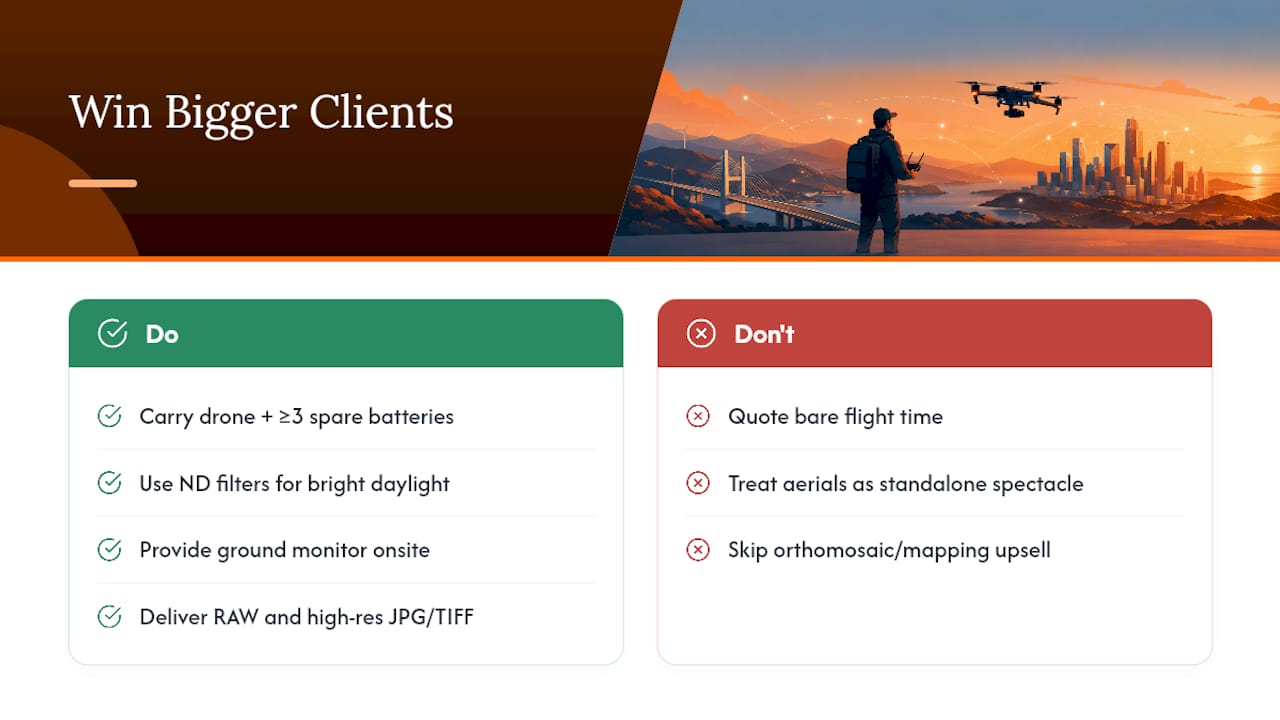
Clients pay for reliability and finished quality, not just flight time. A working kit includes a camera-capable drone, spare batteries (at least three), neutral density filters for bright daylight shooting, a ground monitor for client review on-site, and backup cables. Deliverable formats matter too: high-resolution JPG or TIFF stills, RAW files for post editing, ProRes or high-bitrate H.264 video, and geotiffs for any mapping work.
Technical flying is table stakes. What separates a $150 gig from a $1,500 contract is creative judgment. Veteran aerial filmmaker Jon Collins notes that the most successful freelance pilots shoot with the edit in mind, planning shots that cut cleanly with ground footage instead of treating aerials as standalone spectacle. Smooth gimbal moves, basic color correction, and the ability to integrate drone shots with a ground camera package all raise your commandable rate.
Package your services instead of quoting bare flight time. A property listing package might include five stills, one 60 second flyover video, and a same-day turnaround. An inspection package can add an annotated report referencing the flight plan and site conditions. Orthomosaic processing for mapping clients is a natural upsell most generalist pilots never offer.
Pro Tip: Bundle a short “before and after” clip into construction packages. Contractors reuse that footage for their own marketing, which makes you look indispensable, not just hired.
How to Pitch, Win, and Deliver Client Jobs
A proposal that wins repeat work covers six things: scope, deliverables, timeline, price, payment terms, and a cancellation or rescheduling policy tied to weather windows. Attach a request for the client’s site access details and, if they require it, ask what COI limits they need before you show up.
- Send a one-page Statement of Work with scope and price locked in writing.
- Confirm weather contingency and rescheduling terms before the shoot date.
- Run a preflight brief covering airspace, obstacles, and the shot list.
- Deliver edited assets within the promised turnaround, not “whenever it’s ready.”
- Follow up within a week to ask for a referral or repeat booking.
Industry hiring guidance is blunt about this: freelance drone work is a business, not just a flying skill. Client management, weather planning, and fast turnaround decide who gets called back.
Pro Tip: Ask every satisfied client for one specific referral by name, not a generic “let me know if you know anyone.” Specific asks convert far more often than vague ones.
Platforms and Tools for Managing Freelance Drone Work
Three categories of tools show up constantly in this business, and they solve different problems. Marketplaces give you discoverability, connecting you to clients actively searching for a pilot. Job boards surface local, one-off contract postings mixed in with other freelance categories. Operations workspaces handle the parts nobody enjoys: credential storage, compliance checks, proposals, and flight logs.
When picking a platform, weigh client vetting quality, fee or commission structure, payment protection, geographic reach, and how easily you can present your credentials to a stranger who has never hired a drone pilot before.
An integrated workspace like Dronable centralizes the admin side of freelancing: SkyScore for airspace safety checks, Deal Studio for client proposals, Drone Passport for digital credential storage, and automated flight logs, plus training resources through the Academy. For pilots juggling five scattered apps just to send one quote, that consolidation saves real hours per week.
| Platform type | Best for | Watch out for |
|---|---|---|
| Specialist drone marketplace | Discoverability, verified client demand | Commission fees on booked jobs |
| General job board | Volume of local postings | Heavy competition, thin vetting |
| Operations workspace | Credentials, proposals, compliance in one place | Learning curve for new features |
Before applying anywhere, prepare verified credentials, three to five sample deliverables, clear published pricing, and a stated turnaround time. Profiles missing any of those four get passed over.
Pricing Strategies: Packages and Add-Ons That Raise Your Average Job Value
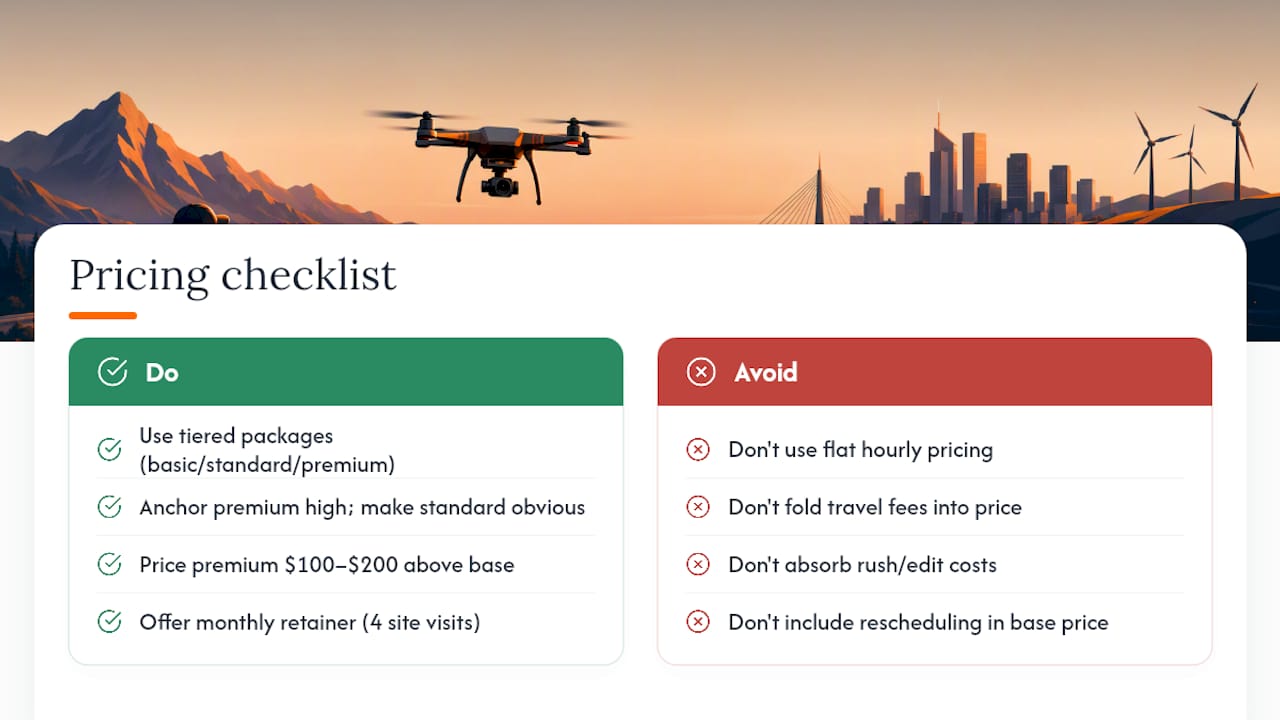
Flat hourly pricing leaves money on the table. Package deals move the conversation from “how much per hour” to “what do I get,” which is an easier sell and a higher-margin structure.
A basic real estate package might bundle five edited stills and one short video for a flat fee. A premium tier adds twilight photography, a floor plan overlay, or a narrated walkthrough video, priced $100 to $200 above the base package. Construction and inspection clients respond well to monthly retainer-style packages covering four site visits, since it locks in recurring revenue instead of chasing one job at a time.
Value-added services are where specialization pays off. Orthomosaic mapping, thermal inspection add-ons, and annotated technical reports referencing flight conditions turn a single flight into a higher-ticket deliverable. Editing and rush turnaround are the two most requested add-ons, so price them explicitly rather than absorbing the cost into your base rate.
Bundling also protects your time. A three-package tier structure (basic, standard, premium) lets clients self-select their budget without you negotiating every job from scratch. Anchor the premium tier high enough that the standard package looks like the obvious middle choice; that pricing psychology works in drone services exactly like it does everywhere else.
Always separate travel fees and weather-related rescheduling costs from the core package price. Folding them in creates disputes when a shoot gets rained out twice in one month.
Networking Strategies and Professional Communities for Drone Pilots
Referrals close more freelance drone jobs than cold applications, and referrals come from relationships you built before you needed the work. Local business groups, chambers of commerce, and real estate association events put you in a room with the exact clients who hire drone pilots repeatedly.
Online communities matter just as much. Regional Facebook groups for drone operators, subreddit communities focused on commercial UAS work, and Part 107 study groups double as informal job boards where members post overflow work they cannot take themselves. Showing up consistently, answering questions, sharing sample work, builds the kind of reputation that gets you tagged when someone needs a last-minute pilot.
Trade shows for real estate, construction, and film production are worth the entry fee if you specialize in that vertical. A five-minute conversation with a property management company’s marketing director beats a hundred cold emails.
Cross-referrals with adjacent freelancers pay off too. Photographers, videographers, and general contractors who do not fly drones themselves often need one on a project and would rather refer a known pilot than gamble on a stranger from a marketplace listing.
Timeline From Inquiry to Delivery: What Clients Actually Expect
Most commercial clients expect a response to their inquiry within a few hours, not a few days. A same-day quote with a clear price and available shoot dates wins jobs that a slower competitor loses by default.
From inquiry to booked shoot typically runs three to seven days, depending on weather windows and site access approval. The shoot itself is usually a single visit lasting one to three hours for real estate or construction documentation, longer for mapping or multi-location inspection work.
Delivery turnaround is where reputations are made. Real estate clients often expect edited stills and a short video within 24 to 48 hours, since listings go live on tight schedules. Inspection and mapping deliverables, including processed orthomosaics or annotated reports, reasonably take three to five business days given the processing time involved.
Setting turnaround expectations in writing during the proposal stage, not after the shoot, prevents the single most common client complaint in this business: silence after payment.
Building a Personal Brand as a Freelance Drone Pilot
A basic website with your portfolio, pricing tiers, and certification visible converts better than a social media profile alone, because clients searching for “drone pilot near me” expect a real business, not just a feed of pretty shots.
Your portfolio should lead with your strongest three to five pieces in the vertical you want more work in, not your entire flight history. A construction client does not need to see wedding footage to hire you for a site survey.
Social media still matters for visibility. Instagram and YouTube work well for showcasing finished edits, while LinkedIn is underused by most pilots despite being where property managers and construction executives actually spend time. Posting a short breakdown of how you shot a difficult job, obstacles, weather, gear choices, builds credibility faster than another generic flyover reel.
Client testimonials and named references carry more weight than any amount of self-promotion. A single quote from a repeat construction client, with their permission to use it, does more for conversion than a dozen unattributed five-star ratings.
Pilot Perspective: Habits That Turn One-Off Gigs Into Regular Revenue
Flying conservative, not flashy, protects both safety and reputation. Pilots who standardize proposals, keep insurance ready, and integrate aerials with ground footage tend to get called back. One common pattern: a single property listing job turns into a standing contractor relationship once the pilot delivers fast and asks for the next site visit before leaving the first one.
— Brent
Get More Proposals Approved With an Integrated Drone Workspace
Chasing paperwork instead of jobs is the real bottleneck for most freelance drone pilots, not flying skill. Dronable puts airspace safety checks, client proposals, credential storage, and flight logs in one place, so a quote that used to take three apps and twenty minutes takes one.
Pilots juggling COIs, certification renewals, and scattered spreadsheets benefit most: SkyScore handles airspace safety checks automatically, Deal Studio turns a client inquiry into a signed proposal without a separate contract tool, and Drone Passport keeps every credential in one verifiable place a client can trust on first contact. Automated flight logs remove the manual record-keeping that eats into billable hours. The Academy also covers exam prep for pilots still working toward certification. For managing day-to-day client tasks alongside flying, a lightweight tool like Seven pairs well for tracking project deadlines and invoices.
Check the tools overview to see what fits your current workflow, then start a profile on Dronable to send your next proposal without switching between five apps.
Sources
- FAA — Commercial operators (UAS)
- Jon Collins — Freelance drone filmmaker services
- UAV Coach — How much does a drone pilot make?
- ZipRecruiter — Key skills and qualifications for freelance drone pilots
FAQ
How much do freelance drone pilots make?
Earnings vary widely by specialization. Basic real estate listing work sits at the lower end of freelance pay, while inspection, mapping, and broadcast specialists can exceed typical freelancer ranges once they build a client base.
Is a drone pilot a good side hustle?
Yes, for pilots with a Part 107 certificate and basic insurance, since local real estate and small construction jobs require minimal setup and can be booked around a full-time schedule.
How much does a drone pilot’s license cost?
The FAA Part 107 exam fee is separate from study materials and typically requires the applicant to schedule a test through an FAA-approved testing center; check the FAA’s commercial operator page for current requirements and process details.
How much do drone pilots charge per hour?
Rates depend heavily on the job type and region, with generalist real estate work priced lower and specialized inspection or mapping work commanding higher rates. Using the operating-cost-plus-target-wage formula keeps quotes profitable regardless of the vertical.
Recommended
Explore Dronable Tools
Deepen Your Knowledge
Get step-by-step video courses in the Dronable Academy — FAA Part 107, EASA, real estate drone photography, and more.
Browse CoursesFree: How to Start a Drone Business
The complete step-by-step guide to turning your passion for flying into a profitable drone business — completely free.
- 10 steps to launching your drone business
- 51 proven drone business ideas
- How to get FAA certified (Part 107)
- Pricing, clients & recurring income
Join the Dronable Newsletter
Get drone tips, new articles, and exclusive deals straight to your inbox. No spam, unsubscribe anytime.


