Avoid $5,000 Fines: National Park Drone Rules for U.S. Pilots
Avoid $5,000 Fines: National Park Drone Rules for U.S. Pilots
You generally cannot launch, land, or operate a drone anywhere on National Park Service land. The National Park Service treats this as a blanket rule, not a suggestion, with narrow exceptions for administrative, emergency, and research missions carrying written approval. Step outside the boundary and NPS jurisdiction ends, but FAA airspace rules follow you anyway.
- Flying a drone in a national park requires written approval for administrative, emergency, or research missions beforehand; unauthorized flights risk citations and penalties.
- Outside park boundaries, FAA airspace rules apply, and launching from non-park land is legal but still subject to FAA regulations and wildlife or visitor disturbance laws.
- State parks have their own permitting processes and designated zones, making it essential to verify rules specific to each location before flying.
- Building thorough safety and permit documentation, including detailed flight plans and certifications, speeds approval and reduces enforcement risk.
- Unauthorized drone use on federal land can result in charges up to six months in jail and a $5,000 fine, with enforcement discretion often determining actual penalties.
Table of Contents
- National park drone rules: what the NPS policy actually says
- When flying in a national park is actually allowed
- Where park authority ends and FAA rules take over
- State parks and individual units don’t all play by the same rules
- How to request approval or fly legally near a park
- What happens if you get caught flying without approval
- Compliance isn’t the boring part of flying, it’s the part that keeps you flying
- How Dronable keeps your flights inside the rules
- Sources
National park drone rules: what the NPS policy actually says
The prohibition traces back to NPS Policy Memorandum 14-05, issued after park superintendents raised concerns about noise, wildlife disturbance, and crashes near cliffs and thermal features. The memo relies on 36 CFR 1.5, which lets superintendents restrict activities that threaten resources or visitor safety. “Uncrewed aircraft” covers any device flown without a person aboard, from a $50 toy quadcopter to a professional cinema rig, and the closure applies whether you launch from a parking lot, a trailhead, or a boat inside park waters.
Two internal documents shape how that rule gets applied day to day:
- RM-60 (NPS Reference Manual 60, Chapter 12) spells out approval authorities, permit categories, and the specific paperwork a mission needs.
- OPM-11, the Department of the Interior’s Operational Procedures Memorandum, sets the aircraft and pilot standards NPS operations must meet before flying at all.
Superintendents keep meaningful discretion here. RM-60 gives them the authority to define what counts as an acceptable use case for their specific park, which is why one unit’s rules can look different from the next even under the same national policy.
When flying in a national park is actually allowed
Legitimate drone use inside NPS boundaries falls into a handful of categories, and none of them happen without paperwork submitted well before your travel dates.
- Administrative and emergency operations. Search and rescue, fire monitoring, and resource management flights get written superintendent approval first, even for NPS staff.
- Scientific research and collecting permits (SRCP). Researchers documenting wildlife, geology, or vegetation can apply through this permit track, which layers UAS-specific conditions on top of the standard research approval.
- Special use permits (SUP). Commercial shoots, weddings, and other non-research projects go through the SUP process, and RM-60 requires a Flight Safety Plan as a baseline element.
That plan needs specifics: pilot certifications, aircraft make and model, project dates, a location map, and a clear statement of who holds operational control of the aircraft during the mission.
Pro Tip: If you’re hired to deliver footage rather than fly under NPS direction, structure your contract as an end-product agreement. RM-60 treats operational control differently for contractors than for missions the park directly commands, and getting that language wrong can stall or sink an application.
Where park authority ends and FAA rules take over
NPS jurisdiction stops at the park boundary. Fly a drone from a pullout on the highway just outside Zion or Grand Teton, and no superintendent’s signature governs that launch. The FAA’s National Airspace System does, and it doesn’t care where the fence line sits.
That gap trips up more pilots than the prohibition itself. Launching outside the boundary still creates real exposure:
- Flying a drone over wildlife inside the park, even from an external launch point, can trigger a citation under 36 CFR 2.2 for wildlife harassment.
- Disturbing visitors with noise or a low pass can fall under 36 CFR 2.34’s disorderly conduct provision, even without ever touching park soil.
- Commercial pilots still need a Part 107 certificate, must keep the aircraft in visual line of sight, and must check for No Drone Zones or temporary flight restrictions that frequently sit over popular parks.
An approved NPS mission doesn’t erase any of this. Every flight, permitted or not, still answers to the FAA on top of whatever the park requires.
State parks and individual units don’t all play by the same rules
Federal NPS land follows one uniform ban, but state parks set their own policies, and they vary enough that assuming one park’s rules apply to the next is a mistake.
- Washington State Parks requires a permit for remote-controlled aircraft and recommends contacting staff directly well ahead of a planned flight, since timelines shift and some sites simply aren’t available.
- Oregon State Parks has moved toward designated drone operation areas, with a policy update taking effect August 8, 2026 that opens specific zones rather than a blanket allowance.
- Individual national park units, like Crater Lake, publish their own drone pages reiterating the federal ban and inviting pilots to contact the superintendent’s office about designated areas or upcoming exceptions.
Check the specific park’s website before every trip, not just once when you bought the drone. Rules change, and superintendent discretion means the answer can differ from the unit forty miles down the road.
How to request approval or fly legally near a park
Getting a mission approved, or finding a legal workaround, comes down to sequencing. Skip a step and you’ll waste weeks waiting on a denial you could have avoided.
- Research before you apply. Read the park’s drone page, then call the superintendent’s office directly. If you’re launching from outside the boundary, confirm you actually have landowner permission for that spot.
- Build your Flight Safety Plan early. Include project dates, a location map, aircraft details, pilot certifications, emergency procedures, and a lost-link contingency, matching the minimum elements RM-60 requires.
- Submit early and confirm insurance needs. Some SUPs ask for proof of liability coverage; find out before your submission deadline, not after.
- Fly conservatively once approved. Keep the aircraft within visual line of sight, hold altitude and distance from wildlife, and have a documented contingency plan ready if conditions change mid-flight.
Pro Tip: Treat “60 days” as a floor, not a target. Washington’s own guidance points pilots toward early contact because permit review can stretch out, and a rushed application almost always comes back with questions that cost more time than starting early would have.
What happens if you get caught flying without approval
Unauthorized drone use on NPS land is a federal misdemeanor. Penalties can reach six months in jail and a $5,000 fine, though most cases don’t max out that scale.
- Rangers exercise wide discretion. The same flight might draw a warning at one park and a citation with equipment confiscation at another.
- A crash near wildlife or a crowded overlook tends to escalate enforcement fast, since it touches both the harassment and public safety provisions at once.
- Carrying your Flight Safety Plan, permit paperwork, and pilot certification on-site gives rangers something concrete to check, which often shapes how a borderline situation gets handled.
Permitted alternatives exist for nearly every legitimate use case. The paperwork is tedious. A confiscated aircraft and a federal citation are worse.
Compliance isn’t the boring part of flying, it’s the part that keeps you flying
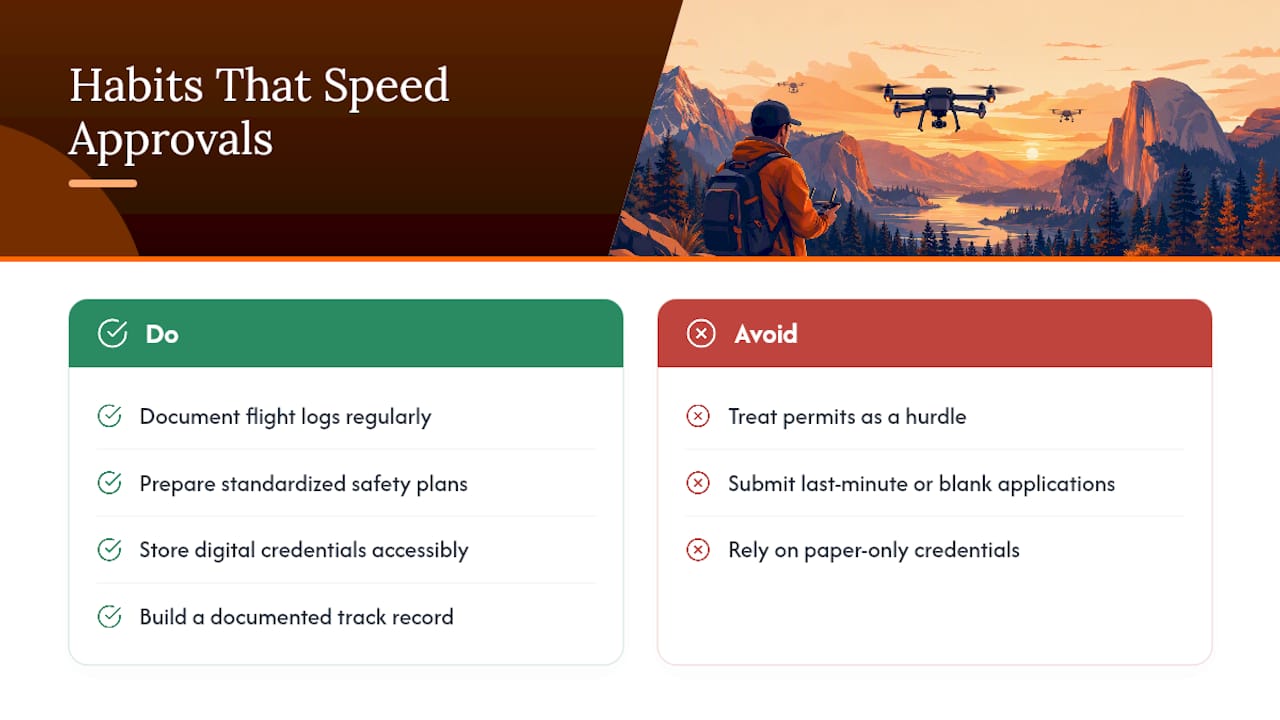
Most pilots treat permits as a hurdle between them and the shot they want. That’s backwards. The pilots who build a habit of documenting flight logs, safety plans, and certifications before they’re asked are the ones who get approved faster the next time, because reviewers can see a track record instead of a blank application.
Standardized safety plans and digital credentials aren’t paperwork for paperwork’s sake. They’re what turns “know before you go” from a slogan into something a superintendent’s office can actually verify in five minutes instead of five weeks.
How Dronable keeps your flights inside the rules
Dronable brings the pieces from this checklist into one workspace instead of scattered folders and email threads. SkyScore™ flags airspace restrictions and no-fly zones before you launch, automated flight logs build the documented history that strengthens future permit applications, and Drone Passport keeps your certifications and credentials verifiable in one place a park office can check quickly.
For the Flight Safety Plan itself, the Operations Manual provides templates that match RM-60’s required elements, so you’re not building one from scratch under deadline pressure. Pilots working toward Part 107 or brushing up on airspace rules can prep through the Academy. Check the full toolset or get started at Dronable before your next application deadline.
Sources
Start with the NPS uncrewed aircraft policy overview and RM-60, Chapter 12 for the federal framework. For state examples, see Oregon’s designated areas policy and Washington’s permit guidance. Before any trip, check the specific park’s own page, and review broader trip logistics through resources like Campgazer’s park guide.
This article is general information, not a substitute for advice from a qualified lawyer. Consult a qualified legal professional about your own circumstances before acting on anything here.
Recommended
Explore Dronable Tools
Deepen Your Knowledge
Get step-by-step video courses in the Dronable Academy — FAA Part 107, EASA, real estate drone photography, and more.
Browse CoursesFree: How to Start a Drone Business
The complete step-by-step guide to turning your passion for flying into a profitable drone business — completely free.
- 10 steps to launching your drone business
- 51 proven drone business ideas
- How to get FAA certified (Part 107)
- Pricing, clients & recurring income
Join the Dronable Newsletter
Get drone tips, new articles, and exclusive deals straight to your inbox. No spam, unsubscribe anytime.


