Part 107 Night Operation Lighting: 3 Mile Visibility, 5 Minute Proof
Part 107 Night Operation Lighting: 3 Mile Visibility, 5 Minute Proof
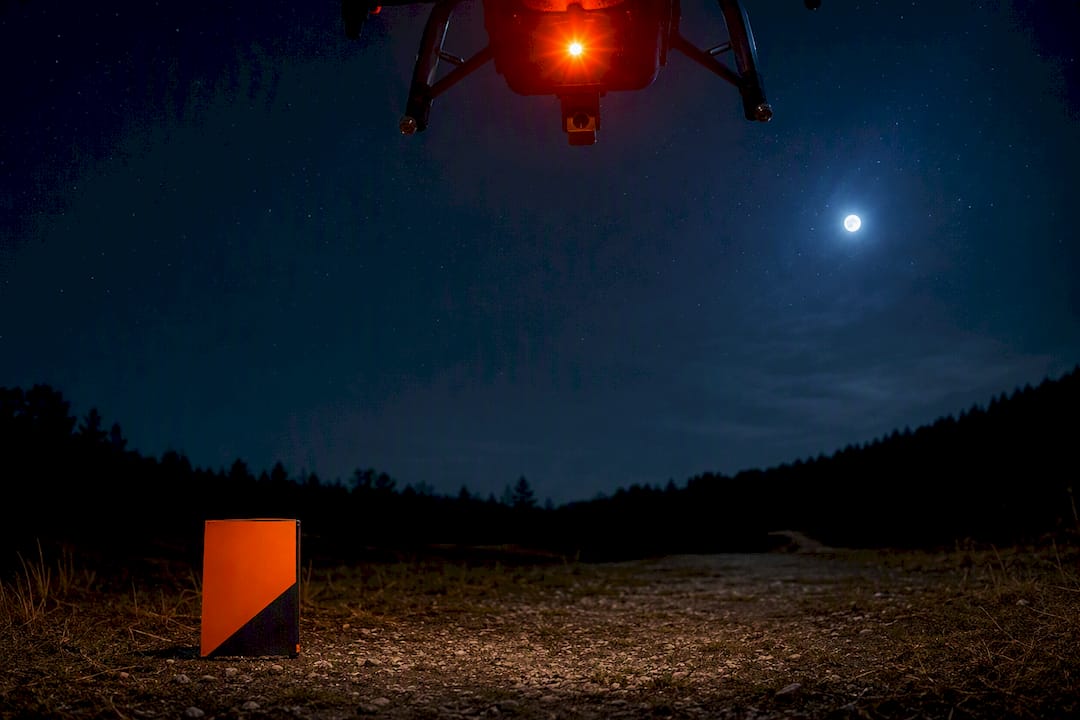
Commercial drone night operations under Part 107 require an anti-collision light that strobes and stays visible for 3 statute miles, in white or red only. Fit a compliant self-contained or hardwired strobe, confirm its runtime matches your mission length, and log a visibility test before you fly. The sections below cover the regulatory basics, then walk through hardware selection.
- The anti-collision light must strobe, be white or red, and be visible for 3 statute miles in conditions tested by the manufacturer.
- Anti-collision lights are distinct from navigation lights, which stay steady and do not fulfill FAA compliance requirements.
- Proper mounting, testing, and documentation of lighting are crucial, with records stored in a structured operations manual for easy retrieval during inspections.
- Weather conditions like fog, rain, and cold can significantly reduce effective visibility and runtime, requiring environmental considerations for equipment choice.
- Use self-contained, ruggedized LED strobes with adjustable settings, mounted at both the top and bottom of the drone for redundancy and maximum visibility.
Flydronable
Keep Night Operations Organized
Dronable brings airspace safety, flight logs, certification preparation, and client tools into one unified drone workspace.
Table of Contents
- What Are the FAA’s Night Operation Lighting Requirements?
- Anti-Collision Lights vs. Navigation Lights: What’s the Difference?
- How Do You Choose the Right Lights for Night Missions?
- Where Should You Mount Night Lights, and How Do You Power Them?
- What Preflight and In-Flight Lighting Practices Reduce Risk?
- How Do You Test and Maintain Night Lighting Equipment?
- Does Weather Affect How Well Night Lights Perform?
- What Are the Health and Safety Risks From Drone Lighting?
- How Have LEDs and Smart Controls Changed Night Lighting?
- An Editorial Take: Compliance Is a Paperwork Problem as Much as a Hardware One
- Dronable Keeps Your Night Ops Compliance Paperwork in One Place
- Sources
- FAQ
What Are the FAA’s Night Operation Lighting Requirements?
Night, under FAA rules, starts at the end of civil twilight and runs until the start of morning civil twilight. That window, not the clock, determines when anti-collision lights become mandatory for Part 107 flights. Daylight operations carry no such requirement, but the sun sets faster than most flight plans account for, so pilots flying near dusk should treat lighting as default equipment, not backup gear.
The technical bar is specific:
- The light must strobe or pulse, not glow steadily.
- Approved colors are white or red. Green alone does not satisfy the anti-collision requirement, even on a bright unit.
- Visibility must reach 3 statute miles under the conditions the manufacturer tested.
That three mile figure exists because the light’s real audience is manned aircraft pilots scanning the sky at altitude, not the drone operator on the ground. A strobe visible from a quarter mile might look fine on a rooftop test but fail the actual safety case entirely.
Rules outside the United States vary. Some regulators set different visibility distances, color rules, or exemptions for micro drones. If you fly commercial missions across borders, confirm requirements with the local aviation authority before assuming FAA standards apply.
Anti-Collision Lights vs. Navigation Lights: What’s the Difference?
Anti-collision lights and navigation lights get confused constantly, and the mix-up causes real compliance failures. Anti-collision lights strobe or pulse and exist to satisfy the 3 statute mile visibility rule. Navigation lights, sometimes called orientation lights, stay on steady and help the pilot judge the drone’s heading and attitude in the dark.
- Anti-collision: strobing, white or red, regulatory requirement.
- Navigation/orientation: steady-on, often green/red/white paired by side, situational aid only.
A common mistake is assuming a steady green light on the aircraft’s left side counts as compliance. It doesn’t, no matter how bright it is. The fix is simple: run a compliant white or red strobe for anti-collision, and add steady orientation LEDs separately for spatial awareness.
Pro Tip: Mount orientation lights so the color pattern is visible from your ground position at all times. If you lose track of which way the nose is pointing at 200 feet in the dark, that’s a bigger risk than any lighting rule violation.
How Do You Choose the Right Lights for Night Missions?
Picking lighting hardware is less about chasing the highest lumen number and more about matching the unit to your actual mission profile. Here’s the order to work through it:
- Verify the visibility claim. Ask manufacturers what conditions they tested under, clear night, no ambient light, no obstructions, because a “3 mile” rating tested in a lab means nothing over a lit parking lot or through haze.
- Balance runtime against weight. A strobe with a big battery buys you longer missions but adds payload and drag. Compare duty cycle (constant strobe vs. intermittent flash) against your typical flight time, and carry a charged spare for back to back sorties.
- Check the beam pattern. A light visible from directly behind is useless to a pilot approaching from the side. Angled or wraparound lenses give 360 degree detectability, which matters more in mixed traffic areas.
- Confirm mode flexibility. Look for adjustable strobe rates and a clean switch between flash and steady, plus color options limited to red or white for the anti-collision function. Tactical lighting design has pushed this kind of adjustable brightness and beam control into smaller, lighter housings that fit small UAS well.
- Weigh durability over raw brightness. An IP rated, shock resistant unit that survives a hard landing beats a fragile high lumen light that cracks on the second flight. Ruggedness matters more for repeated commercial use than a spec sheet number.
Self-contained, battery powered strobes have made this whole process easier. They mount without touching your drone’s wiring and run independently, which keeps installation simple and warranty concerns off the table.
Where Should You Mount Night Lights, and How Do You Power Them?
Self-contained USB rechargeable units and tapped-in systems that draw from the drone’s main battery each solve different problems. Self-contained lights are faster to install, easier to swap between aircraft, and don’t touch your flight controller wiring. Tapped-in systems skip separate charging but add wiring complexity and tie the light’s runtime to your main battery’s health.
- Mount lights at both the top and bottom of the airframe, not just one side. Redundant placement improves sightlines from above and below and helps you recover the aircraft visually if it drifts off your intended path.
- Use VHB tape, dual-lock fasteners, or a dedicated camera mount rather than zip ties alone. Whatever method you choose, keep the light clear of propwash and away from GPS or compass modules, since strobe circuitry can introduce interference.
- Route cables with slack and secure them with strain relief at both ends. A cable that pulls taut mid-flight is a common cause of light failure that never shows up during a ground check.
Pro Tip: Test your mounting setup in full prop wash on the ground before the first night flight. Vibration loosens adhesive-only mounts faster than most pilots expect.
What Preflight and In-Flight Lighting Practices Reduce Risk?
Light discipline is procedural, not just about equipment. Build it into your workflow the same way you handle battery checks or airspace clearance:
- Preflight: Confirm every light is charged, securely mounted, and set to the correct mode (strobe for anti-collision, steady for orientation). Log the check.
- In flight: Keep brightness at the level needed for the mission, not maximum output by default. Excess glare near crew members or camera sensors can wash out footage or disorient ground personnel.
- Redundancy: Carry a spare strobe and charged battery on any mission where a light failure would end the flight early. A five dollar backup clip is cheaper than an aborted job.
- Coordination: Your lights help other airspace users spot you, but they don’t transfer your see-and-avoid responsibility. You remain accountable for avoiding manned aircraft regardless of how visible your strobe is.
How Do You Test and Maintain Night Lighting Equipment?
A manufacturer’s visibility claim is a starting point, not proof. Run your own field visibility test by positioning an observer at measured distances, half a mile, one mile, two miles, three miles if terrain allows, and confirming the strobe is visible under your planned duty cycle at each point.
- Log the test date, distance achieved, weather conditions, and battery charge level.
- Measure actual runtime under real strobe settings, not the manufacturer’s idealized number, and note it in your flight records.
- Inspect lenses for scratches or fogging, check battery health monthly, and replace units on a fixed schedule rather than waiting for failure.
- Store test results in your operations manual alongside other compliance documentation, so they’re ready if a client or auditor asks.
Does Weather Affect How Well Night Lights Perform?
Fog, haze, rain, and even heavy humidity cut effective strobe visibility well below the distance you’d get on a clear night. A light rated for 3 statute miles in dry, still air might only be reliably visible for a fraction of that through moderate fog, and there’s no standardized way to translate lab visibility ratings into real-world weather performance.
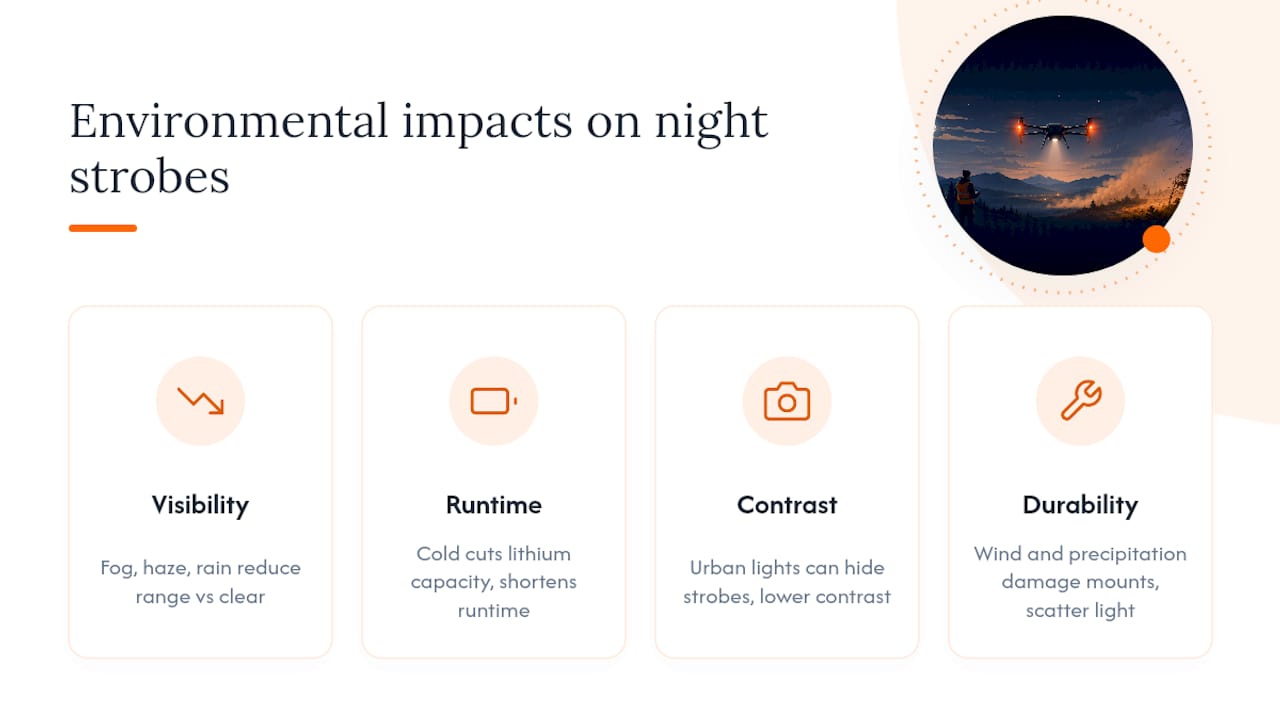
Temperature swings matter too. Cold weather drains lithium battery capacity faster, which shortens strobe runtime exactly when winter’s longer nights demand more of it. If you’re flying in freezing conditions, budget extra runtime margin or keep spare batteries warm until launch.
Ambient light pollution works against you in a different way. A strobe that’s easily seen against a dark rural sky can nearly disappear against a city skyline full of competing lights, signage, and vehicle headlights. Urban night missions call for brighter, higher contrast lighting than the same job would need over open terrain, even though both fall under the identical regulatory minimum.
Wind and precipitation introduce a mounting problem as well. Rain can pool on lens surfaces and scatter light output, while wind driven debris tests the durability of tape or fastener mounts over repeated flights. Matching your gear to the environment, the way tactical lighting guidance recommends across dusk, low-light, and no-light conditions, applies just as directly to commercial drone missions as it does to any other night operation.
What Are the Health and Safety Risks From Drone Lighting?
Bright anti-collision strobes and task lights create real glare risk for ground crew, especially on multi-person commercial shoots where someone is standing close to the launch point. Direct exposure to a high lumen strobe at close range can cause temporary vision impairment, which matters if that person needs to track the aircraft immediately afterward.
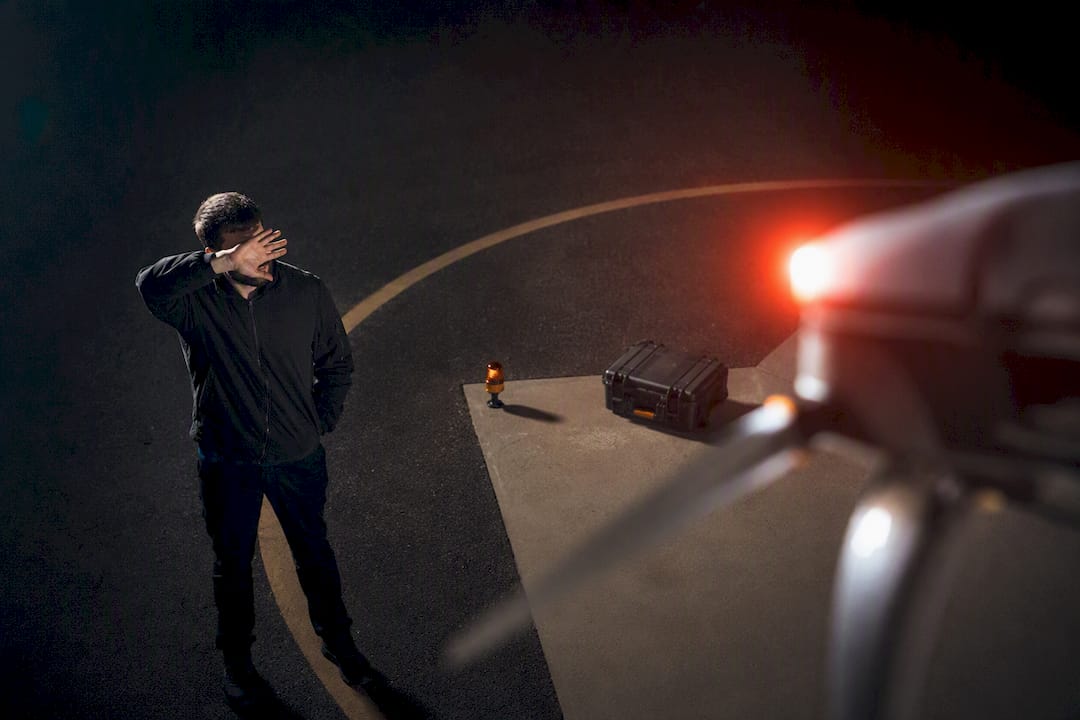
Position lights so their beam pattern favors distant visibility over close range intensity, and brief ground crew to avoid staring directly into any strobe or floodlight during setup. Camera operators face a related problem: an onboard light bleeding into a sensor’s field of view can wash out footage and force a reshoot, so task lighting and camera positioning need to be planned together, not bolted on separately.
Light pollution is a community relations issue as much as a safety one. A bright strobe or floodlight running over a residential area at night can draw noise complaints, prompt calls to local authorities, and damage a pilot’s standing with clients who operate in that neighborhood. Where mission requirements allow it, dimming non-essential lighting during transit legs and only running full brightness during the working portion of the flight reduces friction with the people below you.
Fatigue deserves a mention too. Pilots flying repeated night missions often stare at bright displays and strobes for extended periods, and eye strain accumulates faster after dark than most people expect. Building short breaks into longer night shoots is a simple, low cost way to protect the person actually flying the aircraft.
How Have LEDs and Smart Controls Changed Night Lighting?
LED strobes have replaced older incandescent and xenon based units almost completely in the commercial drone space, and the shift matters for more than just brightness. LEDs draw less power per lumen, run cooler, and survive vibration far better than filament based bulbs, which is a big part of why compact, self-contained anti-collision units became practical in the first place. A strobe that used to require a wired connection to the flight battery now runs for hours on an internal cell the size of a coin.
Smart controls are the next layer. Some current units let pilots adjust strobe rate, switch between flash and steady modes, or change color output from a companion app rather than a physical switch on the housing. That flexibility matters most for pilots who fly a mix of daylight and night missions on the same airframe, since the same light can serve as an orientation aid during the day and switch to full anti-collision compliance mode after dusk without a hardware swap.
The durability gains matter just as much as the smart features. Ruggedized housings, better sealing, and vibration resistant circuit boards mean lights survive rough landings and repeated mounting cycles far better than they did even a few years ago. For commercial operators running the same aircraft dozens of nights a year, that reliability curve, not the marketing spec sheet, is what actually determines total cost of ownership.
An Editorial Take: Compliance Is a Paperwork Problem as Much as a Hardware One
Most pilots treat night lighting as a shopping decision: buy a strobe, mount it, fly. That’s backwards. The hardware side of compliance is genuinely simple, almost any current LED strobe with the right color and strobe rate will satisfy the 3 mile rule if you test it honestly. The part pilots consistently get wrong is proving it after the fact.
An insurance adjuster, a client, or an FAA inspector doesn’t want to hear that your light was probably visible far enough. They want a dated test result, a logged runtime, a maintenance record. Pilots who fly one or two night missions a year can get away with sloppy documentation. Pilots building a commercial night ops business cannot, because eventually someone asks for proof and a memory of “it seemed fine” doesn’t hold up.
That’s the gap an operations manual actually closes, not by making the lighting brighter, but by making the evidence retrievable in thirty seconds instead of thirty minutes. Store your visibility test results and battery logs somewhere structured, and compliance stops being a scramble every time someone asks.
Dronable Keeps Your Night Ops Compliance Paperwork in One Place
Fitting a compliant strobe solves the hardware half of night operations. The other half, proving it, is where most pilots lose time digging through texts, spreadsheets, and old photos when a client or inspector asks for records.

Dronable was built around that gap. SkyScore™ flags airspace risk before you launch, automated flight logs capture mission details without manual entry, and Drone Passport keeps your certifications and credentials in a single verifiable record instead of scattered folders. The Operations Manual tool gives you a structured place to store lighting test results, maintenance schedules, and preflight checklists, so when a client or auditor asks for proof, you’re pulling one file instead of reconstructing a timeline from memory.
For pilots running repeated night missions, that centralized record is the difference between a five minute compliance check and an afternoon of searching. Visit Flydronable or explore the full toolset to see how it fits your current workflow.
Sources
- Drone anti-collision lights - UAV Coach
- Best Drone Anti-Collision Lights (FAA Compliant Strobes) - Droneblog
- Tactical lighting: essential illumination for night operations - MSS Defence
- 5 types of lighting environments in tactical operations - RIX Tactical
FAQ
What color anti-collision lights are FAA compliant?
Only white or red strobes satisfy the FAA’s anti-collision requirement. Green lights, even bright ones, don’t count toward compliance on their own.
How far must a drone’s anti-collision light be visible?
The light must be visible for 3 statute miles under the conditions the FAA specifies for commercial Part 107 night operations. Treat manufacturer visibility claims as a starting point and confirm them with your own field test.
Can I use a steady light instead of a strobe for anti-collision compliance?
No. Anti-collision lights must strobe or pulse; a steady-on light is classified as a navigation or orientation light and does not meet the regulatory requirement on its own.
Do I need lights for twilight flights, not just full darkness?
Yes. FAA night rules begin at the end of civil twilight, so lighting requirements apply before the sky is fully dark. Check the exact twilight times for your location and date rather than assuming based on sunset alone.
Where should I store my drone’s lighting test records?
Keep dated visibility test results, runtime logs, and maintenance records in your operations manual so they’re ready for audits or client requests. Tools like Dronable’s Operations Manual centralize that documentation instead of leaving it scattered across notes and photos.
Recommended
Explore Dronable Tools
Deepen Your Knowledge
Get step-by-step video courses in the Dronable Academy — FAA Part 107, EASA, real estate drone photography, and more.
Browse CoursesFree: How to Start a Drone Business
The complete step-by-step guide to turning your passion for flying into a profitable drone business — completely free.
- 10 steps to launching your drone business
- 51 proven drone business ideas
- How to get FAA certified (Part 107)
- Pricing, clients & recurring income
Join the Dronable Newsletter
Get drone tips, new articles, and exclusive deals straight to your inbox. No spam, unsubscribe anytime.


