60 Question Timed Part 107 Practice Test and FAA Cited Question Bank

60 Question Timed Part 107 Practice Test and FAA Cited Question Bank
This page gives you a timed, 60-question Part 107 practice test plus an extended bank of sample questions organized by the FAA’s knowledge areas, so you drill the exact question types the exam uses. Start with the timed simulation if you feel ready, or jump straight to a weak topic like airspace or weather. Every explanation below traces back to an official FAA source you can verify yourself.
- Focus on mastering airspace altitude notation, especially fractional ceiling and floor values, as these are a common source of errors.
- Practice decoding METAR and TAF weather reports accurately, paying attention to time groups and cloud height details to avoid mistakes.
- Prioritize figure-based questions and use the official CT-8080 supplement during practice to familiarize yourself with real FAA charts and symbology.
- Develop pacing techniques by switching questions if stuck after 90 seconds and treat timed simulations as actual tests to build exam stamina.
- Study the FAA’s official materials regularly, especially the Remote Pilot Study Guide and the regulations, to ensure your information stays current and accurate.
Table of Contents
- Part 107 Practice Test and Sample Questions by FAA Knowledge Area
- How to Use These Sample Questions to Build a Passing Study Plan
- Official Study Materials and Reference Links You Must Use
- Test-Day Tactics, Common Pitfalls, and Figure-Reading Shortcuts
- Why Dronable’s Academy and Operations Resources Help You Study
- Explanation of the Scoring System and How Answers Are Evaluated
- Tricky Part 107 Questions People Consistently Get Wrong
- Strategies for Approaching Multiple-Choice Questions Effectively
- Recent Updates to the Part 107 Exam and What They Mean for Your Prep
- Retaking the Test and Understanding Your Score Report
- An Editorial Take on Practice-First Part 107 Prep
- Sources
Part 107 Practice Test and Sample Questions by FAA Knowledge Area
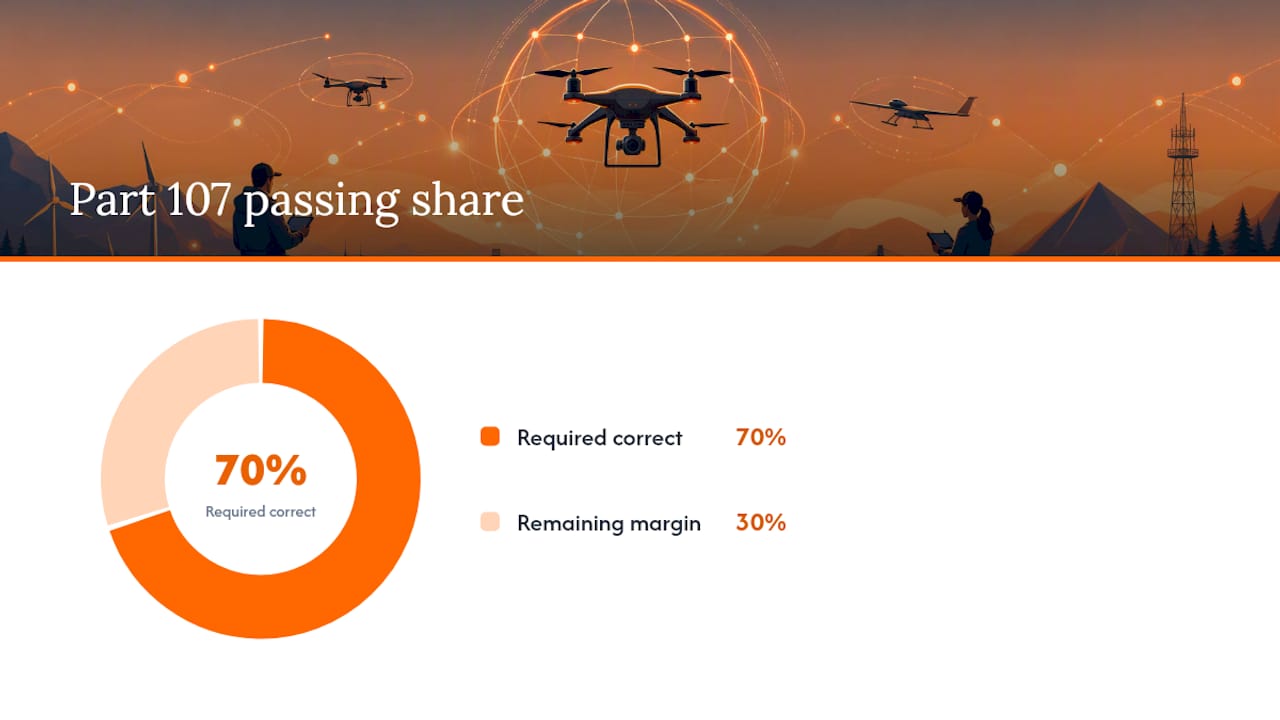
The real Part 107 knowledge test gives you 60 questions and 120 minutes, and you need 70% correct (42 questions) to pass. Anything you practice with should match that clock and that pass line, because pacing habits built in a rushed 20-question quiz do not transfer to a two-hour exam.
A single practice test is not enough on its own. Reputable prep resources typically stack extra questions on top of the set of questions you would see on test day, grouped by knowledge area for repeated exposure to the topics that trip people up most. That redundancy matters because the FAA does not test airspace once and move on. It tests airspace from six different angles across the exam, and if you have only seen one version of a question, you will not recognize the other five.
Here is how the practice bank breaks down by ACS knowledge area, following the same structure the FAA Remote Pilot Study Guide uses to organize test content:
- Regulations (14 CFR Part 107). Covers remote pilot certificate privileges, aircraft registration, waiver requirements, and operating limitations. Roughly a quarter of the real exam lives here.
- Airspace classification and requirements. Class B, C, D, and E airspace rules, authorization through LAANC, and how proximity to airports changes what you can legally fly.
- Weather. METAR and TAF interpretation, how wind and density altitude affect small unmanned aircraft, and cloud clearance requirements.
- Loading and performance. Weight and balance basics, how payload affects flight characteristics, and performance charts.
- Operations. Crew resource management, emergency procedures, and physiological factors like fatigue and hypoxia.
A meaningful share of test questions, including several in the extended bank, require you to read a figure from the FAA testing supplement rather than just recall a fact. That supplement, known as CT-8080, contains the sectional chart excerpts, weather products, and performance tables the real exam pulls from. If you have never opened it before test day, you are studying half the test.
Here is what a typical figure-based question looks like, along with how the answer gets built:
- Correct answer: The number stacked on top of the fraction shown at the chart location (for example, 40/SFC means the ceiling is 4,000 feet MSL, and the number below the line gives the floor).
- Why: Sectional charts print Class B airspace altitudes as a fraction. The top number is the ceiling in hundreds of feet MSL; the bottom number, or “SFC,” is the floor. Misreading which number is which is one of the most common scoring errors on this topic.
- FAA citation: Chart symbology guidance appears in the Remote Pilot Study Guide, which walks through airspace altitude notation as part of the airspace knowledge area.
A non-figure regulatory question runs differently:
Sample question: Under 14 CFR Part 107, what is the maximum groundspeed allowed for a small unmanned aircraft?
- Correct answer: 100 miles per hour (87 knots).
- Why: This limit is written directly into the operating rules and does not vary by aircraft weight class the way some other limits do.
- FAA citation: The exact regulatory language sits in 14 CFR Part 107, and it is worth reading the surrounding sections since altitude and visibility limits appear right next to it.
Weather questions tend to punish memorization without comprehension. A question might give you a raw METAR string and ask whether conditions meet the minimum weather requirements for Part 107 operations. Getting this right means decoding visibility, cloud height, and wind groups in sequence, not just recognizing that “METAR” means “current weather.” The extended bank includes several of these because decoding speed, not decoding knowledge, is usually the bottleneck.
Loading and performance questions are the smallest category by volume but disproportionately confusing because they borrow language from general aviation performance charts. A question might show a chart and ask how increasing payload weight affects climb performance. The answer almost always follows a simple rule: more weight means reduced climb performance and longer takeoff distance, and the chart is just asking you to read that relationship off a graph rather than calculate it.
Operations questions round out the bank with scenario-style prompts. A typical one describes a crew resource management situation, like a visual observer noticing a conflict the remote pilot in command missed, and asks what should happen next. These questions reward common-sense procedural knowledge over memorized figures, which makes them a good warm-up before tackling the harder chart-based items.
How to Use These Sample Questions to Build a Passing Study Plan
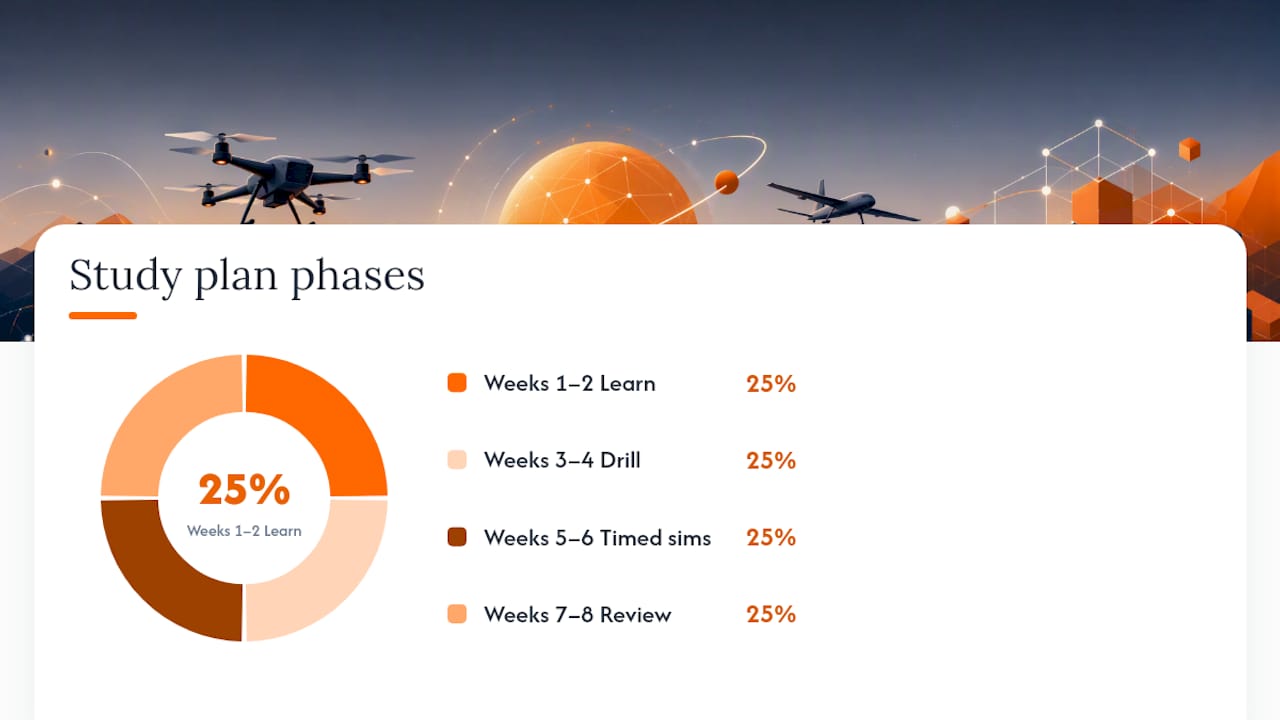
Most people study Part 107 material for two to four weeks, but a six to eight week runway gives you room to actually fix weak areas instead of just recognizing them. Here is a phase-by-phase breakdown that turns question practice into an actual study plan rather than random quizzing.
- Weeks 1 to 2: Learn. Read the FAA Remote Pilot Study Guide cover to cover and take loose notes by knowledge area. Budget 1 to 2 hours per session, 4 to 5 sessions a week. Do not touch timed practice yet.
- Weeks 3 to 4: Drill. Work the categorized sample question bank one knowledge area at a time, untimed, and stop after every wrong answer to read the explanation before moving on. Aim for 45 to 60 minutes daily.
- Weeks 5 to 6: Mixed timed sims. Start running full 60-question, 120-minute practice tests that mix all five knowledge areas the way the real exam does. Take one every two to three days rather than daily. Cramming too many sims too close together teaches you to memorize answer patterns instead of reasoning through new figures.
- Weeks 7 to 8: Review and close gaps. Go back through every missed question from your sims, sorted by knowledge area, and drill only those categories until your error rate flattens out.
Running an effective timed sim means treating it like the real thing, not a casual quiz. Use the actual CT-8080 figures rather than simplified versions, set a visible 120-minute countdown, and practice marking a question for review instead of freezing on it. On the real test, you can flag a question and return to it later, and building that habit now saves minutes you will need for figure-heavy items. Keep an error log with three columns: the question topic, why you got it wrong, and what you will do differently next time. That third column is the one most people skip, and it is the one that actually changes your score.
Prioritize by frequency and failure rate, not by personal interest. Airspace, weather decoding (METAR and TAF specifically), and sectional chart reading show up constantly across the exam and account for a disproportionate share of failed attempts, largely because figure familiarity, not underlying knowledge, is usually the real gap. Someone who understands airspace classes perfectly can still miss a chart question simply because they have never located a floor altitude notation under time pressure.
Track two numbers as you go: percent correct by knowledge area, and average time per question. If your average time on figure questions is creeping past 2 minutes each, that is a pacing problem, not a knowledge problem, and it needs a different fix than re-reading the regulation.
Pro Tip: Build your error log in a simple spreadsheet with a column for the exact figure number from CT-8080 if the question involved one. Patterns show up fast once you can filter by chart type instead of just “airspace” or “weather.”
Official Study Materials and Reference Links You Must Use
The FAA is explicit about which materials it considers authoritative for knowledge test prep, and every credible prep course, including this one, ultimately points back to the same handful of documents. Skipping them in favor of secondhand summaries is how small factual errors creep into your understanding.
- FAA Remote Pilot Study Guide. This is the master document. It maps every ACS knowledge area to the content you need to know, and the FAA itself recommends it as a primary study resource alongside the Airman Certification Standards for UAS. Read it once fully, then use it as a reference during drills.
- FAA online sample questions and the CT-8080 testing supplement. The sample questions PDF gives you real FAA-authored items, and CT-8080 supplies the exact figures those questions reference. Practicing with anything other than the real supplement means you are training on charts that look different from what you will see on test day.
- 14 CFR Part 107 (eCFR). When a sample question hinges on an exact number, like maximum altitude or minimum visibility, the regulatory text itself is the tiebreaker. Study guides paraphrase; the regulation does not.
- NOTAM and briefing tools. PilotWeb and the FAA’s NOTAM search give you live briefing data, which is useful less for the knowledge test itself and more for building the habit of checking current airspace restrictions before you fly commercially after certification.
- FAA digital aeronautical data products. Current sectional charts and aeronautical data from the FAA’s digital products library let you practice reading real, up-to-date charts rather than static textbook excerpts that may lag behind actual airspace changes.
Treat these five sources as a loop, not a checklist. Read the study guide, drill sample questions, hit a wall on a figure, go back to CT-8080 or the eCFR to resolve it, then return to drilling. That loop is slower than passively reading a summary article, and it is also the reason people who use primary sources tend to score higher on the figure-heavy portions of the exam.
Test-Day Tactics, Common Pitfalls, and Figure-Reading Shortcuts
Pacing is the single biggest lever you control on test day. With 60 questions and 120 minutes, you have an average of 2 minutes per question, but that average is misleading. Regulatory recall questions should take you 20 to 30 seconds. Figure-based questions deserve most of your time budget, sometimes 3 to 4 minutes, because you are locating data on a chart, not just recalling a fact.
A simple rule keeps you on track: if you have not made progress on a question after 90 seconds, mark it for review and move on. Coming back to a hard question with 20 minutes of buffer left feels completely different from staring at it cold with the clock at zero.
For any figure-based item, run the same four-step workflow every time instead of improvising:
- Identify exactly what the question is asking for (a floor altitude, a visibility minimum, a fuel weight).
- Find the legend or scale on the figure before you start scanning for the answer.
- Convert units only if the question specifically requires it. Do not add unnecessary math.
- Check for any airspace or altitude note near your target location that might change the answer.
This sequence matters because most figure-question errors come from unfamiliarity with the chart layout, not from a knowledge gap about the underlying rule. Rushing straight to the answer choices without locating the legend first is the most common way people burn time and still get it wrong.
Three mistakes account for a disproportionate share of missed points. First, confusing AGL and MSL altitude references, especially on questions that mix both in the same chart. Second, mixing up METAR and TAF time groups, since TAF forecasts use a different reporting window than current METAR observations. Third, applying general aviation intuition to small unmanned aircraft limits, particularly around visibility and cloud clearance, where Part 107 numbers do not always match manned-aircraft rules.
Some exam items are unscored validation questions the FAA uses to test future material, and you cannot tell which ones they are. Do not let an unusually worded or unfamiliar question rattle you. Answer it with your best reasoning, mark it if uncertain, and move forward. Dwelling on a single strange question is a worse use of your 120 minutes than accepting you might miss it and protecting your pace on the rest of the exam.
Why Dronable’s Academy and Operations Resources Help You Study
Passing the knowledge test is the checkpoint. Operating legally and profitably afterward is the actual goal, and that is where most standalone study guides stop helping you.
Dronable’s Academy builds its certification prep around the same knowledge areas covered here, with timed simulations designed to mirror the 120-minute exam window rather than short quiz formats that do not build real pacing habits. The Operations Manual picks up where the test leaves off, translating regulatory knowledge into documented procedures you will actually reference on paid jobs.
A few ways the platform connects study to practice:
The platform offers features connecting study to practice, such as timed simulation drills that track performance by knowledge area, airspace safety logic applied to real flight planning, digital credentials documenting certification status, and automated flight logs that help build a compliance record from the start of commercial flying.
The gap between passing a knowledge test and running a compliant commercial operation is wider than most new pilots expect. Airspace rules you memorized for 60 multiple-choice questions turn into daily judgment calls once real clients and real airspace are involved.
Check the Academy for the current simulation library and cited practice material, and browse the blog for ongoing study tips as exam content evolves.
Explanation of the Scoring System and How Answers Are Evaluated
The Part 107 knowledge test is scored simply: each question is worth one point, and you need to achieve a passing percentage to pass. There is no partial credit and no penalty for guessing, which means an unanswered question and a wrong answer cost you the same single point.
The exam includes both operational, scored questions and some experimental, unscored items the FAA uses to validate future test content. You will not know which category a given question falls into, so every question deserves your full attention regardless of how unfamiliar it feels.
Your score report after the test shows your overall pass or fail result along with a breakdown of performance by knowledge area, called the Airman Knowledge Test Report. If you fail, this report is the single most useful document you will get, because it tells you exactly which ACS areas dragged your score down rather than leaving you guessing. Bring it into your next study cycle and weight your remaining prep time toward whatever category the report flags weakest.
The passing threshold is fixed regardless of how the mix of questions falls across knowledge areas on your specific test form, since the FAA pulls from a larger question pool and no two test forms are identical. That is exactly why breadth in your practice matters more than memorizing one narrow question set.
Tricky Part 107 Questions People Consistently Get Wrong
A handful of question types show up in almost every failed attempt, and they tend to fail for predictable reasons rather than pure ignorance.
Airspace altitude notation. Questions asking for a specific airspace floor or ceiling using sectional chart fractions trip people up because they misread which number represents the top versus the bottom of the airspace. The fix is mechanical: the number above the line is always the ceiling, the number below (or “SFC”) is always the floor.
METAR versus TAF time groups. A question might give a TAF and ask what conditions are forecast for a specific future hour, and test-takers often apply the reporting logic of a METAR instead, which describes only the current moment. TAF reports use a validity period written in a different format, and mixing the two formats up is the single most common weather-question error.
Right-of-way and operational limitation questions. Some questions test whether small unmanned aircraft yield to manned aircraft in ways that mirror general aviation rules closely enough to feel familiar, but Part 107 has its own specific right-of-way language that does not always match instinct. Reading the regulation text directly resolves this faster than relying on assumption.
Density altitude effects on performance. Questions describing hot, high-elevation conditions and asking about aircraft performance often get missed because test-takers apply the wrong direction of effect, forgetting that higher density altitude reduces performance rather than improving it.
Strategies for Approaching Multiple-Choice Questions Effectively
Every Part 107 question gives you three answer choices, which means process of elimination is often faster than trying to recall the exact correct answer from memory. Read all three choices before committing, because the FAA frequently includes one answer that is factually plausible but answers a slightly different question than the one actually asked.
Eliminate answers that require a fact you can disprove outright, even if you are unsure about the remaining options. On regulatory questions, watch for absolute language like “always” or “never” in an answer choice. Part 107 has enough conditional rules that an absolute statement is often the wrong choice, though not universally, so treat this as a flag to double-check rather than an automatic elimination.
For figure-based questions, resist the urge to look at the answer choices first. Work out what the chart or table actually shows, form your own answer, then match it to the closest choice. Looking at answer choices before analyzing the figure invites you to reason backward and talk yourself into a plausible-sounding wrong answer.
When two answer choices seem almost identical except for one number or word, that difference is almost always the entire point of the question. Slow down on those specifically rather than rushing past them assuming either one is probably fine.
Finally, do not change a marked answer during your review pass unless you find a specific reason tied to the figure or regulation. Second-guessing a correct answer based on vague unease usually costs more points than it saves.
Recent Updates to the Part 107 Exam and What They Mean for Your Prep
The FAA periodically refreshes its question pool and testing supplement to reflect regulatory changes, most notably updates tied to Remote ID requirements and evolving airspace authorization procedures through LAANC. These changes do not happen on a fixed annual schedule, so the safest habit is checking the FAA’s official study materials page shortly before you schedule your test date rather than relying on a study guide’s publication date alone.
Sample question banks that stay current tend to reflect these shifts by updating scenario language around remote identification compliance and airspace authorization workflows, even when the underlying regulatory citation in 14 CFR Part 107 has not changed. A question that once asked generically about airspace authorization might now specifically reference LAANC as the primary authorization pathway, since that is how most operators actually request access today.
The core knowledge areas themselves, regulations, airspace, weather, loading and performance, and operations, have remained structurally stable, so a study plan built around the ACS framework will not become obsolete overnight. What changes more often is the specific scenario wrapping around a question, not the underlying rule being tested. That is one more reason to study from the current Remote Pilot Study Guide rather than a secondhand summary that might be citing an older regulatory framework.
Retaking the Test and Understanding Your Score Report
If you fail, you can retake the Part 107 knowledge test, though the FAA requires a 14-calendar-day waiting period before you can sit for it again. Use that window deliberately instead of just re-scheduling and hoping for better luck.
Your Airman Knowledge Test Report breaks your result down by ACS knowledge area, and that breakdown is more valuable than the pass or fail number itself. If your report shows weakness concentrated in airspace and weather, spend the full 14 days almost exclusively on those two categories rather than reviewing everything evenly. Generic review rarely fixes a specific problem.
Before retaking, run at least two or three fresh full-length timed sims that mix all knowledge areas, not just the ones you failed. A retake failure caused by weak time management in a category you previously passed is common and entirely avoidable with proper pacing practice.
Keep your original score report until your retake is scheduled. It is the clearest evidence you have of exactly where your knowledge gaps sit, and comparing it against your retake result afterward tells you whether your targeted review actually worked or whether you need a different study approach entirely for that category.
An Editorial Take on Practice-First Part 107 Prep
Most Part 107 advice overweights content review and underweights figure fluency. The research behind this exam is fairly clear: candidates fail less because they do not know the rules and more because they cannot read a chart fast enough under pressure. That is a mechanical skill, not a knowledge gap, and it needs repetition against real CT-8080 figures, not another paragraph explaining airspace classes.
The conventional advice to “study until you feel ready” also falls short because it has no feedback loop. An error log sorted by knowledge area beats a feeling of readiness every time, because it tells you precisely where your remaining risk sits instead of asking you to guess.
If you take one thing from this page, prioritize timed, figure-heavy sims over passive review in your final two weeks. Reading about sectional charts teaches you vocabulary. Locating a floor altitude under a countdown clock teaches you the actual skill the exam is measuring.
Sources
- Where can I find study materials for the Part 107 aeronautical knowledge test? | Federal Aviation Administration
- Remote Pilot - Small Unmanned Aircraft Systems Study Guide | FAA
- eCFR — Title 14, Chapter I, Subchapter F, Part 107
- PilotWeb | FAA
Recommended
Explore Dronable Tools
Deepen Your Knowledge
Get step-by-step video courses in the Dronable Academy — FAA Part 107, EASA, real estate drone photography, and more.
Browse CoursesFree: How to Start a Drone Business
The complete step-by-step guide to turning your passion for flying into a profitable drone business — completely free.
- 10 steps to launching your drone business
- 51 proven drone business ideas
- How to get FAA certified (Part 107)
- Pricing, clients & recurring income
Join the Dronable Newsletter
Get drone tips, new articles, and exclusive deals straight to your inbox. No spam, unsubscribe anytime.


