ARROW+T for Pilots: Real Estate Drone Pricing with Dronable
ARROW+T for Pilots: Real Estate Drone Pricing with Dronable
Price real-estate drone work by the deliverable or by the day, not by the hour, and build every quote around three cost blocks: preflight planning and compliance, capture time, and postproduction. Reserve hourly rates for scope you cannot estimate in advance. Offer retainers to repeat clients, and when a buyer pushes back on cost, cut scope before you cut your rate.
- Flat project-based pricing with clear scope and deliverables maximizes profitability and reduces scope disputes, especially with tiered packages.
- Properly calculating costs using the ARROW+T method ensures minimum pricing floors cover all fixed and variable expenses before setting a profit margin.
- Retainers provide predictable income and priority scheduling without resorting to discounts, by adjusting scope or turnaround times instead.
- Price adjustments for rush work, licensing, and add-ons like twilight shots or 3D tours can significantly increase revenue without altering base packages.
- Automated tools for proposals, compliance logs, and credentialing cut admin time, enabling higher rates and faster client approvals.
Table of Contents
- What’s the Best Pricing Model for Real Estate Drone Jobs?
- How Do You Calculate a Fair Drone Photography Price?
- What Should a Real Estate Drone Package Include?
- What Belongs in Every Drone Photography Contract?
- How Do Retainers and Negotiation Protect Your Rates?
- Your 90-Day Path From Underpriced to Booked Solid
- How Dronable Cuts Quoting Friction and Protects Your Margin
- What Pricing Mistake Costs Pilots the Most Money?
- Sources
What’s the Best Pricing Model for Real Estate Drone Jobs?
Real estate drone pricing works best when it’s tied to a deliverable, not a clock. A client buying “12 edited photos and a 60-second video, delivered in 48 hours” understands exactly what they’re paying for. That’s the model most profitable operators default to, according to the operator pricing framework built around ARROW+T, and it’s the one Flydronable’s own quoting tools are built to support.
Day rates make sense when the job itself is unpredictable. A rural acreage listing, a commercial property with security clearance delays, or a multi-building inspection can eat hours you didn’t budget for. A flat day rate protects you from access problems and site complexity that a fixed-deliverable quote can’t absorb.
Hourly pricing has a narrow, defensible use: change orders, on-site client direction, or open-ended consulting. Outside that, it punishes you for getting fast. The better you get at editing a listing package, the less an hourly rate pays you for the same result.
Retainers solve a different problem: unpredictable income. A brokerage that books you for four listings a month at a set retainer gets guaranteed scheduling priority; you get a locked revenue floor and a lower per-visit rate that still nets more than one-off jobs once you factor in reduced sales time.
A few pricing levers apply across every model:
- Usage and licensing terms change the price. A listing photo used only on the MLS costs less than the same photo licensed for a paid ad campaign.
- Rush turnaround (same-day or next-day delivery) justifies a premium add-on depending on deliverable complexity and compressed editing time, per rush pricing guidance for drone service quotes.
- Package-based pricing reduces scope disputes because the client sees exactly what’s included before you fly.
How Do You Calculate a Fair Drone Photography Price?
Start with your costs, not a number that feels right. Fixed costs include equipment depreciation, insurance, software subscriptions, and any platform fees. Variable costs include travel, second-pilot help, and permit fees for restricted airspace.
From there, the ARROW+T method breaks a quote into six pieces you calculate once and reuse on every job:
- Average rate: your internal hourly benchmark, covering salary-equivalent pay plus overhead.
- Rough time on site: how long the flight and ground setup will actually take.
- Remaining work: editing, color correction, and video assembly after you leave the property.
- Other costs: permits, second-shooter fees, or software exports.
- Wear and tear: a per-job allowance for battery cycles, prop replacement, and gimbal wear.
- +Travel: mileage or drive time to and from the property.
Pro Tip: Run the ARROW+T math once per market tier (say, under $500,000 listings vs. luxury) and save each result as a template. Recalculating from scratch every time is where pilots lose margin.
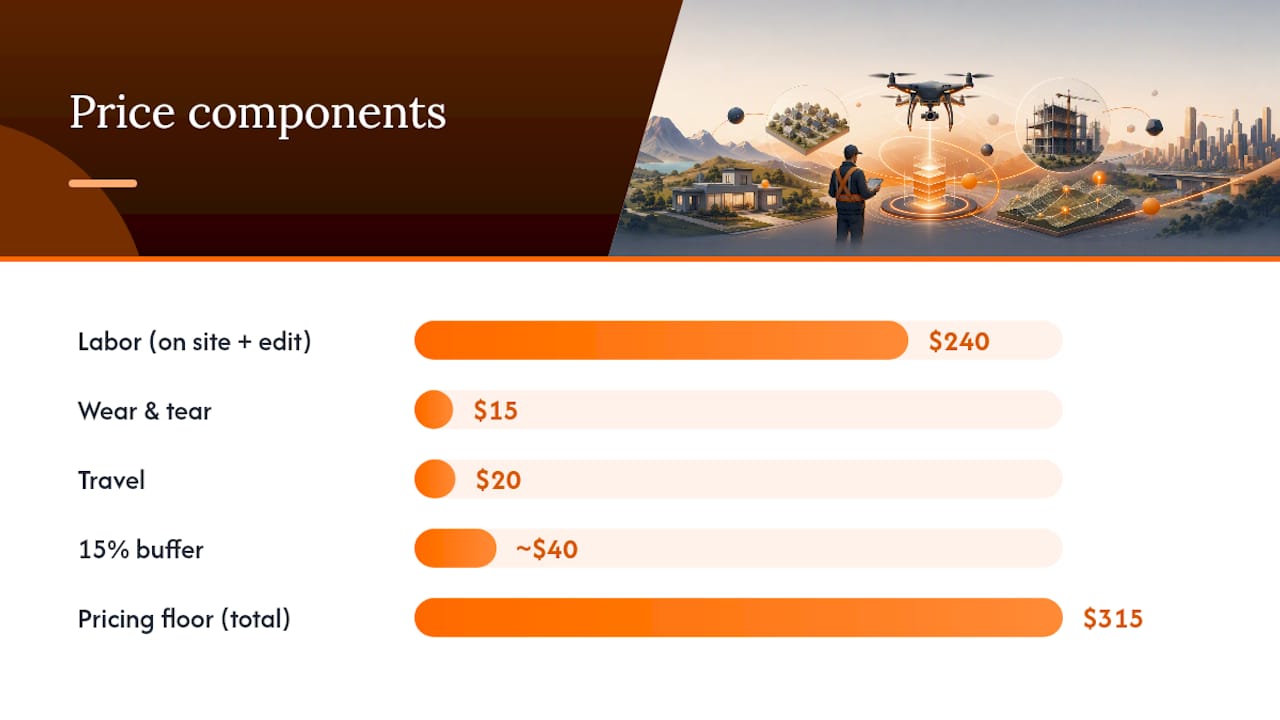
Here’s a compact example: 1 hour on site, 3 hours of editing, an internal rate of $60/hour, $15 in wear and tear, and $20 in travel. That’s 4 billable hours at $60 ($240), plus $35 in other costs, for a $275 baseline. Add a 15 percent buffer for weather delays or client approval loops, and you land near $315. That becomes your floor, not your listed price. Most operators also set an absolute minimum project fee, often $150 to $200, so a small job never pays below what it costs to show up. Keep your $60 average rate as an internal number only. Clients see the package price, not the math behind it.
What Should a Real Estate Drone Package Include?
Publishing three tiers instead of a single price sheet does two things: it gives agents a decision to make instead of a yes-or-no, and it lets you upsell without renegotiating from scratch. A workable structure looks like this:
- Basic: 10 to 15 edited photos, no video, 2 to 3 business day turnaround, one revision round.
- Standard: 15 to 20 edited photos plus a 60 to 90 second video, 2 to 3 day turnaround, two revision rounds.
- Premium: full photo and video package plus one add-on (twilight shots or a walkthrough), rush turnaround available, unlimited minor revisions.
Sample US market ranges run from basic to luxury packages with increasing pricing tiers, depending on package complexity and services included, according to pricing bands compiled across drone real estate operators. Rural markets and secondary cities tend to sit at the low end; luxury and high-density urban markets, where competition for listings is fiercer and marketing budgets are bigger, push toward the top.
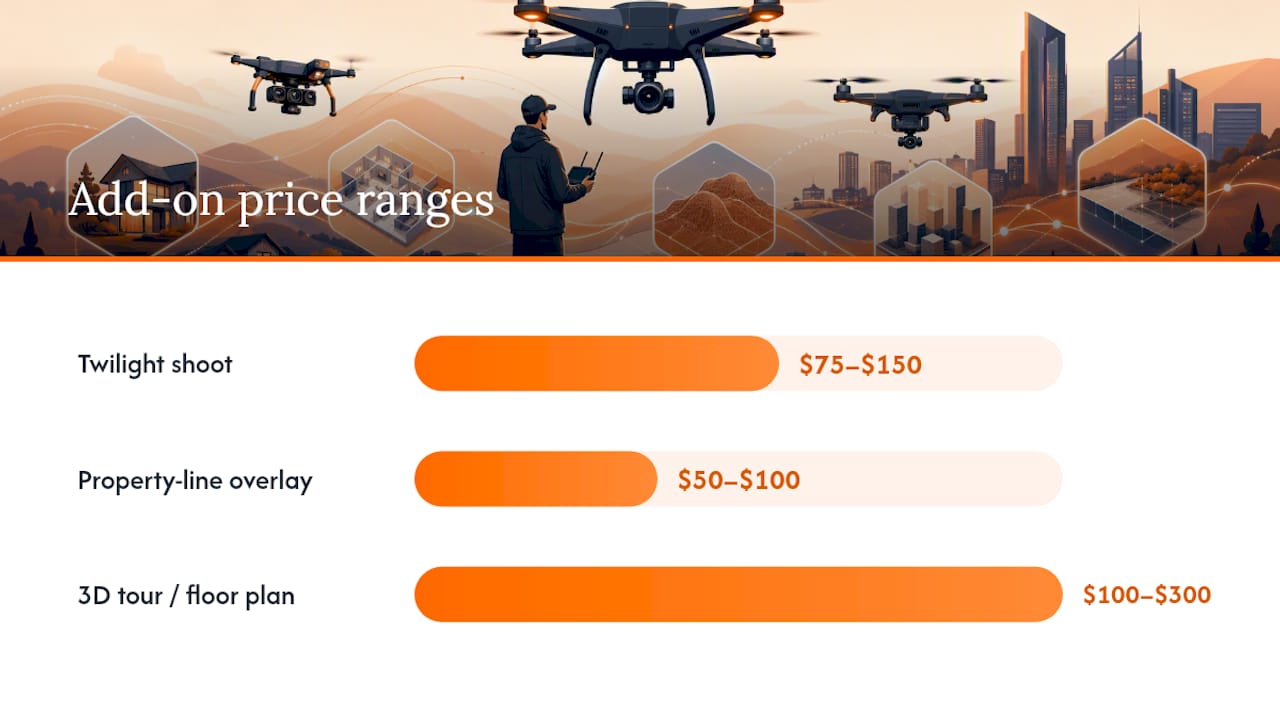
Add-ons carry their own price deltas rather than folding into the base package: twilight shoots often add $75 to $150 for the extra scheduling constraint, property-line overlays add $50 to $100, 3D tours and floor plans can add $100 to $300 depending on square footage. Every package should also state file format (JPEG vs. RAW), resolution, delivery method (cloud link vs. direct upload to MLS), and whether usage rights cover just the listing or extend to paid advertising.
What Belongs in Every Drone Photography Contract?
A proposal that doesn’t define its own edges invites scope creep. State exactly what’s included: deliverable counts, file formats, turnaround window, and how many revision rounds are free. Quotes that spell out turnaround tiers, licensing terms, and what falls outside scope close faster because the client isn’t guessing what happens if they ask for more.
Cover these items every time:
- Licensing and usage rights, with a stated add-on price for paid ad campaigns or extended commercial use.
- A reshoot policy: who pays if weather or a canceled appointment forces a second visit.
- A cancellation clause and a brief note on liability insurance coverage.
- Payment terms: deposit percentage, due date, and accepted methods.
A standard proposal specifies edited image counts, video length, and a turnaround window, typically 2 to 3 business days, so the client knows exactly what “done” looks like before you show up.
Pro Tip: Copy this scope starter directly into your next proposal: “This quote includes [X] edited photos and a [Y]-second video, delivered within [Z] business days, with [N] revision rounds. Additional edits, rush delivery, or extended usage rights are billed separately.”
How Do Retainers and Negotiation Protect Your Rates?
A retainer trades a lower per-visit rate for guaranteed volume. A typical structure: four listings a month at a fixed monthly fee, with a stated per-visit overage rate for anything beyond that and a rollover policy for unused visits, so neither side gets shortchanged when a slow month happens. That structure gives agents priority scheduling and a predictable per-visit scope, which is exactly what brokerages with steady listing volume want to buy.
When a client asks for a lower number, the answer isn’t a discount. It’s a smaller job:
- Offer raw, unedited files instead of a full edit pass.
- Extend turnaround from 48 hours to five business days.
- Drop video and deliver photos only.
Preserving rate integrity means the package changes size, not the price tag attached to your standard offer. Discount the same package twice and every future client expects the same treatment.
Platform tools cut the admin time that otherwise gets baked into your risk buffer. Proposal templates, automated flight logs, and digital credentials mean less manual paperwork per job, which lowers the padding you’d otherwise add to cover admin hours. Raise rates with existing clients once you’ve delivered three or more jobs at a consistent quality bar. Frame it around added value, like faster turnaround or a new deliverable, not just rising costs.
Your 90-Day Path From Underpriced to Booked Solid
Build a portfolio of 3 to 5 properties before you touch full-price quoting. New operators who offer a couple of discounted shoots to local agents in exchange for usable gallery content close their next five deals faster because they’re showing real work, not stock samples.
Publish your three package tiers and a stated minimum fee. Ambiguous pricing is what invites lowball negotiation.
Track actual hours on your next five jobs against your ARROW+T estimate, then recalculate your baseline. Most pilots find their editing time was underestimated, not their flight time.
Automate proposals and compliance logging wherever you can. Every hour saved on admin is an hour you can put toward a job that actually pays.
How Dronable Cuts Quoting Friction and Protects Your Margin
Every buffer you add to a quote, whether it’s for weather delays, airspace approval, or admin time, is a buffer a client is paying for. Reduce the buffer and you can hold your rate without discounting.
Deal Studio gives you proposal templates built around the deliverable-based pricing this guide covers, so you’re not rebuilding a quote from scratch for every listing. SkyScore™ handles airspace safety checks automatically, which shrinks the time you’d otherwise spend manually verifying clearance before flight. Drone Passport stores your digital credentials, so a client or brokerage can verify your certification status without a back-and-forth email chain that delays approval.
Picture a standard listing job: a proposal template cuts quote-drafting from twenty minutes to five, and an automated flight log means you’re not reconstructing compliance records after the fact if a client or insurer asks. That’s less admin time baked into your rate, and a faster client approval cycle.
Brokerages evaluating aerial vendors also want confidence in how a pilot presents work, something covered in more depth in resources on aligning proposals to brokerage workflows. Explore the Dronable tools built for exactly this, or start with the platform itself to see how proposal, compliance, and credentialing tools fit into your next quote.
What Pricing Mistake Costs Pilots the Most Money?
The biggest mistake isn’t undercharging on any single job. It’s pricing without a repeatable method, which means every quote is a fresh negotiation with yourself. Pilots who adopt something like ARROW+T stop guessing because the number comes from an actual calculation, not a feeling about what the market will bear.
The second mistake is treating retainers as a discount instead of a trade. A retainer should lower your sales overhead and guarantee your calendar, not just shave dollars off your rate for the sake of the relationship. If a retainer client isn’t giving you predictable volume in return, it’s not a retainer. It’s a discount with a nicer name.
Pilots who track their real hours against their estimates, even for just five jobs, almost always discover their postproduction time was underpriced. That’s the block most new operators guess wrong, because it happens away from the client and feels invisible until you actually log it.
Sources
- Operator pricing framework and ARROW+T example
- Drone real estate photography: pricing bands and package examples
- Business planning, portfolio building, and tiered packages for drone real-estate operators
Recommended
Explore Dronable Tools
Deepen Your Knowledge
Get step-by-step video courses in the Dronable Academy — FAA Part 107, EASA, real estate drone photography, and more.
Browse CoursesFree: How to Start a Drone Business
The complete step-by-step guide to turning your passion for flying into a profitable drone business — completely free.
- 10 steps to launching your drone business
- 51 proven drone business ideas
- How to get FAA certified (Part 107)
- Pricing, clients & recurring income
Join the Dronable Newsletter
Get drone tips, new articles, and exclusive deals straight to your inbox. No spam, unsubscribe anytime.


