Remote Pilot in Command: Legal Duties Under Part 107

Remote Pilot in Command: Legal Duties Under Part 107
The Remote Pilot in Command is the certificated person holding final authority over a small drone operation. Their core legal duty, spelled out in 14 CFR §107.19, is making sure the flight will not cause undue hazard if control is lost. Carry your Remote Pilot Certificate and photo ID during flight, and keep your recurrent training current. That’s the whole obligation in one sentence.
- The Remote Pilot in Command must designate themselves before flight and retain final authority over the operation, including bypassing client or observer input when necessary.
- Certification through FAA IACRA and the Part 107 exam requires passing a 60-question test with an 82.96% national pass rate, and retakes cost $175 with a 14-day waiting period.
- Final authority entails making urgent go or no-go decisions that override others, especially in situations involving risk to people, property, or airspace restrictions.
- Transferring Remote PIC control mid-flight is legal only if both pilots hold valid certificates, communication is clear, and the new PIC maintains visual line of sight and control.
- Preparing thoroughly with pre-flight checks, documentation, and recurrent training ensures compliance, reduces legal risk, and supports responsible drone operation.
Table of Contents
- What 14 CFR §107.19 Actually Requires
- Who Can Be Remote PIC and How to Get Certified
- What Final Authority Actually Means in Practice
- When and How Remote PIC Can Be Transferred
- A Practical Checklist for Avoiding Undue Hazard
- Staying Current: Recurrent Training Requirements
- How Documentation Tools Reduce Legal Exposure
- What Separates a Safe Remote PIC From a Risky One
- Manage Your Remote PIC Duties in One Place
- Sources
What 14 CFR §107.19 Actually Requires
Section 107.19 is short, but every clause carries weight. A Remote PIC must be designated before or during the operation. Skipping this step, even informally, means no one holds legal accountability if something goes wrong.
The rule also names the Remote PIC as directly responsible and the final authority for the operation. That phrasing matters. It means no client, employer, or visual observer can override a Remote PIC’s decision, and no one else absorbs the legal responsibility when a flight breaks a rule.
The last piece is the “no undue hazard” clause: the Remote PIC must ensure the operation won’t endanger people, aircraft, or property if the aircraft loses control. Regulators read this alongside the careless or reckless operation rule, so a violation here often triggers a broader enforcement look.
In practice, §107.19 breaks down into three obligations:
- Designate a Remote PIC before the aircraft leaves the ground.
- Accept final authority and direct responsibility for the entire flight.
- Confirm, in advance, that a control failure won’t put people or property at risk.
Who Can Be Remote PIC and How to Get Certified
Anyone at least 16 years old, able to read, speak, write, and understand English, and in suitable physical and mental condition to fly safely can qualify. No medical certificate is required, unlike manned aviation.
Certification runs through three steps:
- Create an FAA Tracking Number by starting an application through IACRA, the FAA’s online certification portal.
- Schedule and pass the Part 107 knowledge test. PSI administers the exam and collects a $175 fee at booking. The test covers 60 questions on airspace, weather, regulations, and operations.
- Complete your IACRA application and TSA background check. Once cleared, you can print a temporary certificate immediately; the permanent plastic card typically arrives by mail within a few weeks.
The 2025 national pass rate sat at 82.96%, with test-takers averaging 79.31%. A retake also costs $175 and carries a mandatory 14-day waiting period, so a failed attempt is not cheap in time or money.
Structured courses like Dronable’s Academy update their question banks for current airspace and Remote ID rules, which matters since outdated study material is a common reason pilots fail on the first try.
What Final Authority Actually Means in Practice
Final authority isn’t a title. It’s the power, and the obligation, to make go or no-go calls that override anyone else on site, including a client who wants to fly in marginal weather.
That authority comes with matching responsibility. The Remote PIC must confirm mitigations exist so a lost link or a runaway motor doesn’t turn into a hazard to bystanders or property. This holds even when someone else is physically manipulating the controls, since the Remote PIC can be designated separately from the person flying.
Conduct that can violate the rule includes:
- Flying over people without an applicable waiver or category compliance.
- Ignoring known airspace restrictions or active NOTAMs.
- Allowing an untrained visual observer to serve as the only fallback for maintaining visual line of sight.
- Continuing a flight after a system warning signals loss of GPS lock or battery failure.
The FAA’s enforcement pattern shows a consistent theme: investigators treat the “no undue hazard” clause as the anchor violation, then stack on careless-or-reckless charges once one is triggered. A university aviation policy reference frames this the same way outside FAA channels: the Remote PIC is the final safety authority, full stop.
When and How Remote PIC Can Be Transferred
Transferring the Remote PIC role mid-flight is legal, but only under specific conditions. Both people involved must hold a Remote Pilot Certificate, and the person accepting control must be able to maintain visual line of sight and positive control the moment the transfer happens.
The handoff itself needs clear, positive communication. A phrase like “you have control” followed by acknowledgment works; a nod or an assumption does not. Legal commentary on §107.19 notes that ambiguous handoffs are a recurring issue in incident reports, because responsibility gets contested after the fact.
Common legitimate scenarios include:
- A long survey mission where one certificated pilot flies the departure and another takes over for a different mission phase.
- A shift changes during multi-hour operations, such as extended infrastructure inspection flights.
- Splitting duties between takeoff/landing and cruise phases when both pilots are rated and briefed.
A Practical Checklist for Avoiding Undue Hazard
Meeting the “no undue hazard” standard isn’t abstract. It comes down to a short sequence of checks before the propellers spin.
- Check airspace status. Pull current NOTAMs and confirm LAANC authorization if you’re in controlled airspace.
- Verify Remote ID compliance. Confirm the aircraft is broadcasting correctly or is operating from a FAA-recognized identification area.
- Assess weather and visibility. Confirm conditions support maintaining visual line of sight for the entire flight.
- Brief the crew. Assign visual observer duties and confirm who holds Remote PIC authority before launch.
- Set physical mitigations. Establish exclusion zones, coordinate with ATC if near an airport, and plan a return-to-home contingency if the aircraft isn’t equipped with automatic RTH.
Pro Tip: Log every mitigation decision, not just the flight itself. A written note that says “exclusion zone set at 50 feet, visual observer briefed” is what separates a defensible operation from a guess if an investigator asks questions later. A documented operations manual makes this step automatic instead of an afterthought.
Staying Current: Recurrent Training Requirements
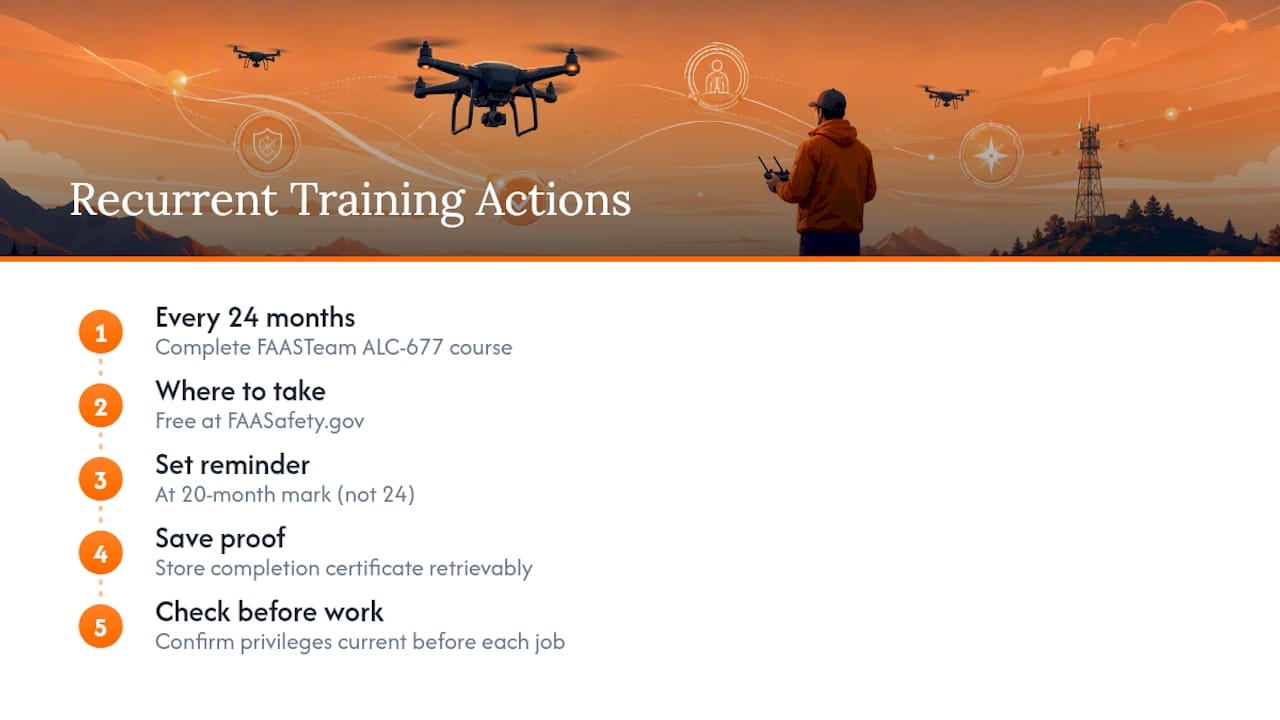
A Remote Pilot Certificate doesn’t expire, but the privileges attached to it lapse without action. Every 24 calendar months, you must complete recurrent training through FAASTeam, using course ALC-677, available free through FAASafety.gov.
Recurrent training differs from the initial knowledge test in scope. It’s shorter and focuses on regulatory updates rather than testing baseline aviation knowledge from scratch. Skipping it doesn’t just risk a fine. It means you’re legally flying without valid Remote PIC privileges, which undermines every other compliance step you’ve taken.
Set a calendar reminder at the 20-month mark, not the 24-month deadline, and save your completion certificate somewhere retrievable. Confirming this is current before every job is standard due diligence in supporting materials on the certification process.
How Documentation Tools Reduce Legal Exposure
An operations manual and organized records don’t replace a Remote PIC’s judgment, but they do create the paper trail investigators and clients expect. Automated flight logs establish exactly when, where, and under what conditions a flight happened. Stored credentials confirm certification status without a scramble before a job.

Tools like Dronable’s platform map directly onto §107.19 duties: SkyScore™ scores airspace risk before launch, a Drone Passport keeps certification and recurrent training records in one place, and automated logs timestamp the mitigations you put in place. None of it substitutes for the Remote PIC’s actual decision-making. It just makes that decision-making visible after the fact.
What Separates a Safe Remote PIC From a Risky One
Discipline in exam prep tends to carry over into flight discipline. Pilots who study until they consistently score well above the pass threshold, rather than cramming to barely clear it, tend to make more conservative go or no-go calls in the field too.
The habit that matters most is logging everything, even decisions that seem obvious in the moment. Undue hazard claims get argued after an incident, not during one, and a documented mitigation is worth more than a good memory.
Manage Your Remote PIC Duties in One Place
Meeting every §107.19 obligation manually means juggling a certificate, a training calendar, an airspace check, and a flight log across separate apps. Dronable puts all four in one workspace, so nothing slips between jobs.

SkyScore™ flags airspace risk before you launch. Drone Passport stores your Remote Pilot Certificate and recurrent training proof so you’re never scrambling before a client job. Automated flight logs timestamp your mitigations automatically, and the Academy keeps your exam prep and recurrent training on schedule. Set up your Dronable account and get your first operation documented correctly from takeoff.
Sources
Recommended
Explore Dronable Tools
Deepen Your Knowledge
Get step-by-step video courses in the Dronable Academy — FAA Part 107, EASA, real estate drone photography, and more.
Browse CoursesFree: How to Start a Drone Business
The complete step-by-step guide to turning your passion for flying into a profitable drone business — completely free.
- 10 steps to launching your drone business
- 51 proven drone business ideas
- How to get FAA certified (Part 107)
- Pricing, clients & recurring income
Join the Dronable Newsletter
Get drone tips, new articles, and exclusive deals straight to your inbox. No spam, unsubscribe anytime.


