Entrepreneurs: Start a Drone Business in 90 Days for $1,500
Entrepreneurs: Start a Drone Business in 90 Days for $1,500
You can start a legal, profitable drone business fast if you follow three steps in order. First, get certified, either a Part 107 Remote Pilot Certificate or your country’s equivalent. Second, pick one niche instead of chasing five. Third, build a minimal starter kit and take your first paying job before buying anything else.
- New drone operators should focus on a single profitable niche such as real estate, construction monitoring, or inspections, to maximize early revenue.
- Certification costs and legal requirements vary widely by region but generally include passing a written exam, aircraft registration, and early planning for necessary waivers.
- Starting costs for a lean drone setup range from $1,500 to $3,000, with more advanced sensors and software needed only for specialized jobs or high-end clients.
- Forming an LLC and securing liability and hull insurance are crucial for legal protection and attracting serious clients, especially in construction and real estate markets.
- Using integrated platforms like Flydronable can significantly reduce administrative time, improve compliance accuracy, and speed up the path to first revenue.
Table of Contents
- How Do You Start a Drone Business the Right Way?
- What Certifications Do You Need to Fly Commercially?
- What Will Starting a Drone Business Actually Cost?
- How Do You Set Up a Drone Business Legally?
- What Does a Drone Job Workflow Look Like?
- Where Do You Find Your First Drone Clients?
- What Should Your First 90 Days Look Like?
- When Should You Scale Your Drone Business?
- How Do Integrated Platforms Cut Time to First Revenue?
- Three Mistakes That Kill Early Drone Businesses
- Run Your Drone Business Without the Admin Drag
- Sources
How Do You Start a Drone Business the Right Way?
Choosing a niche decides almost everything else, your gear budget, your pricing, and how fast you get paid. Some niches pay slower but build long-term contracts. Others pay fast but stay one-off.
Real estate photography and short-form media work convert quickest. Clients book, you fly, you deliver in days, and you get paid within a week or two. Rates typically run $150 to $500 per listing. It’s a low barrier niche, which is exactly why it gets crowded fast.
Infrastructure inspection, mapping, and agricultural surveying sit at the other end. These jobs often pay $500 to $5,000 per day or per project, but they demand better sensors, more certifications, and longer sales cycles. A utility company doesn’t hire a pilot off a Google search. It vets insurance, credentials, and past work first.
Here’s how the major niches break down by speed and revenue potential:
- Real estate and events: Fast cashflow, low equipment cost, high competition.
- Construction progress monitoring: Recurring contracts, moderate gear investment, steady demand.
- Infrastructure and utility inspection: High per-project revenue, requires thermal or zoom payloads.
- Agricultural mapping: Seasonal but lucrative, needs multispectral sensors and processing software.
- Search and rescue or public safety support: Low commercial volume but strong reputation-building work.
Match your niche to what’s actually available locally. A farming county has different demand than a downtown market full of realtors.
What Certifications Do You Need to Fly Commercially?
You cannot legally take a single paid job in the United States without the FAA’s Part 107 Remote Pilot Certificate. Other countries run parallel systems, the UK’s A2 CofC, the EU’s Open and Specific categories under EASA, Canada’s Advanced RPAS certificate. Whatever your jurisdiction, check with your national aviation authority before you fly for money. Rules vary more than most new operators expect.
Here’s how to fold certification into an actual readiness plan:
- Pass the written exam. Study airspace classes, weather, and regulations for two to four weeks, then take the test at an approved center.
- Register your aircraft with your national authority once you own equipment, separate from your pilot certificate.
- Apply for airspace authorizations early. In the U.S., LAANC grants controlled-airspace access in minutes for many locations; some requests still take days.
- Request waivers only when a job needs them. Night operations, flying over people, and BVLOS (beyond visual line of sight) each require separate approval, and BVLOS waivers can take weeks to months.
- Calendar your recertification. Part 107 requires a recurrent knowledge check every 24 months, don’t let it lapse mid-contract.
Build your authorization list around the jobs you actually plan to take. A wedding videographer rarely needs BVLOS. A pipeline inspector usually does.
What Will Starting a Drone Business Actually Cost?
A lean starter kit runs $1,500 to $3,000, enough to book real estate, events, and basic mapping jobs while you validate demand. Inspection and enterprise mapping setups cost considerably more, since thermal cameras, RTK positioning modules, and processing software all add real money fast.
Prioritize your spend in this order:
- Buy now: A reliable mid-range drone, two batteries, a rugged case, and basic editing software.
- Buy after your first paying job: A second aircraft for redundancy and backup insurance against downtime.
- Defer until a client specifically needs it: Thermal payloads, RTK/PPK modules, and specialized mapping software, these solve problems, don’t create demand for themselves.
- Budget monthly, not just upfront: Software subscriptions, propeller replacements, and battery degradation add up quietly.
Batteries degrade, props crack on landing, and gimbal calibration drifts. None of that is dramatic, but skipping the budget line item turns a $40 fix into a missed job.
How Do You Set Up a Drone Business Legally?
An LLC separates your personal assets from business liability, which matters the moment a drone clips a client’s roof or a neighbor’s fence. Sole proprietorships work for testing the waters, but most serious clients, and every insurer, prefer dealing with a registered entity.
- LLC vs. sole proprietor: An LLC costs more to form and maintain but limits personal liability once you’re taking real contracts.
- Insurance: Commercial liability coverage runs roughly $500 to $1,000 a year, and hull coverage for the aircraft itself adds more. Most construction and real estate clients require a certificate of insurance before they’ll even schedule you.
- Registration: Register each aircraft with your aviation authority, separate from your business registration and your pilot certificate.
- Contracts: Every job needs a written scope of work, a liability waiver, payment terms, and a usage-rights clause for delivered footage.
Get an EIN before you open a business bank account. It keeps your books clean from day one.
What Does a Drone Job Workflow Look Like?
Flying is the easy part. What separates a business from a hobby is a repeatable process that turns raw footage into a paid deliverable every single time.
- Plan the mission. Check airspace restrictions, confirm authorizations, scout the site, and brief the client on weather contingencies.
- Capture. Fly the mission according to a pre-set checklist, redundant batteries, backup memory cards, logged flight times.
- Process. Edit footage, stitch orthomosaics, or run inspection software, depending on the deliverable.
- QA. Review output against the client’s brief before anything goes out the door.
- Deliver. Send final files through a client portal or shared drive, with a clear turnaround window stated upfront.
Common deliverables include edited video packages, high-resolution photo sets, georeferenced maps, thermal reports, and 3D models. Clients aren’t paying for the flight, they’re paying for the finished product that flight makes possible.
Pro Tip: Standardize your file naming and folder structure before your first job, not after your fifth. Retroactively organizing a mess costs more time than building the system upfront.
Log every flight, keep dated backups for at least a year, and commit to a turnaround SLA (24 to 72 hours is standard for most niches). Clients remember missed deadlines longer than they remember good footage.
Where Do You Find Your First Drone Clients?
Your first ten clients rarely come from a fancy website. They come from direct outreach, a Google Business Profile, and word of mouth compounding on itself.
- Local outreach: Cold-call real estate agents, contractors, and event planners directly, they hire fast and refer often.
- Google Business Profile: Free, and it’s often the first thing a local client checks before calling anyone.
- Partnerships: Photography studios and marketing agencies subcontract drone work constantly, and they already have client pipelines.
- Referrals: Ask every satisfied client for one introduction, this single habit compounds faster than any ad spend.
- Job boards and marketplaces: Platforms built for pilots can put you in front of businesses actively looking to hire, without you cold-calling everyone in town.
For pricing, calculate your minimum rate before you quote anyone: (hourly cost of your time + equipment depreciation + insurance + software subscriptions) divided by expected jobs per month, then add your target margin. If that math says $200 per job minimum and a client offers $75, walk away, that job is subsidizing their business, not building yours.
Build a sales kit before your first pitch: a five-piece portfolio, your certificate of insurance, a standard contract template, and one clear before/after turnaround example. Clients decide fast when the proof is already in front of them.
What Should Your First 90 Days Look Like?
- Weeks 1 to 3: Study for and pass your certification exam, buy your starter kit, and fly ten practice missions to build a small portfolio.
- Weeks 4 to 6: Register your business entity, get your EIN, secure liability insurance, and draft outreach templates and your standard contract.
- Weeks 7 to 9: Start systematic outreach, twenty contacts a week minimum, and take your first paid jobs even at modest rates.
- Weeks 10 to 12: Refine your pricing based on real demand, document your workflow so it’s repeatable, and ask every client for a referral.
Don’t skip the documentation step. A workflow that only lives in your head can’t scale past you.
When Should You Scale Your Drone Business?
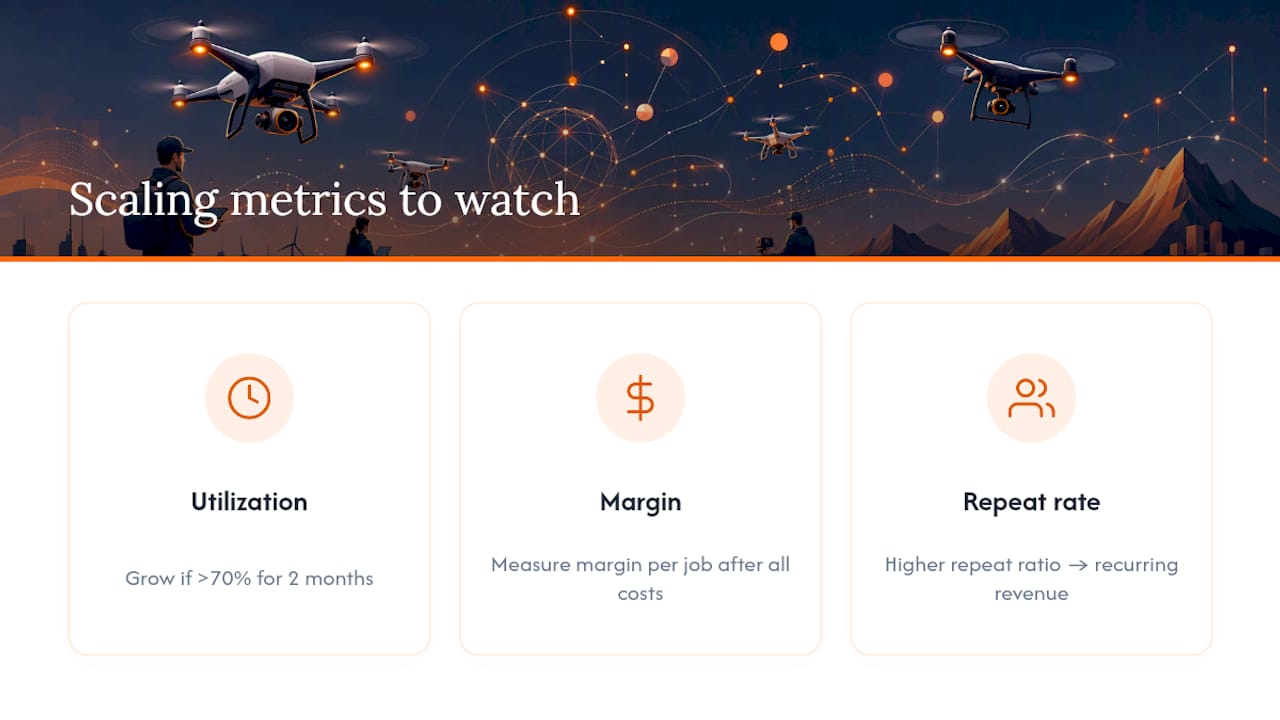
Three numbers tell you when to grow: utilization rate (percentage of available flying days actually booked), margin per job after all costs, and your repeat-contract ratio. If utilization stays above 70% for two consecutive months, you’re leaving money on the table by not raising capacity.
Hiring triggers differ by role. Bring on a data analyst when processing backlogs delay delivery past your SLA. Add a second pilot when you’re turning down jobs due to scheduling conflicts, not gear shortages. Subcontract before you hire full-time if the demand spike looks seasonal rather than sustained.
The real path to recurring revenue runs through enterprise contracts, quarterly inspection retainers, ongoing construction monitoring, agricultural season contracts. These replace the constant hustle of one-off bookings with predictable cashflow, and they reward the operator who already has clean financial projections and a documented process to show a procurement manager.
How Do Integrated Platforms Cut Time to First Revenue?
Missed authorizations and scattered proposals kill deals before they close. Centralizing flight logs, digital credentials, and client proposals in one system directly closes that gap. Flydronable’s SkyScore™ flags airspace risk automatically before you commit to a mission, cutting the chance of a compliance surprise mid-job.

When evaluating any platform for this purpose, check three things: does it automate compliance checks, does it generate client-ready proposals without manual formatting, and does it give clients a delivery portal instead of a shared folder link. Deal Studio and Drone Passport cover the second and third directly, turning scattered admin work into one connected system.
Three Mistakes That Kill Early Drone Businesses
The businesses that fail fastest buy top-tier gear before booking a single paying client. Validate demand first, upgrade second. Documentation matters more than most new pilots think, a missed deadline loses a client faster than a hard landing ever will. And skipping insurance or a written contract to save money upfront is the fastest way to lose far more later.
Run Your Drone Business Without the Admin Drag
Every step above, certification tracking, airspace clearance, client proposals, delivery, eats time you’d rather spend flying or closing the next job. Flydronable exists to fold all of it into one workspace instead of five disconnected tools. SkyScore™ checks airspace risk before you commit to a mission. Deal Studio turns client conversations into signed proposals without a separate document tool. Drone Passport keeps your certifications and flight logs verifiable in one place, so a client asking for proof of insurance or credentials gets an answer in seconds, not a scramble through old email threads.
If you’re still working toward certification, the Flydronable Academy has exam prep built for exactly that stage. If you’re past certification and ready to run real jobs, explore the full toolset or head to Flydronable to see how the platform fits your first ninety days.
Sources
For deeper cost breakdowns and startup timelines, see Rotate’s startup guide. For certification and operating-playbook details, review Rotate’s step-by-step guide. For financial planning templates, consult Growthink’s drone business plan guide, and for practitioner-level client advice, read The Drone Girl’s Drone Business 101.
- How to Start a Drone Business in 2026 (Step-by-Step Guide) | Rotate
- Drone business plan guide | Growthink
Recommended
Explore Dronable Tools
Deepen Your Knowledge
Get step-by-step video courses in the Dronable Academy — FAA Part 107, EASA, real estate drone photography, and more.
Browse CoursesFree: How to Start a Drone Business
The complete step-by-step guide to turning your passion for flying into a profitable drone business — completely free.
- 10 steps to launching your drone business
- 51 proven drone business ideas
- How to get FAA certified (Part 107)
- Pricing, clients & recurring income
Join the Dronable Newsletter
Get drone tips, new articles, and exclusive deals straight to your inbox. No spam, unsubscribe anytime.


