Drone Insurance for Commercial Pilots 2026: What the FAA and EASA Actually Require
Commercial drone insurance in 2026: what the FAA and EASA actually require, what cover operators buy, what it costs and how it meets client contracts.
Ask ten commercial drone pilots whether they need insurance and you will get ten confident answers — most of them wrong. The short version: in the United States there is no federal insurance mandate for Part 107 operations, while in Europe the requirement depends on the ruleset you fly under, your aircraft's mass, and the country you are flying in.
This guide separates what the regulators actually require from what clients, contracts and sound business practice demand — and what coverage costs in 2026.
Is drone insurance legally required?
United States: Part 107 has no insurance mandate
14 CFR Part 107 governs certification of remote pilots, airspace authorisation, operating limits and waivers. It contains no insurance requirement. A Part 107 certificate holder can legally fly commercially with no policy in place.
In practice, uninsured commercial flying is rare, because the requirement arrives from other directions:
- Contract terms. Federal, state and municipal buyers, utilities, construction firms and film productions routinely require a certificate of insurance — most commonly $1,000,000 per occurrence in third-party liability.
- Land access and permits. Parks departments, airports, stadiums, universities and private landowners commonly require proof of cover before granting permission to launch.
- State and local rules. A number of states and cities impose insurance conditions on commercial UAS work, particularly on public property.
- Cross-border work. Flying commercially in another country means meeting that country's rules, not the FAA's.
Verify current FAA guidance at faa.gov/uas.
European Union: Regulation (EC) 785/2004 plus national rules
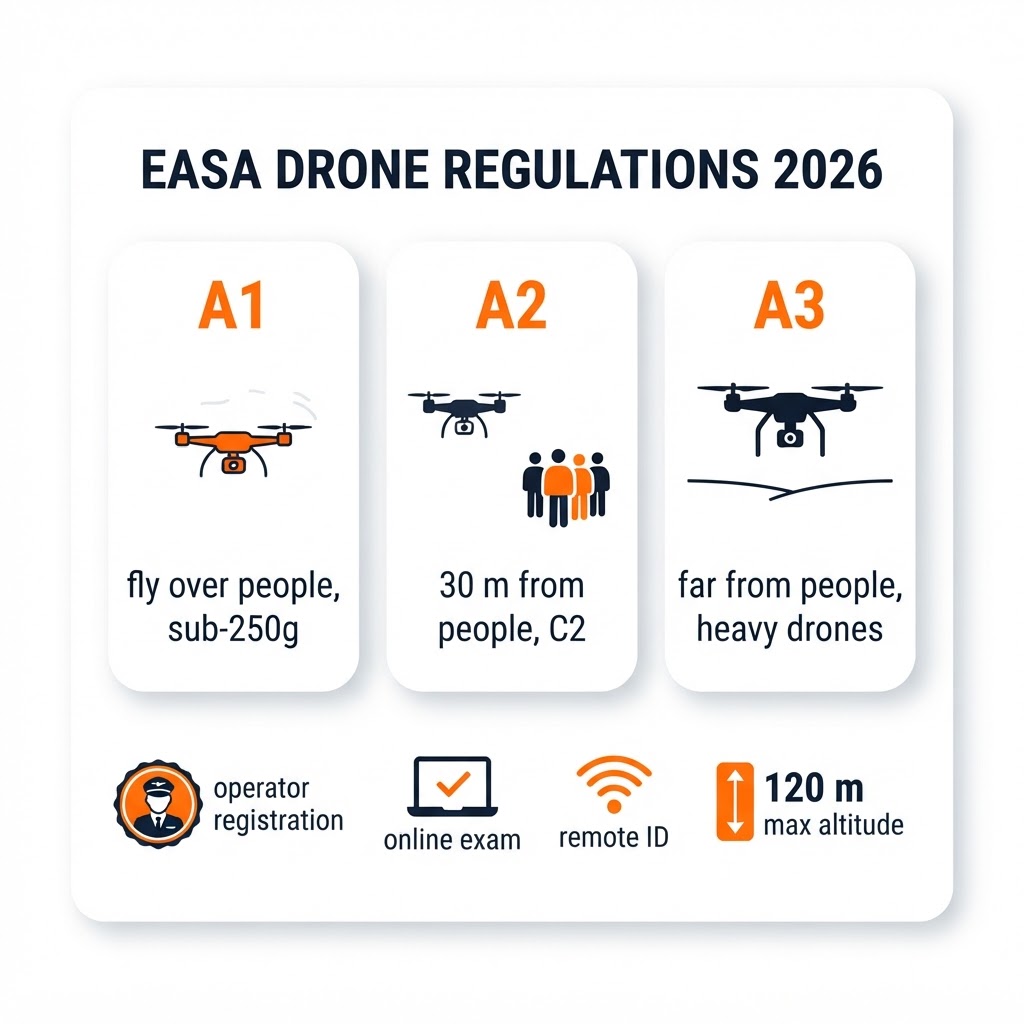
Europe works differently. Regulation (EC) No 785/2004 sets minimum liability insurance requirements for aircraft operators, and it is the reference point most EU operators are told to check. Two details matter:
- The 20 kg threshold. The Regulation does not apply to aircraft below a maximum take-off mass of 20 kg. Above 20 kg MTOM, minimum insurance amounts apply and scale with the aircraft's mass.
- National law fills the gap. For the large majority of operations under Regulation (EU) 2019/947 — the Open category and most of the Specific category — insurance obligations are set by each Member State. Many require third-party liability cover for commercial flights regardless of mass; some set their own thresholds; a few are silent.
Two practical consequences. First, "EASA requires insurance" and "EASA does not require insurance" can both be technically true, depending on the aircraft and the country. Second, an operational authorisation in the Specific category will normally expect you to demonstrate liability cover appropriate to the operation.
Confirm the current position at easa.europa.eu and with the national competent authority of every country you intend to fly in. If you are building the regulatory knowledge to fly in Europe, our EASA certificate programme covers the framework end to end.
What coverage commercial operators actually buy
Four products account for almost every commercial drone policy:
- Third-party liability (public liability). The core cover. Pays for injury to other people and damage to property you do not own — a person, a car, a roof, a power line. $1M per occurrence is the market default; enterprise and public-sector clients often ask for $2M–$5M.
- Hull / equipment cover. Insures the aircraft against crash, water ingress, theft and flyaway, usually with a deductible around 5–10% of hull value. Read the exclusions: wear and tear, flight beyond stated limits and unairworthy repairs are commonly excluded.
- Payload and sensor cover. Hull policies often cap or exclude the payload. If you carry thermal, LiDAR, multispectral or cinema-grade gimbals, schedule them separately — payload value frequently exceeds the aircraft.
- Personal injury and non-owned aircraft. Covers the pilot and crew for injury in the course of work, and covers you when flying a rented or borrowed aircraft that is not on your own policy.
Professional indemnity is a separate question: liability insurance covers physical damage and injury, not claims that your data, survey or advice was wrong.
Typical costs in 2026
For a single small UAS flown commercially, annual third-party liability cover at $1,000,000 per occurrence typically prices between $500 and $750 per year in the United States through on-demand and specialist UAS providers. European quotes sit in a broadly similar band, quoted in euro.
What moves the number:
- Hourly and daily policies. Pay-as-you-fly cover starts at a few tens of dollars per flight hour and is the cheapest way to stay covered for occasional commercial work.
- Operations over people and Specific category work. Higher-risk operations, BVLOS and flights over assemblies attract materially higher premiums.
- Hull value. Hull cover is priced as a percentage of insured value, so a cinema rig or survey-grade airframe raises the total quickly.
- Claims history and documentation. Clean logs, credentials and checklists are the single biggest lever on renewal pricing.
How insurance interacts with client contracts and waivers
Client paperwork and insurance are usually the same conversation. Three things to get right:
- Certificate of insurance. Most buyers want a COI naming them as additional insured, with policy number and expiry visible before the flight. Produce it before signing, not after.
- Waivers are not insurance. A liability waiver signed by a client limits claims between you and that client. It does nothing for a member of the public whose property you damage, and it does not satisfy a contract's insurance clause.
- Indemnity and caps. Check whether the contract requires you to indemnify the client, and whether your policy limit matches what you have promised. Promising $5M of cover while holding a $1M policy is an uninsured gap you are funding yourself.
Keeping contracts, quotes, invoices and insurance documentation in one place makes this far easier at renewal and at claim time. Deal Studio in the Elite tier handles client quotes, contracts and invoices, and the client-facing side is described in the platform features overview.
Pre-flight risk and why insurers like documented operations
Underwriters price uncertainty. Every piece of evidence that your operations are repeatable reduces that uncertainty: pre-flight site surveys, airspace and weather checks, maintenance intervals, battery cycles, pilot currency and a consistent logbook.
That documentation is also what a claim depends on. After an incident the insurer will ask what the site assessment said, what the pre-flight check recorded, who was flying and what their credentials were. Operators who can answer in minutes have a very different claims experience from those reconstructing a flight from memory.
Two tools make it routine: run a free risk check on your planned operation with SkyScore, and let the platform's flight logbook record hours, aircraft and locations automatically. If you are starting out, the Part 107 course covers the regulatory groundwork underwriters expect to see.
Frequently asked questions
Is insurance required for Part 107?
No. The FAA does not require insurance for Part 107 operations and there is no minimum coverage limit in the regulation. Requirements come from clients, contracts, landowners, state and local rules, and non-US jurisdictions.
What does $1M liability cost?
For a single small UAS flown commercially, roughly $500–$750 per year in the US in 2026, or a few tens of dollars per flight hour on a pay-as-you-fly policy. Risk profile, location and payload change the figure.
Does EASA require insurance?
The EU-level requirement in Regulation (EC) 785/2004 applies above 20 kg MTOM. Below that, the obligation is set nationally, and many Member States require third-party liability cover for commercial operations. Always check EASA and the relevant national authority.
Does homeowner insurance cover commercial flights?
Almost never. Home policies typically exclude aircraft used for business or commercial purposes, and may exclude model aircraft entirely. Relying on a home policy for paid work is a common and expensive mistake.
Fly covered, and prove it
Cover is only half the story; the other half is being able to show a client, a landowner or an insurer that your operations are documented. Start a free trial, run your first SkyScore check and keep your flight logs, credentials and contracts in one place. More regulatory and operational guides are on the Dronable blog.
Explore Dronable Tools
Pass Your Certification Exam
Our Academy courses walk you through FAA Part 107 and EASA requirements step by step — study materials, quizzes, and mock exams included.
Explore AcademyFree: How to Start a Drone Business
The complete step-by-step guide to turning your passion for flying into a profitable drone business — completely free.
- 10 steps to launching your drone business
- 51 proven drone business ideas
- How to get FAA certified (Part 107)
- Pricing, clients & recurring income
Join the Dronable Newsletter
Get drone tips, new articles, and exclusive deals straight to your inbox. No spam, unsubscribe anytime.