FAA Part 107 vs EASA A1/A3: Which Drone License Do You Need in 2026?
Commercial drone pilots flying in the US need Part 107, while most flights in the EU start with the EASA A1/A3 certificate — here is how the two compare in 2026, what each actually permits, and how to choose.
If you fly a drone for money, the first question is not which drone to buy or which software to subscribe to. It is which certificate you are legally required to hold. Get that wrong and every invoice you send sits on a shaky foundation.
The answer depends on two things: the airspace you fly in, and how close you fly to people. The good news is that the commercial drone world has settled into two dominant frameworks in 2026 — the FAA's Part 107 in the United States and the EASA open category in Europe — and both are far more accessible than most new operators expect.
The short answer
- Flying in the United States: you need an FAA Part 107 Remote Pilot Certificate. There is no lighter commercial alternative.
- Flying in the EU and EASA member states: your baseline is the A1/A3 open-category certificate, obtained through online training and a short exam. If your work brings you close to people or outside open-category limits, you add an A2 certificate or move into the Specific category.
- Flying in both markets: you need both. Neither certificate is recognised by the other authority, and there is no conversion exam.
FAA Part 107 — the US commercial licence
Part 107 is the FAA's rule set for small unmanned aircraft flown for compensation or hire. To use it commercially you hold a Remote Pilot Certificate, which means passing the Unmanned Aircraft General knowledge test at an FAA-approved testing centre.
In practice: you must be at least 16, pass TSA security vetting through the FAA's online portal, and score 70 percent or better on a 60-question multiple-choice exam. The test fee is around USD 175 and the certificate itself carries no expiry date.
What it lets you do
- Fly aircraft under 55 pounds (25 kg) for commercial work
- Operate in visual line of sight, at or below 400 feet above ground level
- Fly in daylight or civil twilight with anti-collision lighting
- Fly over people and moving vehicles, provided the operation meets the conditions of Categories 1 to 4
Keeping it current
Your certificate does not expire, but your privilege to act as remote pilot in command does. Every 24 calendar months you must complete the FAA's free online recurrent training. Miss the window and you cannot legally fly for compensation until it is done — a quiet trap for operators who treat the plastic card as permanent.
What changed in 2026
Since 26 October 2026, the knowledge test includes sectional chart questions that are not answered by the printed chart supplement. If you are studying from older material that only covers the supplement excerpts, practise on real sectional charts instead of memorised extracts.
Beyond visual line of sight is still not a Part 107 privilege. The long-awaited Part 108 rule, which would move BVLOS operations from individual waivers toward routine compliance, was still not published as the 2026 season closed. Until it lands, BVLOS in the US means a waiver.
EASA A1/A3 — the EU open-category baseline
Europe takes a risk-based approach. Regulation (EU) 2019/947 governs how you operate, while Regulation (EU) 2019/945 governs the aircraft as a product through the C0 to C4 class markings. Both apply directly across the EASA member states: one framework covering roughly thirty markets, though national aviation authorities still run registration, geo-zones and language requirements in their own way.
The open category is the low-risk lane: under 25 kg, visual line of sight, no higher than 120 metres, no dangerous goods, nothing dropped from the aircraft. The A1/A3 certificate is your entry ticket, earned through online training followed by a 40-question multiple-choice exam with a 75 percent pass mark. It is valid for five years and recognised across the member states.
Where A1, A2 and A3 actually differ
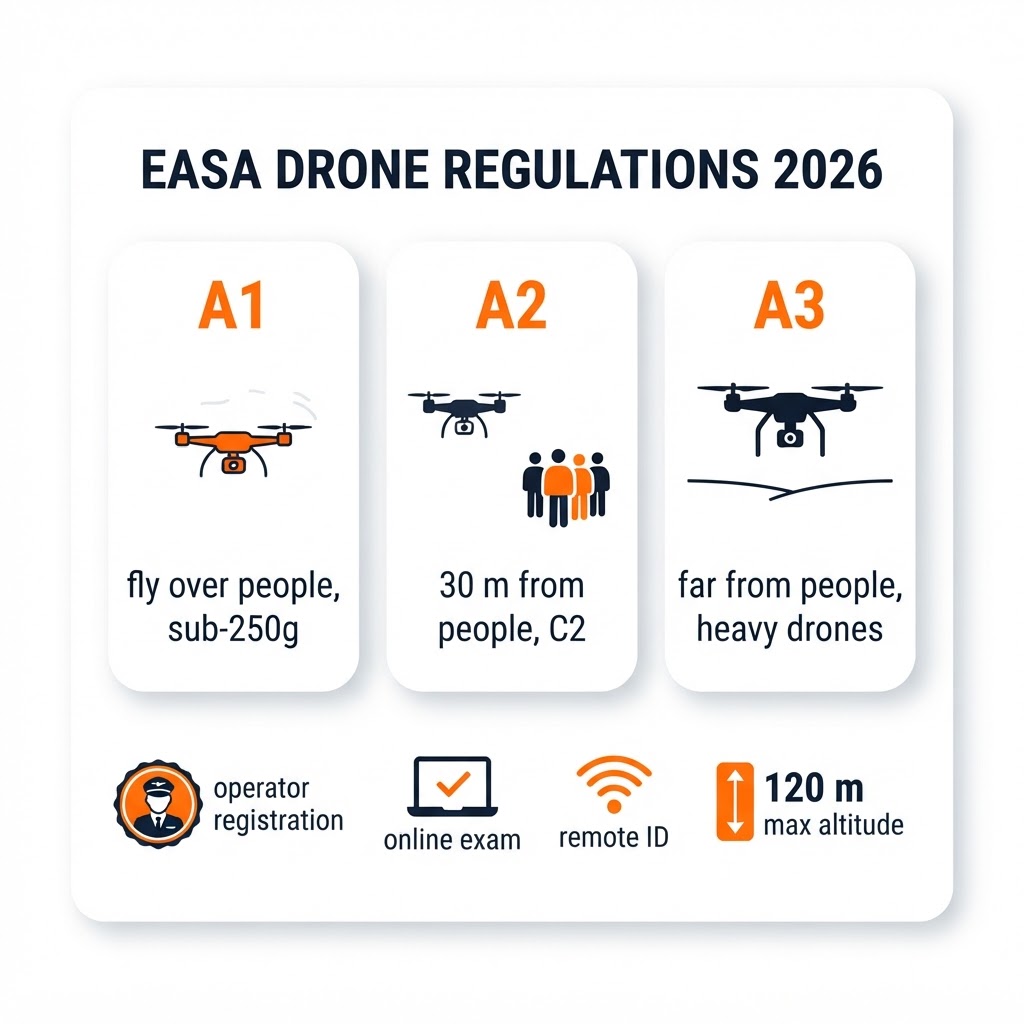
- A1: fly over uninvolved people only with the lightest classes — a C0 aircraft under 250 g, or a C1 under 900 g without hovering over crowds.
- A2: operate closer to people with a C2 aircraft, typically keeping 30 metres horizontal distance (5 metres in low-speed mode). This requires a further exam on top of A1/A3.
- A3: the workhorse for most commercial prototypes and heavier sub-25 kg aircraft — flown at least 150 metres away from residential, commercial, industrial or recreational areas.
Registration is separate
Holding a pilot certificate is not the same as registering as an operator. In most member states the operator registers once, receives an operator ID, and displays it on the aircraft. Remote identification obligations sit alongside that, and both are checked long before anyone asks to see your exam result.
What is changing in 2026
EASA has been consulting on a package of amendments aimed at tightening the security of drone operations, including adjustments touching the open category. These remain proposals rather than applicable rules, so treat any summary you read online — including this one — as a snapshot that needs confirming against the current official text. Two things are already worth stating plainly: the United Kingdom is not part of EASA and runs its own scheme, and a European certificate is not a US certificate.
Part 107 vs A1/A3, side by side
- Governing framework: 14 CFR Part 107 in the US; Regulations 2019/947 and 2019/945 in Europe.
- How you qualify: a proctored knowledge test at a testing centre in the US; online training plus an online exam in Europe.
- Typical cost: roughly USD 175 in the US, plus preparation; usually modest local fees in Europe.
- Validity: no expiry in the US, but recurrent training every 24 calendar months; five years in Europe.
- Geographic reach: the US only; all EASA member states.
- Weight ceiling: 55 pounds (25 kg) in the US; 25 kg in the European open category.
- Height ceiling: 400 feet above ground level in the US; 120 metres in Europe.
- Flying near people: governed by the US over-people categories; in Europe it moves you into A2, or out of the open category entirely.
Which one do you need? A five-question checklist
- Where will you physically fly? That alone decides the authority you answer to.
- Will you fly over or near uninvolved people? Yes in Europe means A2 at minimum. Yes in the US means you must meet an over-people category.
- Do you need to fly beyond visual line of sight, at night without lights, or above the ceiling? Both frameworks push you into waivers or the Specific category.
- Is your aircraft over 25 kg? Then you are outside the European open category and outside Part 107's small-aircraft scope.
- Are you flying in the UK or Switzerland? Check the national scheme separately rather than assuming the EU certificate travels.
Mistakes that cost operators money
- Assuming the A1/A3 certificate covers over-people flights — that is A2 territory or beyond.
- Confusing the pilot certificate with operator registration; they are two different obligations.
- Letting Part 107 currency lapse for 24 months and continuing to invoice clients.
- Treating Part 107 as permission for BVLOS or autonomous operations.
- Studying from outdated US test material that omits the chart questions now on the exam.
- Assuming a European certificate is valid in the UK, or a US certificate anywhere in Europe.
Learn it properly, in one place
Theory is the cheap part of compliance; getting it wrong on a job is the expensive part. Dronable bundles the study material with the tools you actually fly with:
- Start with the FAA Part 107 course for the US knowledge test, including chart practice.
- Prepare for the European online exam with the EASA certificate material.
- Go deeper across both frameworks in the Academy.
- Run a pre-flight check before you launch, so airspace and site questions are answered before take-off.
- Keep certificates, logs and currency dates together with a Pilot Pro membership.
Bottom line
If you fly in the United States, get Part 107 and diarise your recurrent training. If you fly in Europe, start with A1/A3, then decide honestly whether your work keeps you far from people or takes you close enough to need A2. If you operate in both markets, budget for both certificates — the combined cost is a fraction of a single lost contract, and neither authority accepts the other's paperwork.
This article is general information, not legal advice. Rules change and national implementation varies. Confirm current requirements with the FAA, EASA and the relevant national aviation authority before you operate.
Explore Dronable Tools
Pass Your Certification Exam
Our Academy courses walk you through FAA Part 107 and EASA requirements step by step — study materials, quizzes, and mock exams included.
Explore AcademyFree: How to Start a Drone Business
The complete step-by-step guide to turning your passion for flying into a profitable drone business — completely free.
- 10 steps to launching your drone business
- 51 proven drone business ideas
- How to get FAA certified (Part 107)
- Pricing, clients & recurring income
Join the Dronable Newsletter
Get drone tips, new articles, and exclusive deals straight to your inbox. No spam, unsubscribe anytime.