Part 107 Recurrent Training in 2026: What Every Remote Pilot Must Do to Stay Current
Free FAA ALC-677 recurrent training keeps your Part 107 certificate current every 24 months. Here is exactly how to stay legal, insurable and client-ready in 2026.
# Part 107 Recurrent Training in 2026: What Every Remote Pilot Must Do to Stay Current
If you earned your FAA Part 107 remote pilot certificate, congratulations — but the certificate alone does not keep you legal. The FAA requires recurrent training, and the rules changed in 2024 when the FAA replaced the old two-year online recurrent test with the free Recurrent Training for Part 107 Remote Pilots (ALC-677) in the FAA Safety Team (FAASTeam) system. In this guide you will learn exactly what recurrent training is required in 2026, how to complete it, what happens if you let it lapse, and how EASA remote pilots in Europe handle the equivalent requirements.
The FAA's position is simple: aviation knowledge decays. Rules change, airspace tools change, and drones themselves change. Recurrent training keeps every certificated remote pilot aligned with current regulations — new Remote ID enforcement, night operations rules, operations over people categories, and airspace authorizations via LAANC. Skipping it does not just risk your knowledge; it can invalidate the legality of every commercial flight you fly with an expired currency.
Since the FAA retired the old Part 107 recurrent web test, currency is maintained by completing the free online course **ALC-677: Part 107 Small UAS Recurrent – Non-Part 61 Pilots** on FAASafety.gov. Key facts:
- **Cost:** free.
- **Time:** roughly 1.5–2 hours.
- **Content:** operational requirements, airspace classification and operating requirements, weather sources and effects, loading and performance, emergency procedures, crew resource management, night operations, Remote ID, and operations over people.
- **Certificate:** after passing the course you can print a certificate of completion. Keep it with your flight records — it is your proof of current knowledge if the FAA, an insurer, or a client ever asks.
- **Frequency:** every 24 calendar months to maintain currency under 14 CFR 107.65.
If you hold a Part 61 certificate with a current flight review, a different path applies (the online recurrent course for Part 61 pilots, ALC-515), but for most commercial drone pilots ALC-677 is the requirement.
Letting your 24-month window lapse is more common than pilots admit. The consequences in 2026:
1. **You cannot legally exercise Part 107 privileges.** Any commercial flight with a lapsed currency is an FAA violation — the certificate itself does not expire, but your authority to operate does.
2. **Insurance exposure.** Most aviation insurers require current recurrent training evidence. A claim filed while lapsed can be denied.
3. **Client contracts.** Corporate clients increasingly require proof of currency in vendor onboarding. An expired certificate of completion can cost you the contract, not just the fine.
4. **The fix is easy — but do it now.** There is no penalty for completing ALC-677 late; you simply regain currency the day you pass. The penalty only exists for flying while lapsed.
1. Create a free account on FAASafety.gov (or sign in with your existing FAA account).
2. Search the course catalog for **ALC-677** — "Part 107 Small UAS Recurrent".
3. Work through the modules. The course is self-paced; you can pause and resume.
4. Pass the end-of-course check. The pass threshold is generous but not trivial — pay attention to the airspace sections, which trip up the most pilots.
5. Print and save the completion certificate. Store a digital copy with your Dronable flight logs so it surfaces in any audit trail.
6. Calendar the next due date: exactly 24 calendar months from your completion date. Set a reminder 60 days out.
The FAA can request proof of currency during ramp checks or incident investigations. Insurers ask for it at renewal. Corporate clients ask for it in safety documentation. A disciplined system beats a folder of scattered PDFs:
- Keep the ALC-677 completion certificate with your certificate number recorded.
- Log your recurrent training date as a maintenance-style entry alongside flight hours.
- Tie the record to the drone(s) you fly commercially — some enterprise clients want per-aircraft histories.
- Use a platform-level record (Dronable flight logs plus document storage) so the evidence survives a lost laptop.
The current ALC-677 version reflects the rules that changed since your initial knowledge test: night operations now require anti-collision lighting visible for 3 statute miles and no recurring night training waiver unless you completed the initial knowledge test after the 2021 update; Remote ID is fully enforced for nearly all drones flown commercially; and operations over people follow the four category framework. Recurrent training is where these changes get refreshed into your working memory — one more reason not to skip the modules.
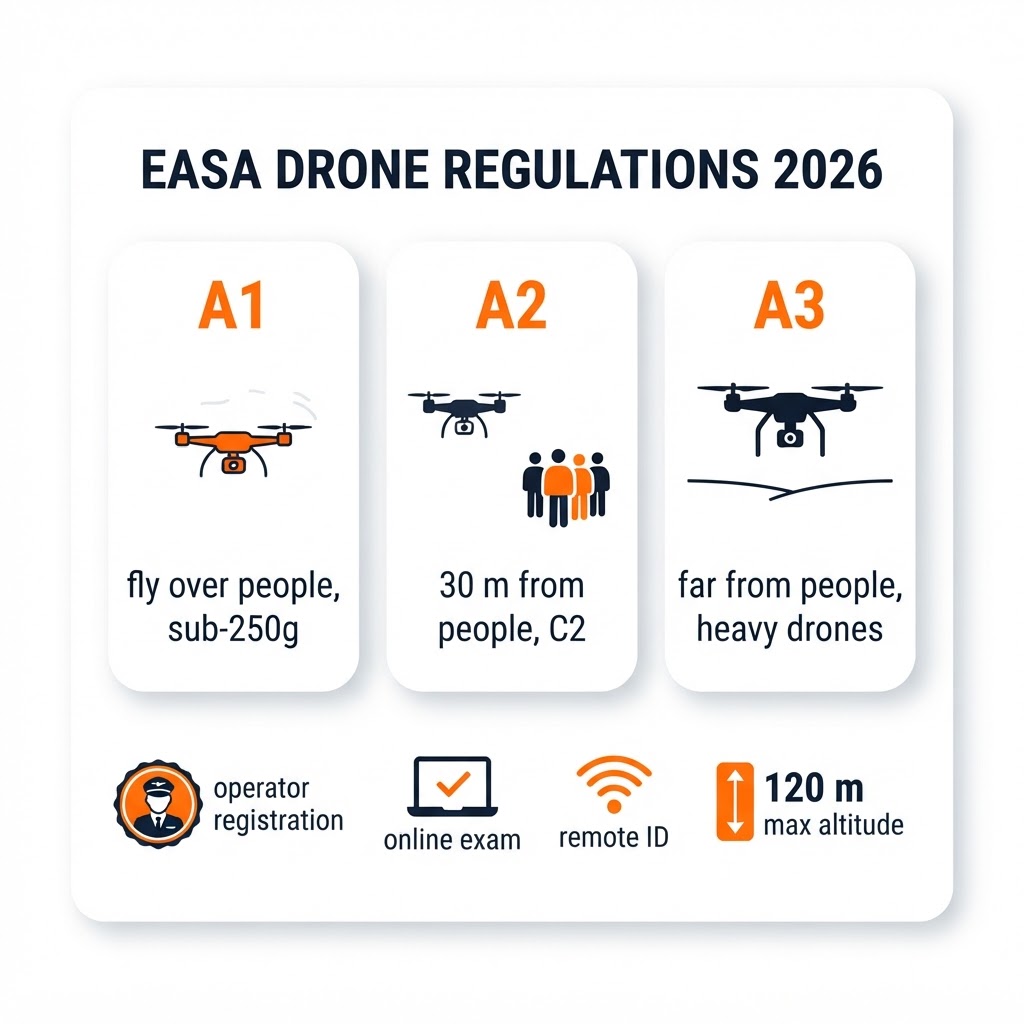
If you fly in the EU under EASA rules, the parallel obligation is keeping your certificate of competence valid through **continuity of competency**: you must fly at least once in the prior 24 months and complete a self-practical assessment, or refresh your skills at an ATO. The A1/A3 certificate does not expire by date, but your privileges lapse without the continuity proof. US pilots flying in Europe (or EU pilots working for US clients) need to track both systems — and our EASA A1/A3 course covers the self-assessment paperwork in detail.
Here is the workflow we recommend to every commercial pilot:
- **Day 1 today:** check your last completion date. If it is more than 22 months ago, start ALC-677 this week.
- **Automate the reminder:** put the due date in your ops calendar with a 60-day warning.
- **Store the proof:** completion certificate saved next to your insurance certificate and ops manual.
- **Bundle the audit:** when a client or the FAA asks, one link should surface certificate, insurance, currency and flight logs. That is exactly what the Dronable digital drone passport and flight logs are built for.
**Is the Part 107 recurrent training free?** Yes — ALC-677 on FAASafety.gov is free.
**How long is it valid?** 24 calendar months from your completion date.
**Can I fly commercially while lapsed and just renew after?** No. That is an FAA violation and it voids most insurance coverage for those flights.
**Does the recurrent course have a test?** It includes an end-of-course assessment you must pass to get the certificate.
**What about the 61.56 flight review?** Only relevant for Part 61 certificate holders; pure Part 107 pilots use ALC-677.
**Does EASA require recurrent training?** EASA uses continuity of competency instead — recent flight experience plus a self-assessment every 24 months.
Recurrent training is the cheapest compliance you will ever buy: two free hours every two years that keep every commercial flight you fly legal, insurable and client-ready. Check your due date today, and let your platform remember it for you — that is what the flight log and passport system in Dronable does automatically.
**Sources:** FAA Part 107 recurrent training (ALC-677), FAA Safety Team (faasafety.gov); 14 CFR 107.65; EASA Open Category continuity requirements (Commission Delegated Regulation (EU) 2019/947).
Explore Dronable Tools
Pass Your Certification Exam
Our Academy courses walk you through FAA Part 107 and EASA requirements step by step — study materials, quizzes, and mock exams included.
Explore AcademyFree: How to Start a Drone Business
The complete step-by-step guide to turning your passion for flying into a profitable drone business — completely free.
- 10 steps to launching your drone business
- 51 proven drone business ideas
- How to get FAA certified (Part 107)
- Pricing, clients & recurring income
Join the Dronable Newsletter
Get drone tips, new articles, and exclusive deals straight to your inbox. No spam, unsubscribe anytime.